GEO Operating Model: The Truth About AI Visibility
Why SEO Is No Longer Enough: The GEO Operating Model Every Leader Needs Now
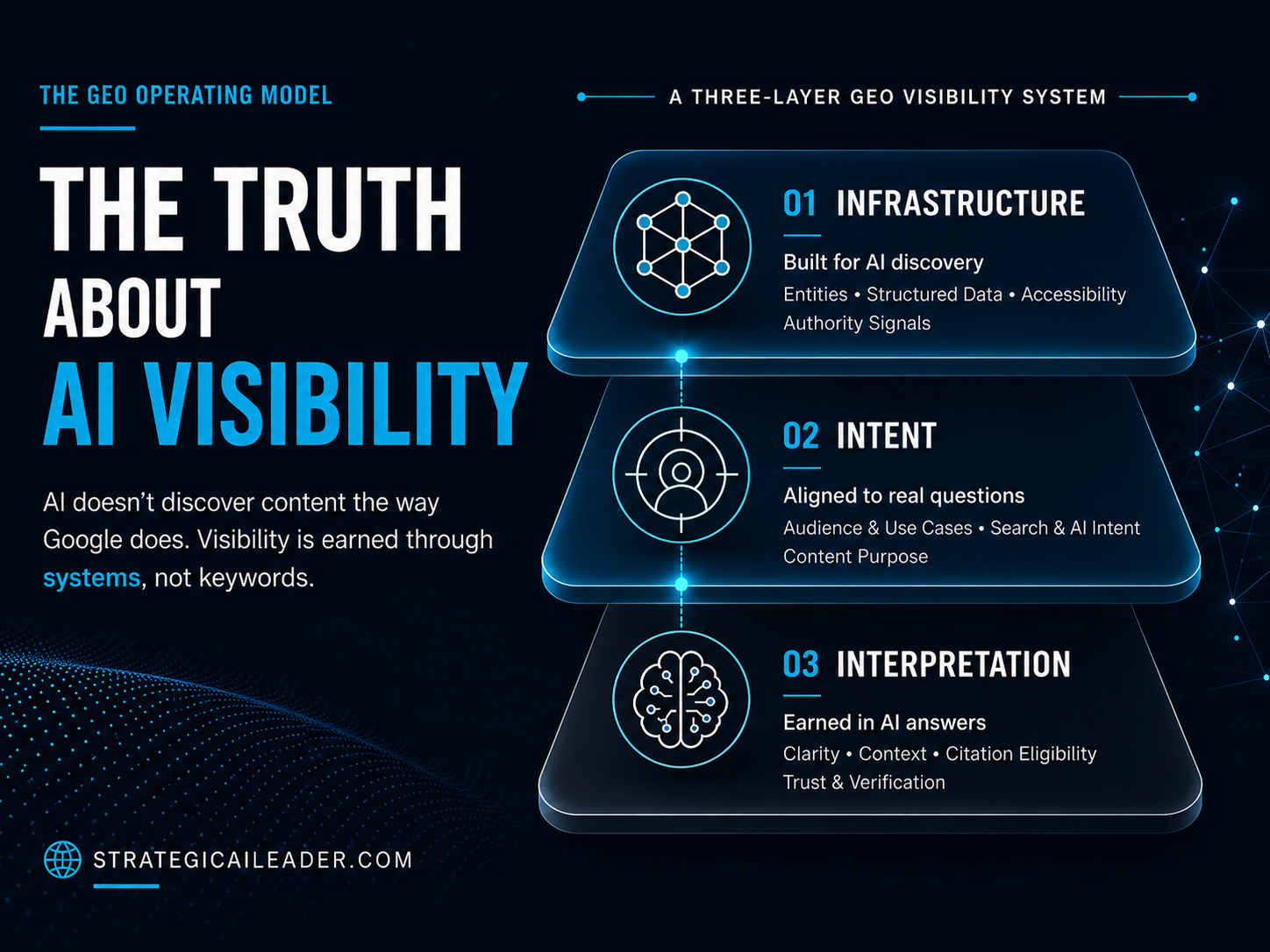
The GEO Operating Model is a three-layer visibility system, Infrastructure, Intent, and Interpretation, that structures how content becomes citation-eligible within AI-generated answers. It replaces the single-dimensional ranking model with a system designed for an era in which being found and being cited are two different problems.
Most companies think they have an SEO problem right now. They don’t. They have an authority architecture problem. They’re trying to solve it with keyword tactics, and it isn’t working.
AI-referred sessions jumped 527% year-over-year in the first five months of 2025, according to Previsible. Google AI Overviews now appear in more than 13% of all searches, up from 6.49% in January, a number that more than doubled in two months, per Semrush. Meanwhile, CTR on organic position one dropped from 1.41% to 0.64% when an AI Overview appears on the page, based on an Ahrefs 300,000-keyword study. The traffic model that powered content investment for the past decade is changing faster than most strategy teams have adjusted for.
I’ve watched this shift play out firsthand. At MyEListing, improving listing accuracy from 92% to 96% and pushing internal trust signals from 65% to 90% through structured data improvements didn’t just change how the platform performed for users. It changed how AI systems read and represented it. The infrastructure work and the AI citation outcome were the same investment. That’s the insight most SEO-adjacent GEO advice misses entirely.
What this means in practice: your content team is no longer publishing blog posts. They are building a retrieval infrastructure. The output looks similar. The architecture required to make it work is completely different.
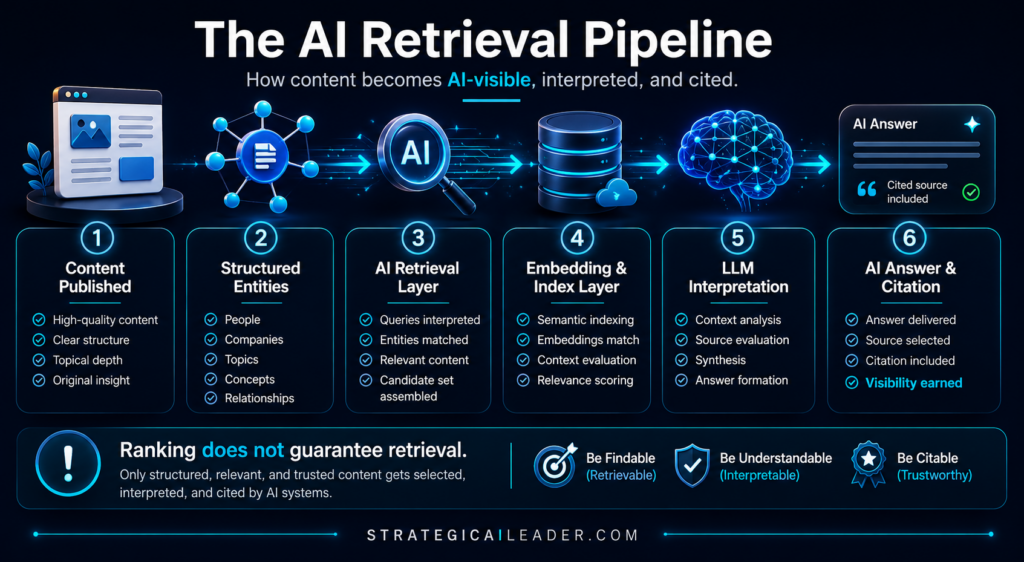
embedding interpretation and AI citation systems
| What is the GEO Operating Model? The GEO Operating Model is a three-layer framework that makes content citation-ready for AI-generated search answers. Layer 1 covers Infrastructure (crawlability, structured data, entity clarity). Layer 2 covers Intent (topical authority, cluster depth, answer block coverage). Layer 3 covers Interpretation (AI parsing, entity consistency, extractable answers). All three layers must function together for AI systems to reliably cite a source. |
What Leaders Keep Getting Wrong About GEO
The most common mistake I see is treating GEO as an SEO update rather than a structural shift in how authority is built.
Teams add schema markup. They rewrite heading tags. They swap keyword clusters for topic clusters. These are tactical adjustments to the same underlying approach. The framing remains the same: rank higher, get more clicks.
GEO operates on a different currency. SEO trades in rankings and clicks. GEO trades in trust and citation. And the mechanism for earning that trust is not faster or smarter optimization. Its depth.
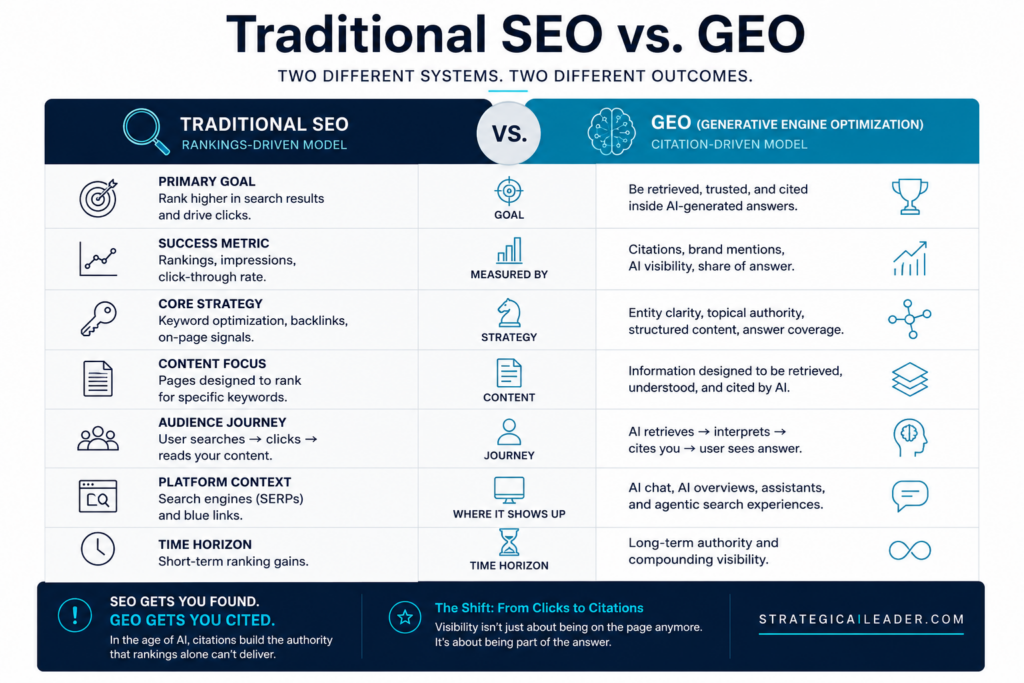
| Contrarian Take: Most of what’s being marketed as GEO strategy in 2026 is repackaged SEO with an AI wrapper. The companies actually winning AI citations aren’t doing GEO tactics. They’re building genuine topical authority, structured, layered, entity-consistent content that covers a domain deeply enough that AI systems have no choice but to trust them. The citation is the outcome. The authority architecture is the strategy. Most companies are chasing the outcome while skipping the architecture. |
There’s a stat that explains this gap clearly. ChatGPT only cites 15% of the pages it retrieves during a given search, per AirOps March 2026 research. That means 85% of sources retrieved during a user’s query are never shown to the user at all. The retrieval happened. The citation didn’t. That gap between being retrieved and being cited is where most GEO strategies fail — not because the content isn’t indexed, but because it isn’t trustworthy enough at the interpretation layer.
What this means in practice: being indexed and being cited are now two separate outcomes. SEO solves the first problem. The GEO Operating System solves the second. Most companies are only working on one of them.
The GEO Operating System: Three-Layer Framework
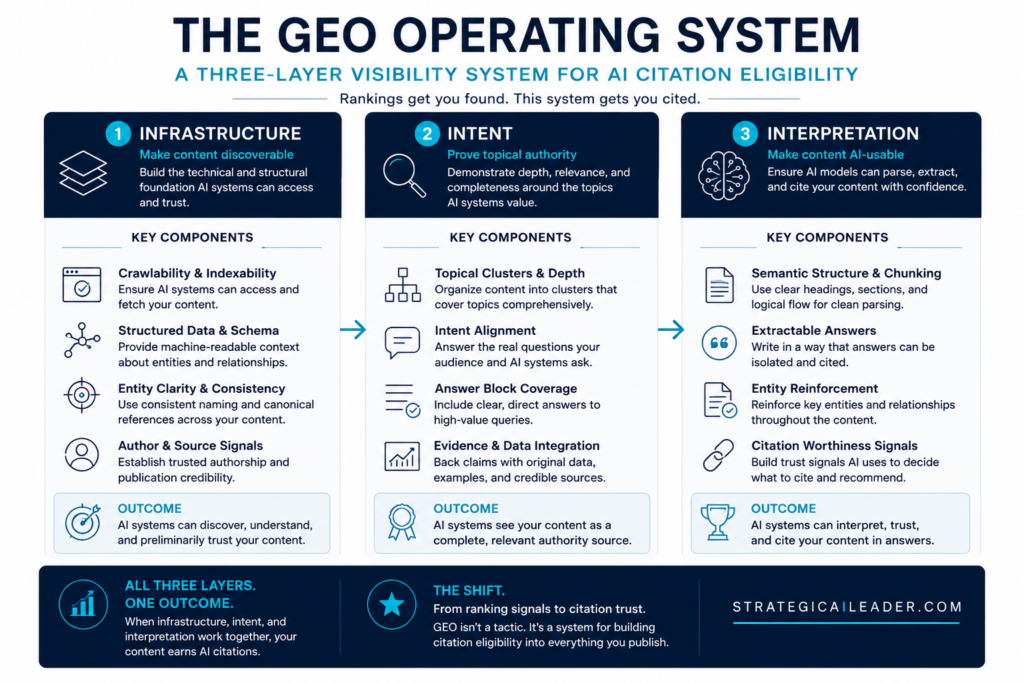
work together to improve AI citation eligibility
| How does the GEO Operating System work? The GEO Operating System layers Infrastructure, Intent, and Interpretation into an interdependent visibility system. Infrastructure ensures the content is crawlable and structurally clear. Intent ensures it covers the right topics with the right depth. Interpretation ensures that AI systems can parse, chunk, and reliably extract answers from it. Fixing one layer without the others still leaves the content partially invisible. |
Layer 1: Infrastructure
Infrastructure is the layer most companies think they already have covered. They don’t. Not for AI retrieval.
Traditional SEO infrastructure was built for indexing. A crawler reads a page, follows links, and files it. AI retrieval works differently. An LLM grounding a response doesn’t just check whether your page is indexed. It asks whether your content can be trusted as an authoritative source for a specific concept. That requires an entirely different kind of infrastructure.
The specific Infrastructure gaps I see most often: no canonical entity architecture (key concepts named inconsistently across articles), no knowledge graph alignment (schema that describes what a page is authoritatively about, not just that it exists), weak semantic chunk boundaries (content that AI systems can’t split cleanly into citable passages), and missing structured authorship signals (no persistent author entity linked across publications). Each of these is invisible to a standard SEO audit. Each one directly affects AI citation eligibility.
A named concept referenced three different ways across ten articles isn’t a naming quirk. It’s a trust signal failure at the Infrastructure layer. AI systems that encounter the same idea under different labels don’t aggregate those mentions as authoritative. They treat them as separate, weaker signals. That’s the Infrastructure problem most content teams don’t know they have.
Layer 2: Intent
Intent covers topical authority. Not keyword density. Not content volume. Depth.
AI systems cite content that covers a subject domain at a level that justifies trust. A cluster of five surface-level articles on the same topic doesn’t build that trust. A connected set of layered articles, each answering a different stage of a reader’s understanding, does.
SE Ranking research from November 2025 found that sites with over 32,000 referring domains are 3.5x more likely to be cited by ChatGPT than sites with fewer than 200. That’s partially about domain authority. But it’s also about the signal that high-quality inbound links represent: other credible sources have found this content worth referencing. That’s topical authority made visible.
Layer 3: Interpretation
Interpretation is where most GEO execution fails. This layer covers whether AI systems can parse, chunk, and cite your content accurately.
I tested this directly when building structured content for different AI models. The same information presented in flowing prose and in answer-block format produced meaningfully different citation results. Structured content with comparison tables earned 25.7% more citations; pages with organized list sections earned 26.9% more, per AirOps April 2026 data. The content wasn’t different. The structure was. The AI system could parse one version cleanly and the other only partially.
Entity consistency compounds this effect. Domains with millions of brand mentions on Quora and Reddit have roughly 4x higher chances of being cited, per SE Ranking November 2025 research. That’s not a social media strategy insight. That’s a signal about how consistently a brand or concept is named and referenced across external sources. When AI systems see a concept named consistently across many corroborating sources, they treat it as trustworthy. When they see the same idea under five different labels, they don’t.
What this means in practice: the editorial style guide is now an AI infrastructure document. What you call things, how consistently you call them, and whether external sources use the same language, these are citation architecture decisions, not brand preferences.
Why Most GEO Tactics Fail at the Interpretation Layer
| Why does ranking position no longer predict AI citation? AI systems retrieve and cite content based on structural parsability, entity clarity, and topical trust, not ranking position. Bain research from February 2025 found that 60% of searches in traditional engines end without a click due to AI summaries. The content that earns citations isn’t the content ranked highest; it’s the content that AI systems can most reliably extract a grounded answer from. |
The overlap between top Google links and AI-cited sources has dropped from 70% to below 20%, per Brandlight GEO research. Ranking first and being cited are now largely separate outcomes. They require different types of investment.
Here’s what I didn’t expect when I first started paying attention to this: the decay rate for citations is faster than for rankings. Amsive research found that 50% of content cited in AI search responses is less than 13 weeks old. Rankings take months to move. Citations refresh constantly. That means the content infrastructure problem compounds over time — you can’t build a citation position once and hold it the way you could with a ranking.
The implication for operators is direct. The content team’s output cadence, entity consistency standards, and structural formatting choices are no longer just SEO decisions. They are infrastructure investments that determine whether AI systems can reliably include your brand in a generated answer.
What Leaders Should Actually Do Differently
Here’s the audit that matters. It has nothing to do with keyword rankings.
Ask these questions across your content and brand presence:
- Does AI know who we are? Can it associate our brand consistently with the right topics across platforms?
- Are our key concepts named consistently? The same framework under five labels is a trust problem, not a naming quirk.
- Do we have structured, extractable answers for the questions our buyers are actually asking?
- Is our content cluster deep enough to signal genuine topical authority, or is it volume without depth?
- Are our entity signals corroborated externally, or do they exist only on our own domain?
The structural move that produces measurable results is entity optimization. The Schema App case study data shows a 19.72% increase in AI Overview visibility from entity-linking implementation. Princeton University’s 2024 research found that higher fact density produces a 40% improvement in AI visibility. These aren’t incremental SEO gains. There are changes to how AI systems classify content reliability.
The platform fragmentation problem also requires attention; most teams haven’t given it. Only 11% of domains appear in both ChatGPT and Perplexity AI answers, per Semrush 2026 data. Gemini leads in citation volume at 21.4%, while Perplexity delivers the highest average citation-position quality at 1.3, according to Techmagnate. Optimizing for one platform misses 60% to 80% of total AI search visibility. The only strategy that works across all of them is genuine topical authority backed by consistent entity infrastructure, not platform-specific tactics.
| What should operators do right now to improve GEO performance? Stop auditing keyword rankings. Start auditing entity authority. Confirm AI systems associate your brand with the right topics consistently. Make key concepts entity-consistent across every article. Build structured answer blocks for the questions your buyers ask. Ensure your content cluster is deep enough to signal genuine topical authority. Measure AI Citation Share as the primary performance metric, not ranking position. |
The GEO and VECTOR Connection
The GEO Operating System is a three-layer architecture specifically for retrieval eligibility. It fits within a broader framework called the VECTOR Framework, which covers the full AI-era content strategy, semantic retrieval, authority signals, structured content architecture, and response optimization, all working together.
If you’re working through the future of SEO and GEO at a strategic level, the VECTOR Framework provides the broader operating context. The GEO Operating System is where the retrieval-specific execution lives.
For measurement, AI search measurement is now a distinct practice from traditional SEO analytics. Microsoft now exposes AI citation visibility inside Bing Webmaster Tools, including total citations, cited pages, and grounding queries. That’s a real performance surface that most teams haven’t yet connected to their content strategy.
The Operator Checklist: Applying the GEO Operating System
Infrastructure Layer Checks
- Schema markup is present and validated across all core content pages
- Key concepts named consistently across every article in the cluster
- Structured data matches visible page content
- Entity clarity confirmed, no concept referenced under multiple different labels
Intent Layer Checks
- Cluster has depth, not just volume; articles answer different stages of understanding
- Internal linking reinforces topic relationships across the cluster
- External sources corroborate your brand or framework as an authority on the topic
- Content cadence is consistent enough to prevent citation decay
Interpretation Layer Checks
- Definition blocks are present for every major concept, within the first 120 words, where applicable
- Answer blocks structured for extraction, 40 to 70 words, self-contained, direct
- Comparison tables and list structures are used where they improve clarity
- Fact density is high enough to signal information richness to AI retrieval systems
Your 90-Day GEO Operating Plan
The checklist above tells you what to have in place. This plan tells you the order to build it. Most teams try to do everything at once. That produces partial improvement across every layer and measurable improvement on none. Sequence matters.
Weeks 1-2: Entity Audit
List every key concept, framework, and product name across your content. Find every variation. Pick one canonical label for each. Enforce it going forward and retrofit it backward into your highest-traffic articles first. This is the Infrastructure fix that costs nothing except editorial discipline and produces an immediate trust signal improvement.
Weeks 3-4: Answer Block Restructuring
Identify your top 10 to 15 articles by organic traffic. Add a direct definition block within the first 120 words of each. Add one to two structured answer sections per article, 40 to 70 words, self-contained, answering the most common question in that article’s topic. Add schema markup that matches visible content. This is the Interpretation fix with the fastest citation impact.
Month 2: Cluster Depth Expansion
Map your existing content clusters and identify depth gaps, questions your buyers ask that you haven’t answered yet, or answered only partially. Publish articles that fill those gaps, linked internally to the anchor article and to each other. This builds the Intent layer that transforms a collection of articles into a topical authority signal. I expected this to be the slowest part. It moved the citation needle faster than the structural changes did.
Month 3: AI Citation Measurement
Set up Bing Webmaster Tools AI Performance tracking. Begin monitoring AI Citation Share as a primary metric alongside organic traffic and ranking position. Query ChatGPT, Perplexity, and Gemini directly for your core topics and note which competitors are being cited instead of you. That gap is your next content investment target. Measurement isn’t the last step. It’s the feedback loop that makes every earlier step compound over time.
For a deeper look at how AI models actually read and process content, the experiments in how AI models read content are worth reviewing before making structural changes to your content format.
If you want to understand the broader AI visibility systems landscape, including how different AI discovery surfaces are evolving, that article connects the GEO Operating System to the full ecosystem of AI search behavior.
Where This Is Heading in the Next 24 Months
In 24 months, AI search fragmentation will force a clear choice. Companies either build genuine topical authority that works across ChatGPT, Perplexity, Gemini, and Google AI Mode simultaneously, or they chase platform-specific optimizations that decay with each model update.
The market data already signals this direction. The global GEO market is projected to reach USD 1.09 billion in 2026, with a 40.6% compound annual growth rate through 2034, according to Dimension Market Research. BrightEdge data shows AI Overviews have crossed the 50% threshold in some query classes by early 2026. Only 43% of marketers are actively implementing GEO strategies, while just 14% currently track AI citation monitoring, according to a Goodfirms 2026 survey. That gap between adoption and measurement represents the exact space where early movers build a durable advantage.
The companies that win this transition won’t be the ones who optimized fastest. They’ll be the ones who treated GEO not as a search tactic but as an investment in content infrastructure. The losers will be the ones still waiting for a GEO playbook that looks like their old SEO playbook. It won’t come. The game changed at the level of what trust means, not at the level of what tags to add.
| Forward-Looking Insight AI search infrastructure is becoming the new content moat. The companies building it now, through entity consistency, structured depth, and genuine topical authority, are compounding a citation advantage that will be harder to close in 24 months than a ranking gap ever was. |
If you’re rebuilding your content strategy around AI visibility and want a structured approach to the GEO audit, subscribe to the StrategicAILeader newsletter. The next issue covers how to audit your entity authority in one working session, the exact process for identifying where your authority architecture is breaking down before the citation gap widens.