What Is GEO? A Practical Guide for Operators
Learn what GEO is, how operators get a live fact cited in AI search, and how GEO differs from SEO and AEO.
Effective SEO strategy goes beyond keywords – it’s about aligning search intent with business goals. This tag features scalable frameworks, audit templates, and long-term planning tactics for CMOs, founders, and growth marketers building high-performance organic engines.
Learn what GEO is, how operators get a live fact cited in AI search, and how GEO differs from SEO and AEO.
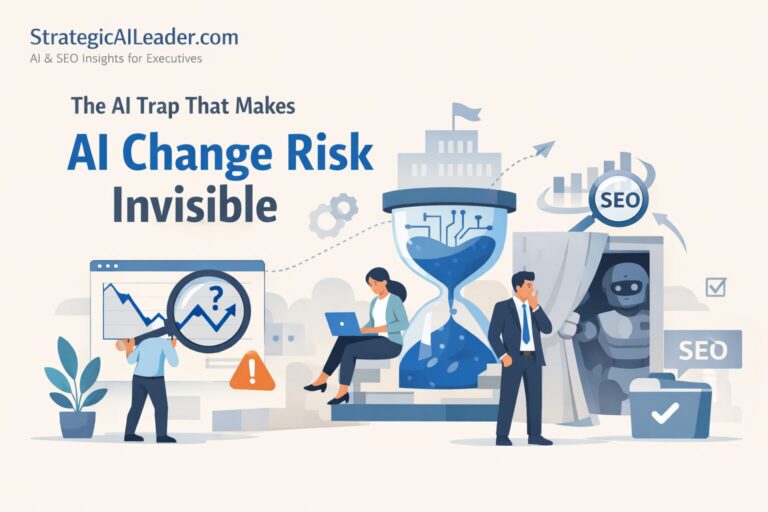
AI change risk rarely announces itself through broken dashboards or sudden traffic loss. It hides inside familiar language, stable metrics, and the comforting belief that nothing fundamental has changed. As AI-driven discovery reshapes how information gets selected, validated, and surfaced, SEO teams face a new risk layer. Visibility decisions now happen before human clicks, often without clear feedback. This piece explains why reassurance appears first in every major transition, how AI systems quietly alter SEO outcomes, and what leaders must recognize before familiar strategies stop compounding advantage.
Agentic browsers are turning the web into a decision engine for AI. They don’t just display content, they read, reason, and act. Learn how this shift is redefining search, structure, and visibility for brands competing in the agentic era.
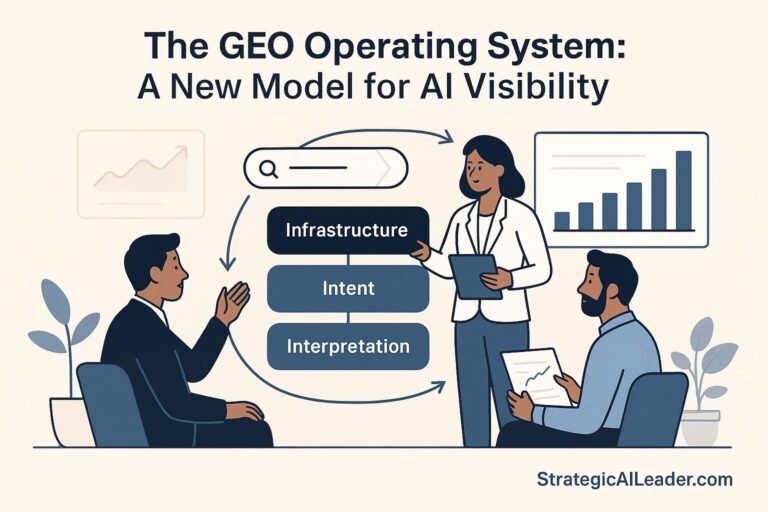
The GEO Operating System is a new model for AI visibility. It aligns marketing, IT, and PR under one framework to make visibility measurable, repeatable, and scalable. This article explains how the GEO-OS connects infrastructure, intent, and interpretation to help leaders turn fragmented efforts into a unified visibility engine.
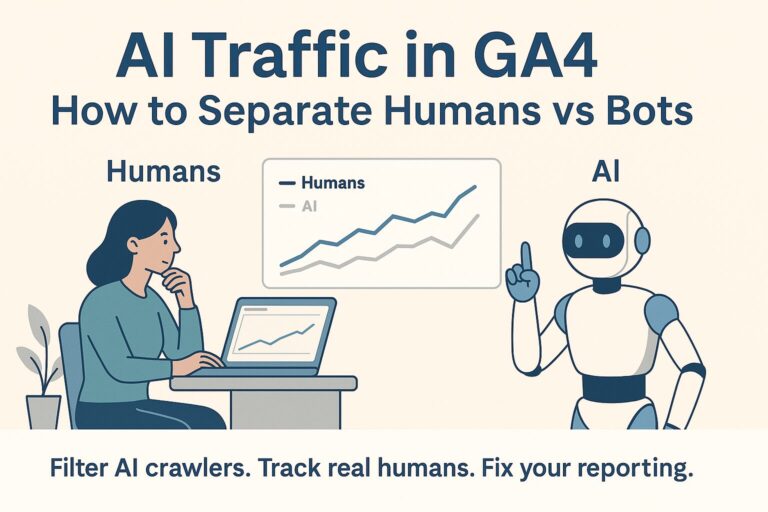
AI bots are inflating your analytics. In GA4, traffic from ChatGPT, Claude, Gemini, and other AI tools gets mixed with human visits, creating false growth signals. Without separating AI traffic from human behavior, executives risk celebrating fake gains while their real audience declines. This guide shows you how to filter AI crawlers, track AI search referrals as a distinct channel, and report human visits with accuracy.
Here’s a question that’s been keeping me up at night: What happens when everyone’s chasing the same AI-powered shortcuts, but the real winners are the ones who remember that humans are still doing the searching? The potential for success in human-led search strategies is immense, offering a hopeful outlook for the future. A few weeks…
For early-stage founders aiming for rapid growth, ‘Skyrocket Growth with Keyword Strategy for Founders’ by Richard Naimy reveals why traditional keyword approaches often fall short. This article introduces the transformative R.A.N.K. Framework, a four-step system designed to move beyond guesswork to strategic ranking. Learn how to ‘Research Customer Language, Not Competition’ through insightful interviews, ‘Analyze Search Intent & Competition’ for optimal targeting, ‘Niche Down Before Scaling Up’ with hyper-specific keywords, and ‘Key Performance Tracking Beyond Rankings’ for true growth measurement. Discover how Lia’s Flower Shop achieved a 3x traffic increase and 58% conversion boost in 90 days by embracing this framework, proving that a data-driven keyword strategy is crucial for both SEO and your entire product roadmap.
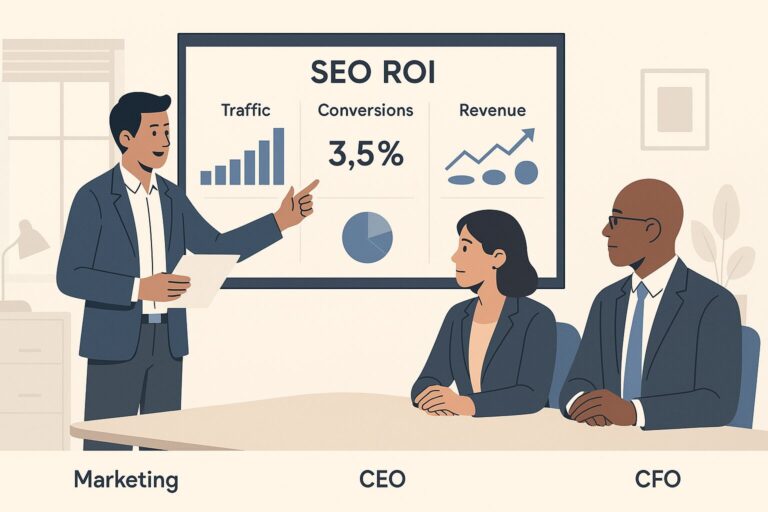
Many leaders and SEO professionals often misinterpret the true return on investment (ROI) for their Search Engine Optimization efforts, focusing on activity metrics rather than tangible business outcomes. The article ‘The Truth About SEO ROI: What Leaders Miss’ by Richard Naimy addresses this critical gap, introducing the ‘SEO Value Chain’ framework. This framework guides businesses through establishing clear objectives, creating sensible attribution models, and connecting technical SEO metrics to financial results. Learn how a B2B software company leveraged this approach to achieve a 3.8x ROI and secure a 60% budget increase, and discover practical ‘quick wins’ to start effectively measuring SEO’s impact on your bottom line.