
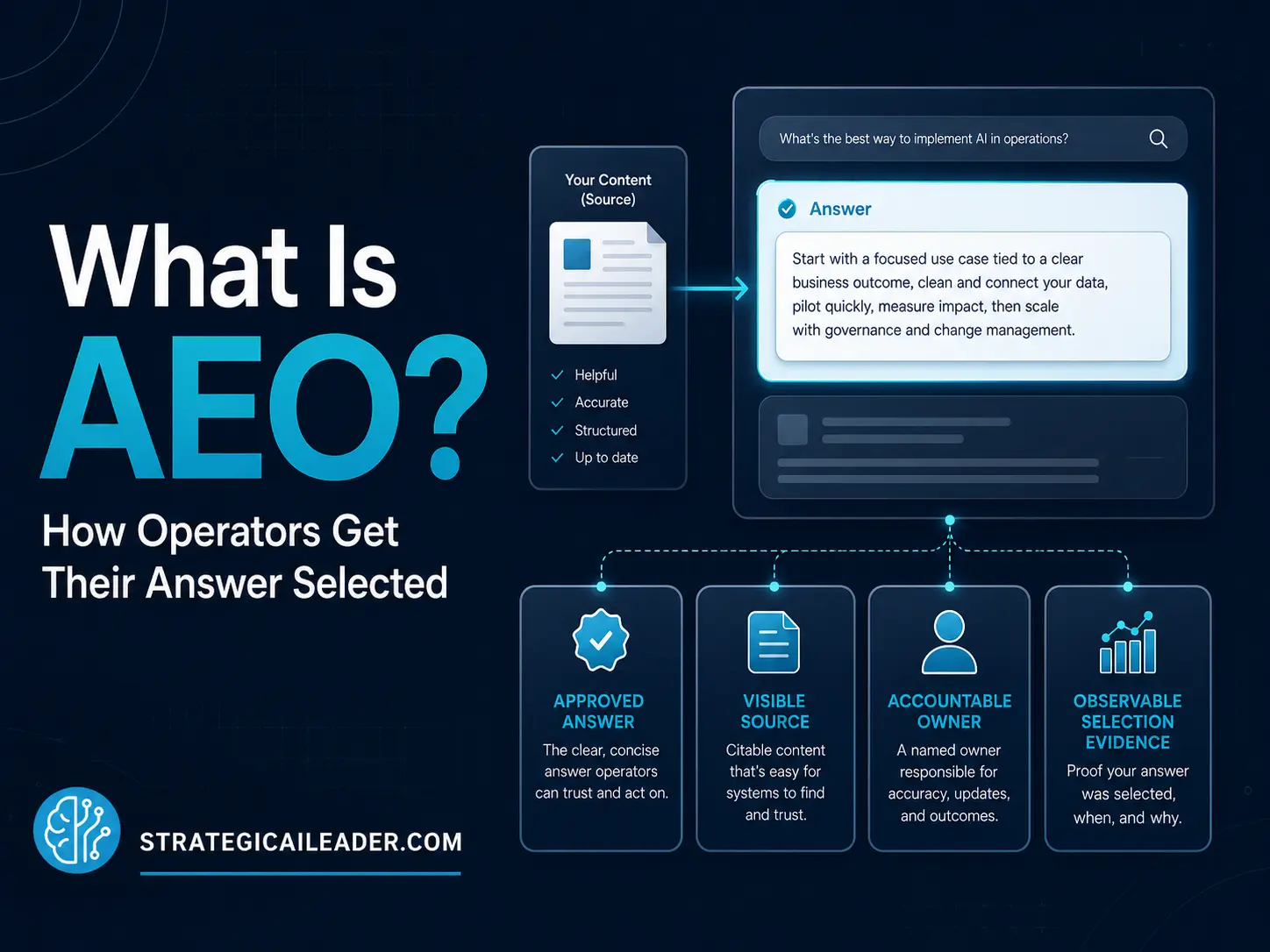
What Is AEO? A Proven Guide to Answer Selection
Buyers used to click a blue link.
Many now read the answer box, the featured snippet, or a voice result and stop.
If the approved answer is not the one selected on that surface, ranking a page is not enough.
For this article, AEO focuses on one problem: getting the company’s approved answer selected on the answer surface. AEO does not replace SEO, and it is not the same as GEO. The terms overlap, but they measure different outcomes.
Leaders get a clear definition, a selection-gap test, an illustrative shipping-policy example, and a one-week exercise. Start by naming the approved source and the person responsible for keeping it current.
What Is AEO?
| Answer engine optimization (AEO) is the repeatable work of making an approved answer selectable on answer engines and answer surfaces, with an accountable owner, a visible source, and observable selection evidence. |
The work starts with an approved answer, not a keyword list. That answer might be a shipping window, a return rule, a product constraint, or a sales comparison. AEO puts that approved answer on a live source that answer engines can find, extract, and select.
AEO, GEO, and AI search do not have one agreed-upon definition yet. Different companies and publications use the terms in different ways. PRINT Magazine also highlights the overlap among SEO, AEO, and GEO.
For this article, the distinction is practical. AEO focuses on selecting the approved answer. GEO focuses on getting the approved source cited inside generated answers. SEO focuses on discoverability and organic visibility.
The labels may keep changing. Your team still needs to know which answer it stands behind, where that answer lives, who owns it, and whether the target surface selected it.
If the team cannot show the approved answer, the live source, the person who owns it, and evidence from the target surface, the team does not have a working AEO process. It has content without clear ownership or proof.
Content and SEO investment can still lose the answer when another source gets selected. A selected answer keeps the company’s approved information in front of the buyer. That makes AEO a demand-capture job, not another ranking report.
Operators control the approved answer, source accuracy, freshness, extractability, ownership, monitoring, and the correction process. Answer engines control final selection. AEO improves selection readiness and gives the team evidence of what happened. It does not guarantee selection.
What Leaders Get Wrong About AEO
Teams publish more pages and assume the problem is solved. The answer surface can still pull from an old FAQ, a partner page, or a competitor.
SEO, AEO, and GEO often get treated as the same job. They overlap, but they solve different problems. Ranking matters. Citation matters. Neither automatically means the company’s approved answer gets selected.
A content calendar can look healthy while the wrong answer reaches the buyer. Sales then hears about an outdated shipping policy from someone who has already seen the snippet. Nobody owns the correction.
Buying a snippet-tracking tool does not create an AEO process. The tool can record what gets selected. Your team still has to decide which answer it stands behind, where that answer lives, and who acts when the wrong source wins.
Google Search Central is clear about featured snippets. Publishers cannot request one. Google decides whether a page is a good fit for the featured snippet. That means teams can improve the source and its eligibility, but they do not control the final selection. See Featured Snippets and Your Website.
The Four Parts of AEO Work
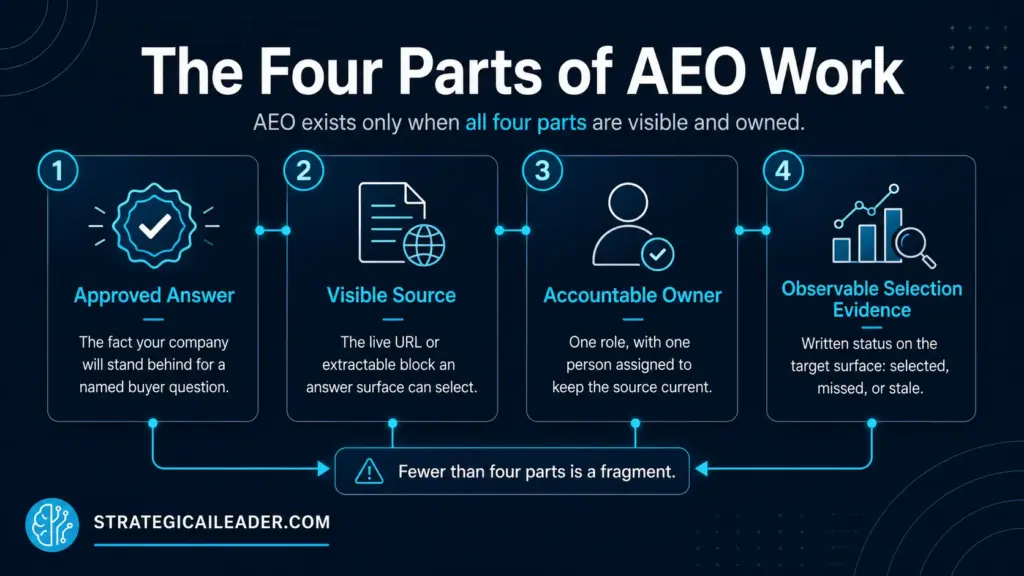
and observable selection evidence
The four-part test proves AEO exists. Recurring, high-stakes, or frequently asked answers need more design before the route earns trust.
| Term | Definition |
|---|---|
| Approved answer | The fact the company will stand behind for a named buyer question |
| Visible source | The live URL or extractable block an answer surface can select |
| Accountable owner | One role, with one person assigned to keep the source current and check selection |
| Observable selection evidence | Selected, missed, or stale on the target surface, written from the operating record |
Selected is the outcome you want. Missed and stale are still useful because they indicate where the team should act. The point of selection evidence is to show what happened, not to pretend the team controls the engine.
Approved answer
Start with the fact the company is willing to stand behind.
“We should win the snippet” is not an answer.
“Standard ground shipping arrives in five to seven business days, published on the shipping-policy page and reviewed by Operations” is an answer.
If two leaders give buyers different answers, AEO has nothing reliable to choose from.
Visible source
The approved answer needs a live source that an answer engine can find and extract.
A Slack thread is not enough. A buried paragraph inside a long article is harder to use.
Put the answer on a stable URL in a clear, extractable block.
Accountable owner
Every approved answer needs one person responsible for keeping it accurate and current.
That person owns the source, checks what the target surface is showing, and takes action when the answer is missing or outdated.
A team name does not create accountability. If everyone owns the answer, no one owns the answer.
Observable selection evidence
Publishing the answer does not prove it was selected.
The team needs to record what the target surface showed: selected, missed, or stale.
For each check, record the buyer question, the surface checked, the date, the answer shown, the source selected, and the result. Keep a screenshot or captured result when possible.
If the team cannot show the approved answer, the live source, the owner, and the selection result, the AEO work is not complete.
The source can be ready while the engine still selects something else.
What Production-Ready AEO Also Needs
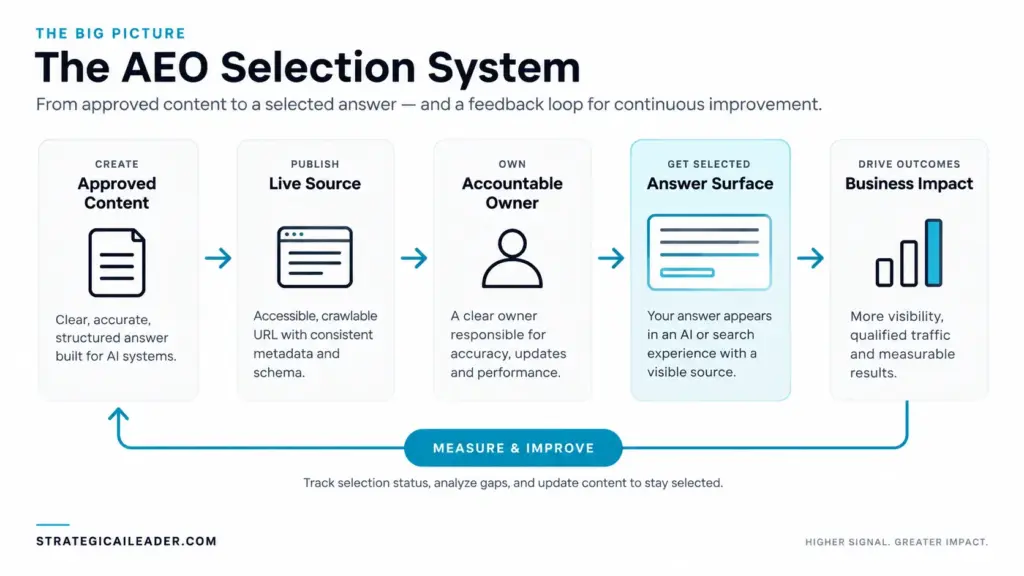
answer surface visibility and continuous measurement
Not every answer surface works the same way. A featured snippet may pull a short passage from one page. A generated answer may combine several sources. A voice result may reduce the answer even further.
The operating question stays the same: What answer did the buyer receive, what source supported it, and was it the company’s approved answer?
Name the answer surface you are checking. Identify the exact block you want selected. Define when the source needs to be refreshed. Decide what happens when the surface shows an old or incorrect answer. Then set the next check date.
That gives the team a simple operating record: the answer, the source, the owner, the target surface, the current status, the refresh trigger, the correction path, and the next check.
For the broader AI visibility system, see The GEO Operating System.
AEO vs SEO, GEO, and Content Strategy
AEO, SEO, GEO, and content strategy overlap, but they do different jobs.
In this article, AEO focuses on whether the approved answer gets selected. SEO focuses on whether the page gets found. GEO focuses on whether the approved source gets cited inside generated answers. Content strategy decides what the company is willing to say in the first place.
The same page can support all four jobs. A page can rank well and still lose the answer surface. A source can get cited in an AI response without being the selected featured snippet. The work overlaps, but the outcomes are different.
GEO, or generative engine optimization, focuses on making an approved source visible and citable inside AI search and generated answers.
AEO does not replace SEO. GEO does not replace either one. If a page ranks but the answer surface still pulls from another source, the company still loses that answer.
That is why answer selection matters as a growth signal. The Truth About SEO ROI explains why activity metrics alone can hide that gap.
| Question | AEO | SEO | GEO | Content strategy |
|---|---|---|---|---|
| What is it? | The work of making an approved answer selectable on answer surfaces | The work of becoming findable and chosen on traditional results | The work of making an approved answer citable in AI search | The choices about what the company will say |
| What does it require? | Approved answer, visible source, owner, selection evidence | Indexable pages, relevance, and earnable rankings | Approved source, sequence, owner, citation evidence | Audience, offer, and editorial judgment |
| What proves completion? | The approved answer is selected on the target surface | The intended pages earn the intended placements | A model cites, quotes, or refers from the approved source | The intended message is published and used |
| What does it support? | Short-form answer capture and growth capture | Discovery and clicks | AI visibility and answer integrity | Message quality |
| Common failure | The page ranks and the snippet is someone else’s | Rankings exist and the buyer still asks an assistant | Models quote a stale or competitor source | Plenty of content, no owned source for the live fact |
An AEO Example
Here is a simple example using a shipping policy.
Leadership approves a new shipping-window answer because buyers keep asking when their order will arrive. Sales keeps repeating the same answer on calls, so the company wants one approved source buyers and answer engines can rely on.
Trigger: Leadership approves the shipping-window answer.
Sequence:
- Operations confirms the exact shipping language.
- Content publishes the approved answer on the shipping-policy page in a clear, extractable block.
- Support updates the FAQ with the same answer.
- The assigned owner checks the target answer surface the following Friday.
- The owner records the result as selected, missed, or stale and takes action when needed.
Accountable owner: The Head of Growth coordinates the process. SEO, content, product, support, and operations may contribute to the answer and source. One person remains accountable for ensuring the approved answer stays current and that the selection check occurs.
Done-state: The approved shipping answer is live, the FAQ matches, and the result of the Friday selection check is recorded.
Exception: If the answer surface still shows the old shipping window or pulls from another source, diagnose the reason before changing anything.
If the approved answer is incorrect, correct it.
If the source is outdated, refresh the source.
If the answer is hard to extract, improve the answer block.
If the page is not discoverable, check indexing and SEO.
If another source keeps winning, compare what that source provides that yours does not.
Then record the miss, document the action taken, and set the next selection check.
Failure state: Without this process, SEO can keep improving the page while sales continues answering the same question manually. The company still does not know whether buyers are seeing its approved answer.
Lesson: The goal is not to publish another page. The goal is to give buyers the approved answer before sales has to repeat it.
Diagnostic Questions
You can usually find an AEO problem by looking at how the answer is managed.
Ask:
- What question do buyers keep asking?
- What answer is the company willing to stand behind?
- Where does that answer live?
- Who owns keeping it current?
- What did the target answer surface show the last time someone checked?
- What happens when the answer is missed or stale?
- How quickly does an approved change reach the live source?
- When will someone check the answer surface again?
If the team cannot answer the first five questions, the AEO process is not clear enough to manage.
Do not measure AEO by the total number of answers selected. Measure the questions that matter to the business.
Useful measures include selection rate on priority questions, stale-answer rate, time from an approved change to a live source, time from a source update to the next check, and the number of repeat-buyer questions that sales still handles manually.
AEO matters most when the same questions come up repeatedly, the answers carry risk, or the information changes often. Those are the questions where an outdated or competitor answer creates a real business problem.
Not every query deserves an AEO workflow. Prioritize questions where the company owns the underlying fact, the answer affects a buyer decision, or getting the answer wrong creates cost or risk.
You do not need a large dashboard to start. One operator can manage the process if the approved answer, source, owner, and next check are clear.
Answer selection should also connect to the larger growth system. What Is Growth Strategy explains how individual demand-capture activities fit into a broader growth strategy.
How to Test AEO This Week
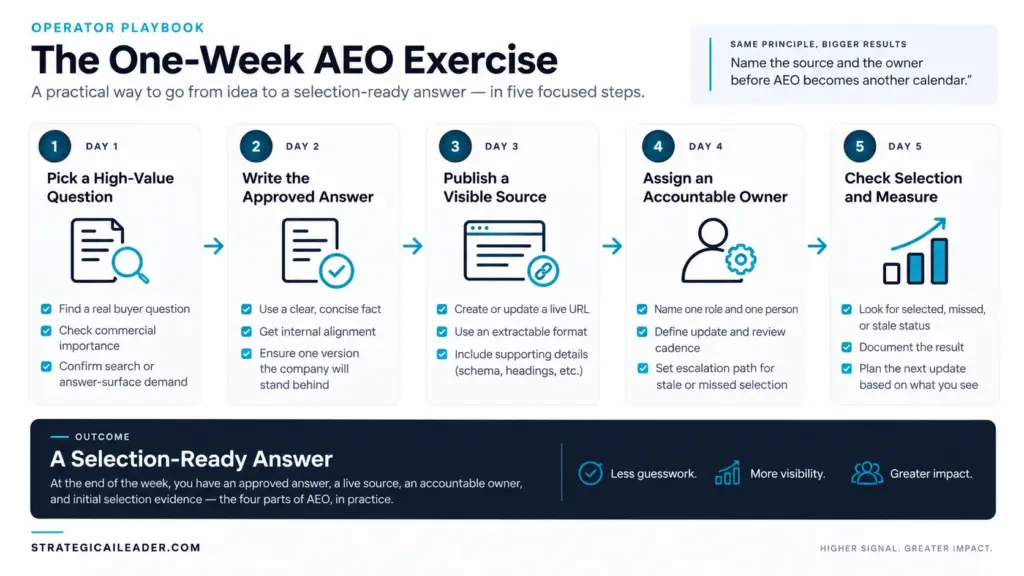
visible source accountable ownership and initial selection evidence
Run one exercise on a repeating buyer question that already costs sales time.
- Choose one question buyers already ask that should become a selected answer.
- Write the approved answer in one sentence.
- Assign one accountable role.
- Name the person currently assigned to the live source.
- Point to the URL or extractable block that should be selected.
- Name the target surface you will check.
- Define selection evidence someone can observe without a meeting: selected, missed, or stale.
- Check the target surface and record the outcome.
- Run that check once before anyone buys an AEO tool.
- Review the misses and document the correction rule each one needed.
Score is not the goal. The team needs a visible source it can defend on Monday.
FAQ
What is AEO?
Answer engine optimization (AEO) is the repeatable work of making an approved answer selectable on answer engines and answer surfaces, with an accountable owner, a visible source, and observable selection evidence.
How is AEO different from SEO?
SEO focuses on discoverability and organic visibility. AEO focuses on whether the approved answer gets selected. The work often overlaps on the same pages and source infrastructure. A URL can rank and still never become the answer the surface selects.
How is AEO different from GEO?
In this article, AEO focuses on whether the approved answer gets selected. GEO focuses on whether the approved source is cited in the generated answers. SEO focuses on discoverability and organic visibility. The terms overlap, but the outcomes are different.
Who should own AEO?
AEO usually requires a cross-functional team. SEO, content, product, growth, and operations may all contribute to the work. One accountable owner should coordinate the process, make sure the approved answer stays current, and confirm that selection is being checked. The accountable owner does not need to be an AEO or GEO specialist.
What proves AEO is working?
Selection on the target surface proves the approved answer won. Missed and stale are observable statuses, not success. A published page without that check is not proof. AEO manages selection readiness and selection evidence. It does not guarantee selection.
How does AEO support growth?
Answer engine optimization helps keep the company’s approved answer in front of the buyer. When another source gets selected, content and SEO investment can still lose that answer. Getting the right answer selected can also reduce the number of questions that sales has to answer repeatedly.
Continue Learning
AEO turns an approved answer into a selected extract.
Subscribe to the Strategic AI Leader newsletter for practical systems covering AI, operations, and growth.
Next, read Future of SEO: Unlocking AEO & GEO for Smarter Growth for the visibility essay beside this definition.
Help Support My Writing
Subscribe for weekly articles on leadership, growth, SEO, and AI-driven strategy. You’ll receive practical frameworks and clear takeaways that you can apply immediately. Connect with me on LinkedIn or Substack for conversations, resources, and real-world examples that help.
Related Articles
GEO Operating Model: The Truth About AI Visibility
The Truth About AI-Driven SEO Most Pros Miss
Intent-Driven SEO: The Future of Scalable Growth
SEO Strategy for ROI: A Better Way to Win Big
Future of SEO: Unlocking AEO & GEO for Smarter Growth
Skyrocket Growth with Keyword Strategy for Founders
I write about:
- AI + MarTech Automation
- AI Strategy
- COO Ops & Systems
- Growth Strategy (B2B & B2C)
- Infographic
- Leadership & Team Building
- My Case Studies
- Personal Journey
- Revenue Operations (RevOps)
- Sales Strategy
- SEO & Digital Marketing
- Strategic Thinking
Want 1:1 strategic support?
Connect with me on LinkedIn
Read my playbooks on Substack