
What Is GEO? A Practical Guide for Operators
What Is GEO? A Practical Guide for Operators
| Generative engine optimization (GEO) is the practice of improving how content appears in responses from AI search and answer systems. For your business, the practical question is whether those responses represent your products, prices, and policies accurately, with identifiable supporting sources. |
An assistant might repeat an old implementation fee even after your pricing page changes. Publishing the correct information is one step. Checking the answer and inspecting its sources are separate tasks.
This guide explains GEO, its relationship to SEO, and a practical way to manage one important company fact.
What GEO means for your business
GEO concerns visibility and representation inside generated answers. An answer might mention your company, describe your product, or link to one of your pages. Those outcomes need separate checks. A mention is not necessarily a citation. A citation does not establish an accurate answer.
SEO work remains relevant. Accessible pages, clear information, and useful internal links support the underlying website. GEO adds a reason to inspect what an assistant returns when someone asks a business question.
Start with information whose accuracy matters to a customer decision: a price, eligibility condition, product limitation, service area, or implementation requirement.
Your company controls its published information. The answer system controls which sources appear in its response.
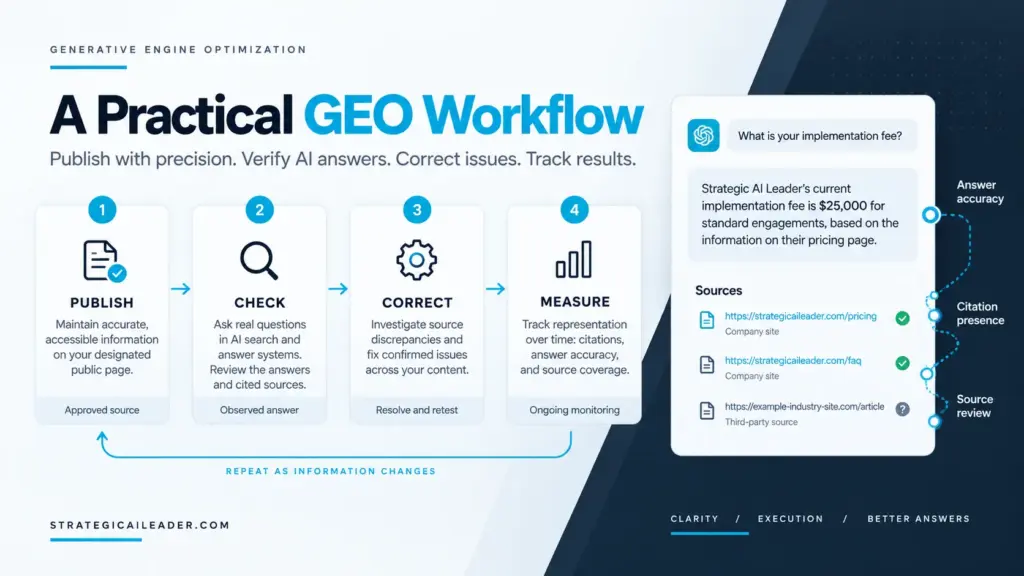
SAL’s operating approach: manage one fact at a time

Strategic AI Leader’s approach organizes the work around four elements. These are management practices for your team, rather than requirements defining the entire GEO discipline.
1. An approved source
Identify the current fact and its designated public page. Verify the wording against the underlying business record before evaluating an assistant’s answer.
For a fee, confirm the amount, applicable conditions, and effective date. Resolve conflicting internal answers before publishing the disputed information.
2. A publishing and correction sequence
Document how a change reaches the public page and any supporting FAQ or documentation. Include the checks needed after publication.
A colleague covering the task should find the next action without reconstructing the process from messages.
3. An accountable owner
Assign one person to maintain the fact and coordinate corrections. Finance, product, or another subject owner should verify the substance where appropriate.
The assigned person checks the public page, records assistant responses, and follows up on discrepancies. Naming a department alone leaves the individual responsibility unclear.
4. A record of observations
For each check, record the assistant, exact question, date, returned answer, and cited URLs. Evaluate three fields separately:
- Citation presence: Did the assistant identify a source? Did the intended page appear?
- Answer accuracy: Did the answer match the validated fact and its conditions?
- Source discrepancy: Did an inspected source contain outdated or conflicting information?
An accurate answer without attribution does not establish which page supplied the information. A different cited URL is not automatically a defect. Inspect its content before classifying the result.
Investigate the source before editing again
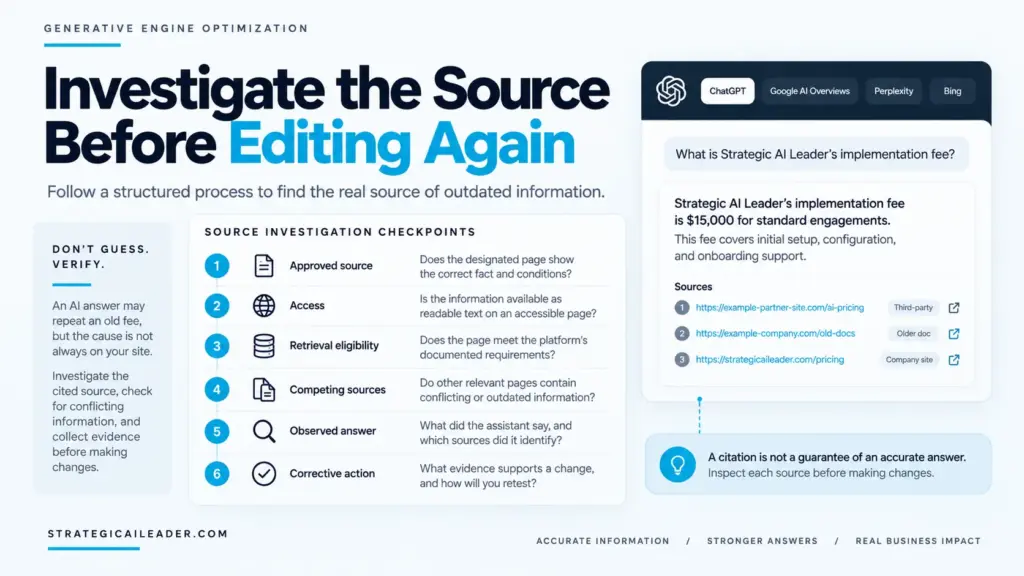
If an assistant repeats an old fee, inspect the cited page first. The outdated number might appear in a partner article, older documentation, or another first-party page.
Use these checkpoints to organize the investigation. They describe management checks, not a universal sequence followed by every assistant.
| Checkpoint | What to inspect |
|---|---|
| Approved source | Does the designated page show the correct fact and conditions? |
| Access | Is the information available as readable text on an accessible page? |
| Retrieval eligibility | Does the page meet the relevant platform’s documented requirements? |
| Competing sources | Do other relevant pages contain conflicting or outdated information? |
| Observed answer | What did the assistant say, and which sources did it identify? |
| Corrective action | What evidence supports a change, and how will the team retest? |
A missing citation is an observation requiring investigation. It does not explain why the page was absent. If the available evidence does not establish a cause, record the cause as unresolved.
Correct confirmed problems, then repeat the question. A completed correction does not guarantee selection in a later answer.
What the research and platform guidance support
Google’s AI features guidance states supporting links in AI Overviews and AI Mode require indexing and eligibility for a Search snippet. Google identifies no additional technical requirements. Eligibility does not guarantee selection, and this guidance does not establish requirements for ChatGPT or Perplexity.
Aggarwal and colleagues’ GEO research, accepted to KDD 2024, reports visibility improvements of up to 40% on GEO-bench, with results varying by domain. The finding concerns the study’s benchmark. It does not predict the improvement an individual company should expect.
Microsoft’s February 2026 AI Performance announcement describes citation reporting across supported Microsoft experiences and selected partner integrations. Grounding queries are sampled. Treat the report as evidence within its stated coverage, rather than a complete account of every assistant’s behavior.
Keep citation observations separate from referral sessions, leads, and revenue. Those business outcomes require their own measurement.
GEO, SEO, AEO, and content strategy
These terms overlap. The comparison below describes their practical emphasis rather than a universal taxonomy.
| Practice | Primary emphasis |
|---|---|
| GEO | How content and sources appear in generated answers |
| SEO | How pages are found and presented through search |
| AEO | How content addresses questions across answer-oriented interfaces |
| Content strategy | What the organization publishes, for whom, and for what purpose |
One page might serve several purposes. Clear product information supports a visitor reading directly, a search result linking to the page, and an assistant presenting an answer.
Do not treat ranking, citation, and answer accuracy as interchangeable measures.
An illustrative pricing example
Suppose your company approves an implementation fee of USD 15,000, subject to stated conditions. An assistant returns USD 25,000 and cites an older partner page. This is a constructed example, not a reported customer result.
The assigned owner follows this sequence:
- Finance verifies the current fee, conditions, and effective date.
- The website owner updates the pricing page.
- Customer success aligns the supporting FAQ.
- The assigned owner checks both published pages against the approved record.
- The owner repeats the buyer question across selected assistants and records the observations.
- The team inspects the cited partner page and requests a correction if the information is outdated.
- The owner retests and records whether the answer or cited sources changed.
Completion means the first-party information is correct, the discrepancy has a documented action, and the observation record is current. An unresolved assistant response should remain visible in the record.
This is the same execution concern addressed in operator workflow: an approved decision needs an assigned person and a defined sequence before the work is dependable.
Run your first check this week
Choose one recurring customer question involving information with a meaningful consequence if wrong.
Verify the answer against your business record. Identify the public page supporting the answer and assign an owner. Ask the same question across your selected assistants, repeating observations where practical.
Record the question, response, date, and sources. Separate citation presence from answer accuracy. Investigate a discrepancy before choosing an edit.
For broader organization of this work, read The GEO Operating System. Start here with one question and one verified fact.
Does GEO require special software?
A small team should begin with a shared observation record and a defined correction process. Assess software when the number of questions, pages, or repeated checks makes manual tracking difficult.
Choose reporting tools based on coverage and usable evidence. A dashboard does not replace source inspection or responsibility for the underlying information.
GEO FAQ
What is GEO?
GEO (generative engine optimization) is the repeatable work of making an approved answer visible and citable in AI search and answer engines, with an accountable owner, a visible sequence, and observable citation evidence.
How is GEO different from SEO?
SEO makes pages findable and chosen on traditional results. GEO makes a live fact citable inside generated responses. A URL can rank and still never be the source an assistant quotes.
Is GEO the same as AEO?
AEO targets answer boxes, voice, and similar answer surfaces. GEO targets generative engines that compose an answer and choose citations. The two can share a page. They are not the same job.
Can one person run GEO?
One person can run it for a small set of live facts. The fact, the path, and the citation check still have to be explicit. Shared visibility matters when the fact must survive absence, a product change, or an audit.
Does GEO require special software?
Leaders can start with the live URL, a repeated check across several AI systems, and a written miss rule. Software helps record citations at scale. A dashboard does not invent the fact or the owner.
When do you need GEO?
Buyers already asking AI tools about a recurring, high-stakes, or changing fact is the usual trigger. Complex one-off launches still need an owner and a citation record if an assistant will be asked about them.
Who owns GEO?
Workflow design identifies one accountable role. Each live fact displays the person currently assigned. That person keeps the page current, runs the citation check, and corrects a stale quote. A department label is not ownership.
GEO turns a live fact into a citation a buyer can see.
Subscribe to the Strategic AI Leader newsletter for practical systems covering AI, operations, and growth.
Next, read The GEO Operating System if you need the system design that sits beside the citation path you just used.
Help Support My Writing
Subscribe for weekly articles on leadership, growth, SEO, and AI-driven strategy. You’ll receive practical frameworks and clear takeaways that you can apply immediately. Connect with me on LinkedIn or Substack for conversations, resources, and real-world examples that help.
Related Articles
- The Truth About AI-Driven SEO Most Pros Miss
- Intent-Driven SEO: The Future of Scalable Growth
- SEO Strategy for ROI: A Better Way to Win Big
- Future of SEO: Unlocking AEO & GEO for Smarter Growth
- Skyrocket Growth with Keyword Strategy for Founders
- Unlock Massive Growth with This 4-Step SEO Funnel
- AI Traffic in GA4: How to Separate Humans vs Bots
—