How to Master Operational Leadership After Strategy
The room treats Friday’s vote as finished work. Direction is approved. People leave thinking the hard part is over. Monday has no named owner, no standard for a miss, and no review on the calendar. By midweek the same problem is back in the queue, and nobody can say who decides. Operational leadership is the work that should have started when the meeting ended.
I saw this gap firsthand at MyEListing. We could leave a leadership discussion aligned on what needed to happen, then discover days later that the decision had never become an operating practice. The direction was clear, but nobody had been named to own the result, no standard defined what success or failure looked like, and no review forced the issue back into view. The problem was not strategy. We had made the decision. The problem was everything required to make the decision operational.
What Is Operational Leadership?
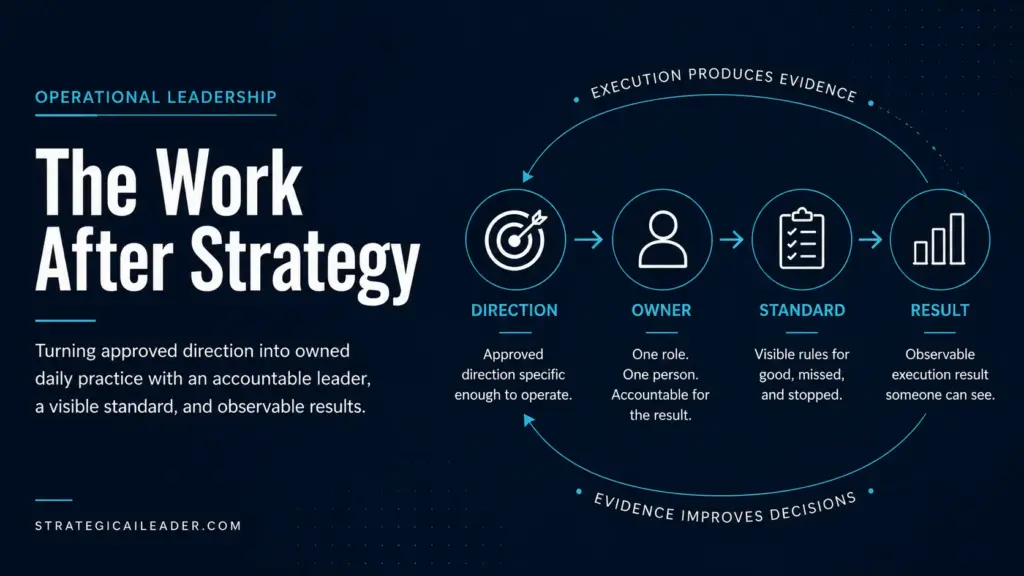
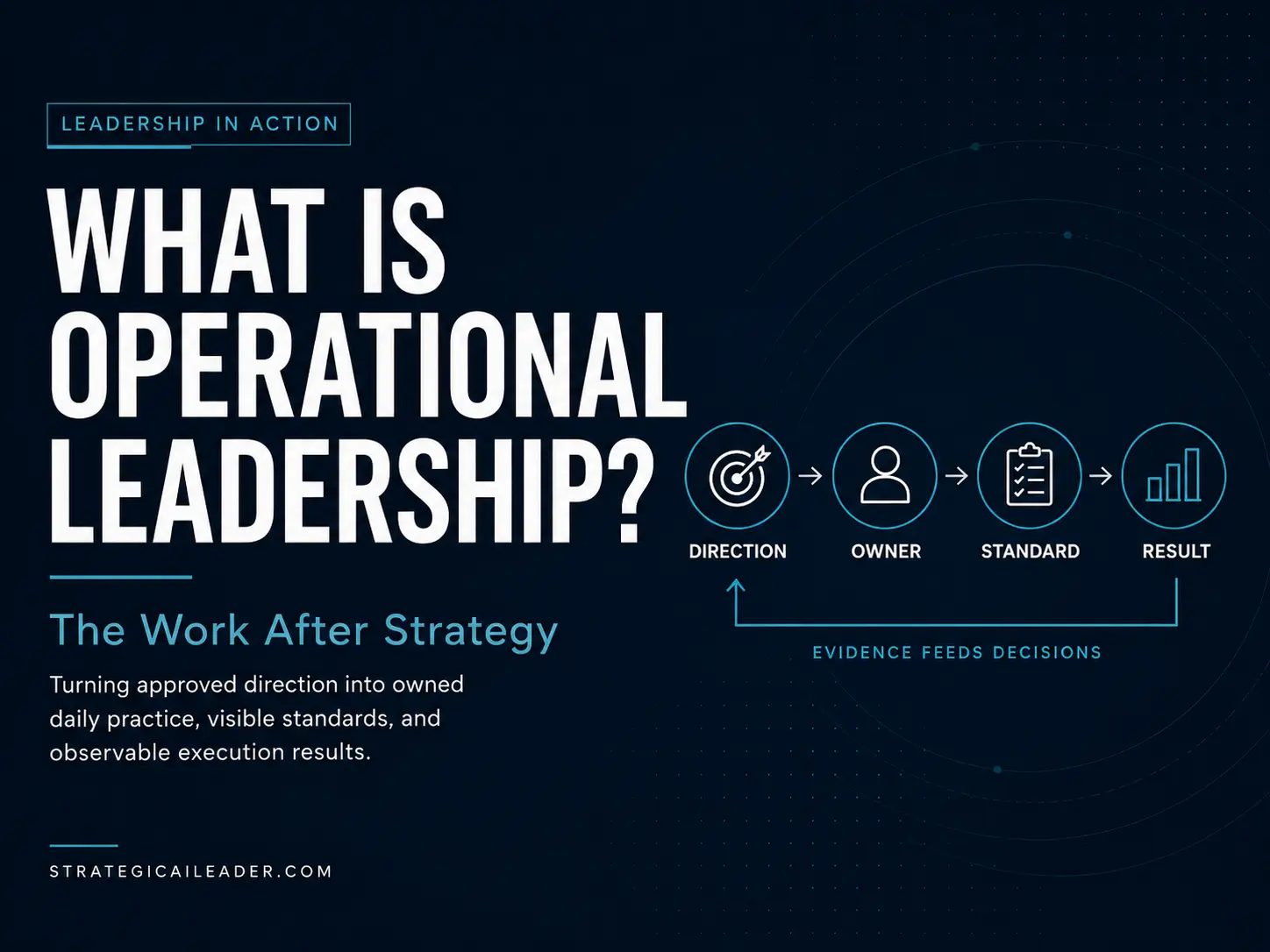
direction owner standard and result
Operational leadership is the work of turning an approved direction into owned daily practice, with an accountable leader, a visible operating standard, and observable execution results.
Once a direction exists, the operational leader sets weekly priorities, decides where scarce time and budget go, makes cross-functional trade-offs, handles exceptions, runs a review cadence, escalates when a rule is broken, feeds execution evidence back into strategy, and develops other people who can do the same work. Name the owner before anyone debates a new title.
Direction shapes execution. Execution produces evidence, and that evidence changes decisions, standards, or strategy. Skip the last step and the original choice never gets tested.
In the public abstract of Why Strategy Execution Unravels (March 2015), Donald Sull, Rebecca Homkes, and Charles Sull report that two-thirds to three-quarters of large organizations struggle with execution, and that only half of middle managers can name any of their company’s top five priorities. Full text was not accessed. The finding does not prove a four-part test. It does show why a direction that felt clear in the room can still leave the week without a usable priority.
| Term | Definition |
|---|---|
| Approved direction | A choice specific enough that two leaders would write the same promise |
| Accountable leader | One role, with one person assigned to the practice |
| Visible operating standard | Shared rules for good, missed, and stopped |
| Observable execution result | Evidence someone can see without attending the original meeting |
The Work After the Direction
Buying a dashboard does not create operational leadership. The chart can be green while the exception still has three “owners” and no authority.
Missing parts fail in predictable ways. No direction, and people make inconsistent decisions. No owner, and responsibility is shared with no authority. No standard, and judgment stays subjective. No result, and activity gets reported as execution.
For a wider operating design, use Build a Simple Operational Excellence Framework Now.
The Four Parts of Operational Leadership Work
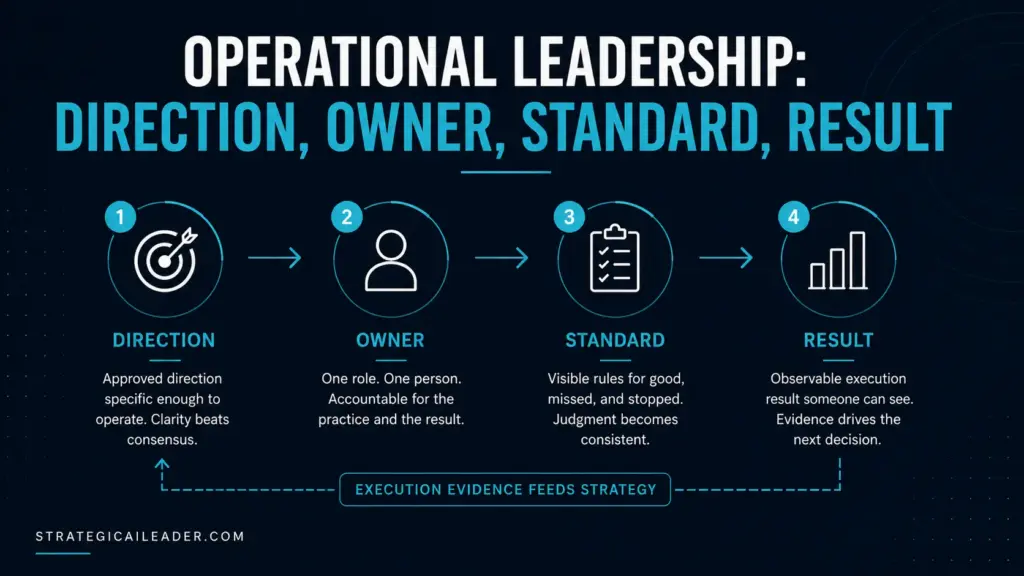
Use four presence checks.
Approved direction
Leadership already approved something specific enough to operate. “Priority tickets stay inside the published service window” can be run. If two leaders would write different promises, daily work has nothing safe to follow.
Accountable leader
One role, one assigned person. Ops, support, product, or a founder seat can hold it. That person uses the standard, runs the review, and acts when a result violates the rule. A department name is not a leader.
Visible operating standard
Good, missed, and stopped have to be visible. Record a priority miss the same day, assign it, and review it in the weekly exception meeting. If two leaders would judge the same miss differently, the team is improvising.
Observable execution result
Look for a closed miss, a changed practice, or a reused exception rule. If the team cannot tell executed from ignored without a recap meeting, there is no done-state.
After those four are named, talk about the owner, the standard, and the result.
How Operational Leaders Decide When the Week Is Messy
Incomplete direction is the usual start. Pick what the week will protect, write that assumed priority in one sentence, run it, and send the evidence back. Waiting for a cleaner strategy memo is how the miss repeats.
Two teams often own pieces of the same outcome. Support owns the ticket, product owns the defect, and revenue owns the customer promise. The Sull abstract locates the harder problem in coordination across units, not vertical alignment. Name one owner for the result, then name who must supply a decision inside a set window.
The standard will collide with a real customer. A published window says stop or escalate. A key account asks for an exception. Grant a written exception with an expiry, or hold the rule and take the relationship cost. Silent bending teaches everyone that the rule is optional.
Authority is often thinner than the job. The owner may not control hiring, budget, or another team’s queue. Gary L. Nelson, Karla L. Martin, and Elizabeth Powers, in the public abstract of The Secrets to Successful Strategy Execution (Harvard Business Review, June 2008), treat redrawing the org chart as a weak first move. Clarifying decision rights and improving information flow up the line and across the organization is more effective. Their survey covered more than 125,000 employees in some 1,000 organizations across more than 50 countries. Full text was not accessed. The research does not name a company case that maps to owner, standard, and review. It does support a practical rule: if the owner cannot decide, the gap is a decision right, not a missing slide.
Sometimes the evidence says the original strategy was wrong. Volume hits the window every week. Customers still churn on a different failure. Surface that conflict with a written result, then change the direction the result keeps falsifying.
Speed versus risk is the last recurring trade. Skip the review and the miss stays hidden until it is expensive. Document every ticket and the queue stalls. Match the review cadence to the cost of being wrong, then keep it.
AI Leadership: How to Turn Values Into Measurable Results covers the same ownership problem when the decision is an AI judgment rather than a service window.
Operational Leadership vs Strategic Leadership, Operations Management, and People Management
Nearby jobs share vocabulary. Confusing them is how a team can claim operational leadership on a slide and still have no owner for the week.
Strategic leadership sets the bets. Operations management runs capacity, cost, and reliability. People management hires, coaches, and develops people. Operational leadership sits after those choices: owner, standard, and a result another leader can see.
| Concept | What it means | Why it matters |
|---|---|---|
| Operational leadership | Turns funded direction into owned practice, a usable standard, and a visible result | Without it, strategy stays a meeting |
| Strategic leadership | Sets direction, capital, and the bets the company will fund | Without it, operations optimizes the wrong work |
| Operations management | Runs capacity, cost, and reliability of the current system | Without it, even a clear owner inherits chaos |
| People management | Hires, coaches, and develops the people who do the work | Without it, the owner has no bench |
An operator workflow is the route a single decision or trigger follows to finished work. Use it to move an item. Operational leadership keeps the practice alive after the item is done.
Illustrative Operating Scenario
Illustrative operating scenario. No company name, metric, or quote is attached.
Leadership approves a direction: priority tickets stay inside the published service window, and missed windows get a same-week review.
Head of Support owns the practice. A miss is recorded the same day and judged good, missed, or stopped in the weekly exception review. Done-state: the miss is in the review, the standard was applied, and one result is written down. Repeating miss classes get an exception filed the same week. If the same class repeats with no written result, the owner escalates the same day.
Without that route, the meeting said, “protect the customer promise.” Support works the queue. The miss sits in a thread. Operators already know the same failure from operator workflow: a decision can exist and still fail in execution.
Diagnostic Questions
Start with the direction that is live this week.
Ask: Which direction is live? Who owns the practice? What does good, missed, and stopped look like? Where is that standard used? What result did the last review produce? What happens when a miss violates the standard? How long from approval to a named owner? How long from that owner to a written result?
If the team cannot answer the first five from the work record, operational leadership is not visible enough to manage, improve, or teach.
How to Test Operational Leadership This Week
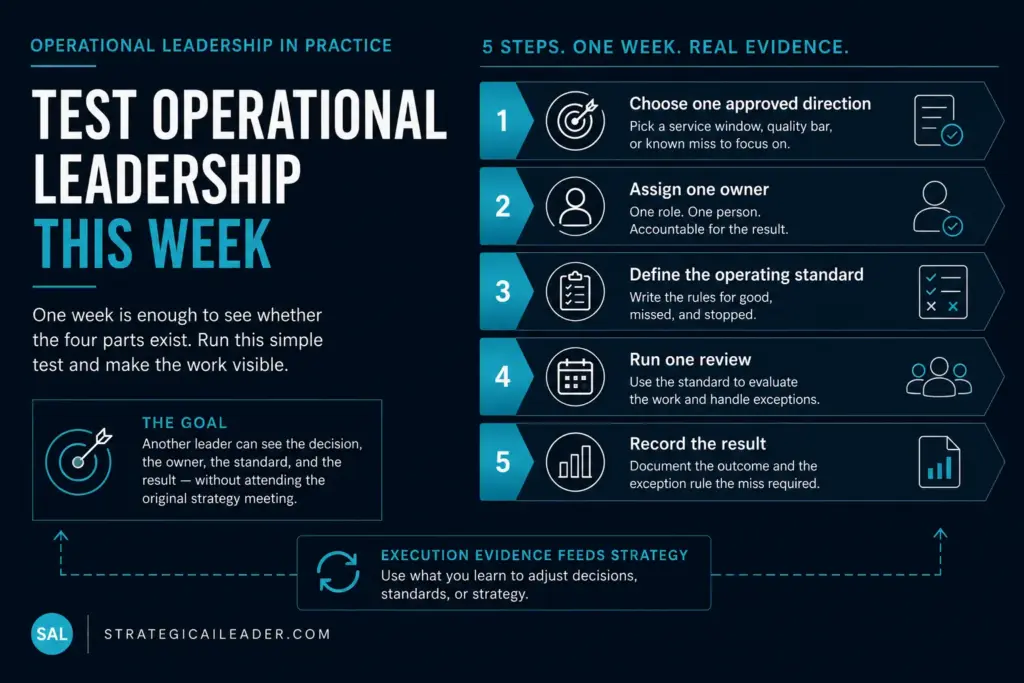
One week is enough to see whether the four parts exist.
- Choose one approved direction (a service window, a quality bar, or a stop on a known miss).
- Assign one owner: one role, and the person currently assigned.
- Define good, missed, and stopped in writing.
- Run one review that uses that standard.
- Record the result and the exception rule the miss required.
Another leader should be able to identify the owner, apply the same standard, and see what changed.
FAQ
What is operational leadership?
Operational leadership is the work of turning an approved direction into owned daily practice, with an accountable leader, a visible operating standard, and observable execution results.
How is operational leadership different from strategic leadership?
The strategy function chooses the bets. Operational leadership names the owner, the standard, and the result that proves the standard was used. A funded direction can exist while Monday still has no owner.
Who should be the accountable operational leader?
Name one role, and display the person currently assigned. That person uses the standard, runs the review, and acts on a miss. Ops, support, product, or a founder can hold the role.
What proves operational leadership is working?
Closed misses, changed practices, and reused exception rules. If last week’s review left no written result, the practice is not yet visible.
How is operational leadership different from operations management?
Operations management runs the current system: capacity, cost, reliability. Operational leadership is the work after a direction is funded: owner, standard, and execution results.
How is operational leadership different from people management?
People management develops the humans. Operational leadership develops the practice those humans run. Coaching without a standard still leaves judgment subjective.
Can one person practice operational leadership?
A founder can hold the role for a small set of practices. The standard, the review, and the result still have to be explicit. Shared visibility matters when the practice must survive absence, a volume spike, or an audit.
Continue Learning
Another person should be able to see the decision, the owner, the standard, and the resulting change without attending the original strategy meeting.
Subscribe to the Strategic AI Leader newsletter for practical systems on AI, operations, and growth. Next, read AI Leadership: How to Turn Values Into Measurable Results if AI decisions need the same ownership after the values slide.
Help Support My Writing
Subscribe for weekly articles on leadership, growth, SEO, and AI-driven strategy. You’ll receive practical frameworks and clear takeaways that you can apply immediately. Connect with me on LinkedIn or Substack for conversations, resources, and real-world examples that help.
Leadership and Team Execution: Next Steps
Use strategic delegation to define ownership without centralizing every decision.
Use leadership and team building to organize team development around practical leadership.
Use performance management to connect expectations to observable results.
Use hiring and onboarding to clarify expectations as people join your team.
I write about:
- AI + MarTech Automation
- AI Strategy
- COO Ops & Systems
- Growth Strategy (B2B & B2C)
- Infographic
- Leadership & Team Building
- My Case Studies
- Personal Journey
- Revenue Operations (RevOps)
- Sales Strategy
- SEO & Digital Marketing
- Strategic Thinking
Want 1:1 strategic support?
Connect with me on LinkedIn
Read my playbooks on Substack