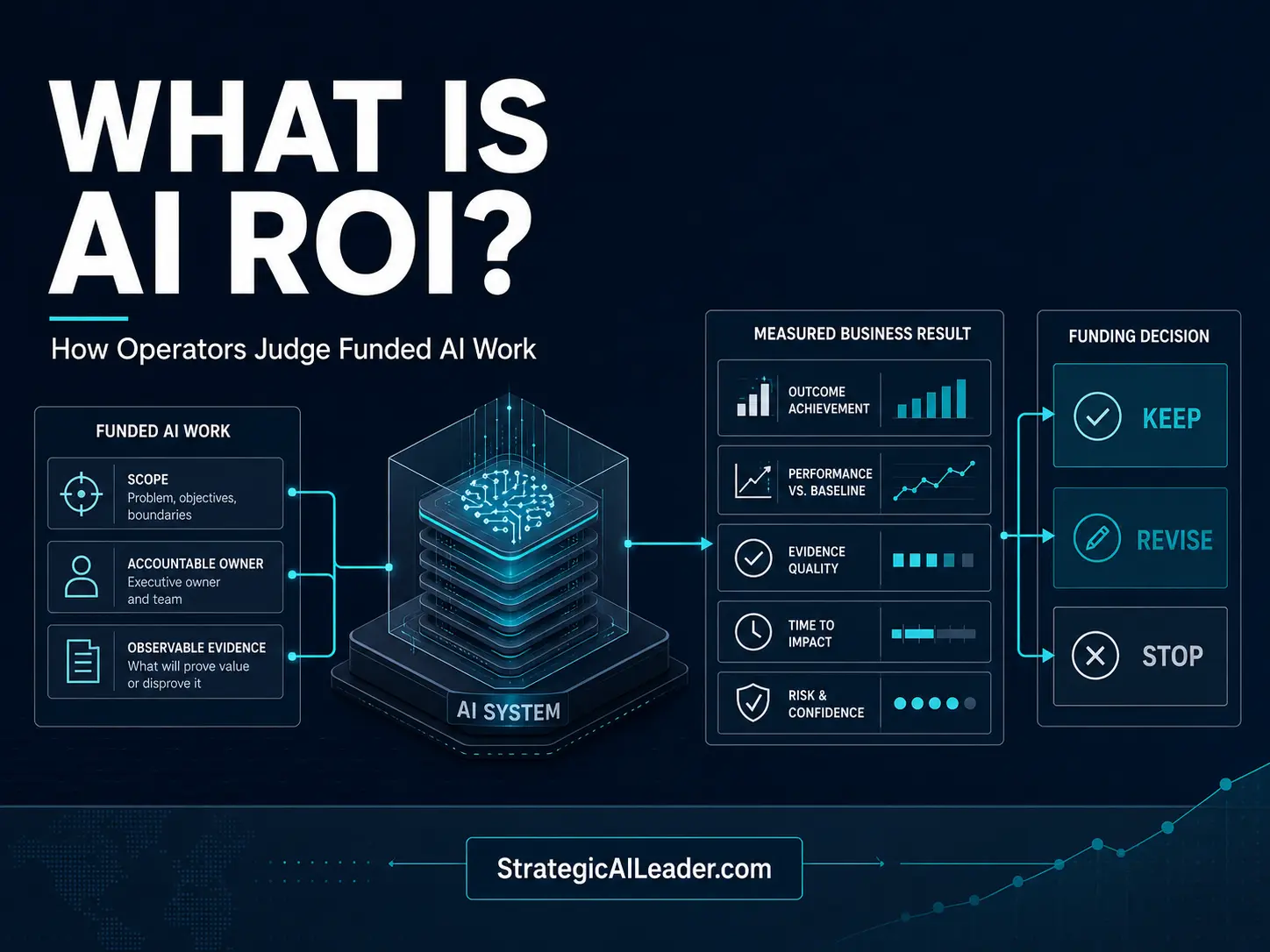
Proving AI ROI: How Operators Evaluate Funded AI Projects
Finance approved the spend. Moreover, the vendor sent a utilization chart. Additionally, support still cannot say whether the named ticket type left the human queue. Furthermore, seat counts and demo wow are not proof of AI ROI. Thus, ROI starts with the return produced against the result the company agreed to buy.
I have seen teams point to high adoption, active seats, and a strong demo as proof of ROI.
Before anyone wrote down the business result the investment was supposed to produce.
However, the dashboard looked positive, but no one owned the funding judgment.
It lacked evidence connecting usage to the result.
The dashboard showed activity, but the team lacked a defensible AI ROI judgment.
What Is AI ROI?
Moreover, AI ROI is the return made by funded AI work against the result the company agreed to buy.
An AI ROI judgment requires defined scope, an accountable owner, observable evidence, and a recorded decision to keep, revise, or stop the work.
Start with that bought result, not a seat report. A model catalog, cost-savings slide, or wow demo can look like progress. However, None names what the company paid for. Who decides keep, revise, or stop, or what evidence the next funding call will use.
Operators treat ROI as the return, and the judgment as the management process that funds or stops the work. Result validation is part of the evidence. Validation alone is not the funding call. Without that record, the team cannot defend an AI ROI claim.
What Return Means in AI ROI
Return is not one number until the company names what it bought.
Financial return covers revenue, cost reduction, avoided cost, and financially valued capacity. When the bought result has an assigned financial value, traditional financial ROI still matters. Finance already has a formula. Use it. Cycle time, quality, risk reduction, and strategic capability are operating returns. Name the window, quality bar, risk limit, or capability the company intended to own.
When leadership has not assigned a financial value, report the operating return as an operating result. Do not convert hours, quality gains, or risk reduction into dollars without an approved valuation method.
Some readers will ask whether a non-financial outcome should be called ROI at all. Traditional financial ROI needs a financial gain and a cost. Many companies still fund operating outcomes on purpose. Name the return type. Without an approved financial value, call it an operating return against the funded objective. The funding judgment can accept that return. It cannot skip the owner or the evidence.
Demonstrating that value is still hard. In a May 2025 newsroom summary, the IBM Institute for Business Value reported that surveyed CEOs said only 25 percent of AI initiatives had delivered expected ROI over the last few years, and only 16 percent had scaled enterprise-wide. The study covered 2,000 CEOs. Spending and adoption are not the same as a judged return.
Ethan Mollick’s Making AI Work: Leadership, Lab, and Crowd explains why individual productivity gains often fail to become company results without workflow and incentive changes. Mollick identifies the gap between individual productivity and organizational results. Leadership still judges whether funded AI work produced the bought result.
What Leaders Get Wrong About AI ROI
Teams count seats, replay a demo, and call the spend justified. This week still has no named result, no owner, and no keep, revise, or stop record. Cost-savings slides and login rates can matter. Neither one judges funded AI work against the bought result.
Ben Thompson’s Enterprise Philosophy and the First Wave of AI describes enterprise buyers who invest top-down for revenue.
Additionally, they pursue cost outcomes.
Vendors control usage data.
Functional leaders control workflow results.
Finance controls the investment arithmetic.
Executives control continued funding.
When nobody combines those pieces into one judgment, utilization becomes the easiest substitute for a complete ROI judgment.
Support waits for IT. IT waits for a steering committee. Finance sees spend and no judged result. Another tracking login does not create ROI. Leaders still have to name the bought result and who will judge it.
The Four Parts of an AI ROI Judgment

The four-part test is a presence check for the AI ROI judgment. Each part is present or missing. Keep, revise, or stop is the recorded funding decision after the four-part check. It is not a fifth part.
| Term | Definition |
|---|---|
| Bought result | The result the company said it would buy |
| Funded AI work in scope | What sits inside the judgment, and what is out |
| Accountable owner | One role, plus one person assigned to the live judgment |
| Observable evidence | Evidence someone can see against the bought result |
Bought result
Name the result the company said it would buy. “We should get value from AI” is a wish. “Fewer repeat support tickets of one named type reach a human queue, with the same resolution quality” is a bought result. If two leaders would write different results from the same spend, there is nothing to judge.
Funded AI work in scope
Show which funded AI work sits inside the judgment. “The company is doing AI” is not scope. “The support-deflection assistant on the named ticket type is funded. A general intranet chatbot is out” is scope.
Accountable owner
One accountable role, with one person assigned to the current judgment. That person keeps evidence current, records keep, revise, or stop, and escalates a miss. A department name is not ownership.
Observable evidence
Evidence supports the ROI conclusion. A demo is not enough. Evidence looks like named tickets still reaching a human, staying out of the queue, or a recorded quality miss. A written keep, revise, or stop decision shows that leadership completed the funding judgment. Written decisions do not, by themselves, prove AI ROI.
Read AI ROI Strategy: The Important Truth Leaders Need Now for the operating-model essay on funding and judging AI work. AI strategy chooses which work receives funding. AI ROI measures the return against the bought result. The AI ROI judgment determines whether funding continues.
When the funded work is an agent inside a workflow, use The Ultimate AI Agent Strategy for Leaders Who Want ROI. Agent placement is not the ROI judgment.
AI ROI vs Cost Savings, Utilization, Strategy, and Pilots
Cost-savings slides, tool utilization, AI strategy, and AI pilots sit beside AI ROI. Confusing them is how a team “shows value” and still fails the bought result.
| Concept | What it means | Why it matters |
|---|---|---|
| AI ROI | Return from funded AI work against the bought result | Honest funding decisions |
| Cost-savings slide | A subtraction story about spend or hours | Not the full return |
| Tool utilization | Seats, prompts, or logins | Adoption without a judged result |
| AI strategy | Funded, owned, judged choice of AI work | Compounds capability |
| AI pilot | Bounded test of one funded AI use | Learning before scale, not a judged return |
Open operator workflow for the path from an approved AI decision to finished work. A finished route is not a judged return.
An AI ROI Example

The claim below is an illustrative operating scenario. No company, metric, quote, or percentage is attached.
Trigger: Leadership funds a support-deflection assistant for one named ticket type. The bought result is fewer of those tickets in the human queue, with the same resolution quality.
Baseline before the test: Capture human-queue volume, resolution quality, exception rate, processing time, and review effort for that ticket type before go-live.
Visible sequence:
- Support writes the bought result and names the ticket type in scope.
- The owner writes evidence for keep, revise, or stop: named-type volume in the human queue, plus same-day quality misses.
- The assistant handles that ticket type on live volume; a human reviews exceptions the same day.
- The owner records keep, revise, or stop from the ticket record, not from a demo.
Accountable owner: Head of Support, with the person assigned this week on the work item. Done-state: keep, revise, or stop written from ticket evidence against the bought result.
Illustrative four-week decision rule: Keep when named-type volume meets the written target and same-day pulls show no quality miss against the written standard. Revise when volume moved toward the target but quality misses exceeded the written threshold or remained unresolved beyond the same-day review window. Stop when volume does not move toward the written target, quality falls below the minimum standard, or exception handling requires more effort than the funded workflow saves. Set the target and decision thresholds before go-live.
Exception: If the assistant closes a ticket that still needed a human, pull it the same day and record the miss.
Failure state: The demo looks strong and seats are full, yet no ticket type is named, no person is assigned, and the only evidence is applause.
What Production-Ready Work Also Needs
Recurring, customer-facing, or high-stakes AI spend also needs a next judgment date, exception process, stop rule, and coverage person when the owner is out. Those controls support the judgment. They do not replace the four-part presence check.
Diagnostic Questions
ROI gaps show up on the utilization report before the work record. Ask: What result did the company say it would buy? Which funded AI work is in scope? Who owns the live judgment? Where can someone observe the evidence without a meeting? Which record shows keep, revise, or stop? If the team cannot answer those five questions from the work record, the return is not clear enough to justify more funding.
How to Test AI ROI This Week

Pick one funded AI work item.
- Write the bought result in one sentence.
- Name the funded AI work in scope, including what is out.
- Assign one accountable role and the person currently assigned.
- Point to evidence someone can observe without a slide.
- Record keep, revise, or stop from that evidence.
- Run that judgment once before expanding funding: more budget, more workflow coverage, more people, or more seats.
After the four parts exist, write next judgment date, exception, stop rule, and coverage person. Defend the return and the funding judgment on Monday.
AI ROI FAQ
What is AI ROI?
AI ROI is the return produced by funded AI work against the result the company agreed to buy.
What is an AI ROI judgment?
An AI ROI judgment requires defined scope, an accountable owner, observable evidence, and a recorded decision to keep, revise, or stop the work.
How do you calculate AI ROI?
Conventional financial ROI is calculated as gain minus cost, divided by cost: (gain − cost) ÷ cost. Use the formula approved by Finance. Use that when the bought result has a financial value. Then name the bought result, funded work in scope, accountable owner, and observable evidence, and record keep, revise, or stop.
Who should own the AI ROI judgment?
Identify one accountable role for the live ROI call. Each funded work item displays the person currently assigned. A department label is not ownership.
What evidence supports an AI ROI conclusion?
Observable evidence against the bought result supports the ROI conclusion. A written keep, revise, or stop decision shows that leadership completed the funding judgment. Demos, seat counts, and utilization reports might contribute evidence, but they do not establish the return by themselves.
Continue Learning
Operators compare the return with the bought result, then use the completed funding judgment to decide whether the work stays.
Subscribe to the Strategic AI Leader newsletter for practical systems on AI, operations, and growth. Next, use the AI ROI Strategy essay linked above when you need the operating-model view of that funding judgment.
Related Articles
Context Architecture: The Truth About Better AI Systems
Master AI Workflows for Business with REPEAT Framework
The Ultimate 10-Layer Architecture That Prevents AI Failures in Production
AI Cognitive Effects: Hidden Dangers and a Proven Framework
AI Disruption Risk Assessment: Protect Your Product Now
AI Workflow Process: Practical Solutions Leaders Need
The Truth About Vibe Coding and AI-Assisted Development
Unlock Better MarTech with AI Marketing Automation
Win With AI: A Proven 5-Step Guide for Founders
Remarkable AI-Assisted Development Hack Slashed Dev Time
Help Support My Writing
Subscribe for weekly articles on leadership, growth, SEO, and AI-driven strategy. You’ll receive practical frameworks and clear takeaways that you can apply immediately. Connect with me on LinkedIn or Substack for conversations, resources, and real-world examples that help.
I write about:
- AI + MarTech Automation
- AI Product Development
- AI Strategy
- Context Engineering
- COO Ops & Systems
- Growth Strategy (B2B & B2C)
- Infographic
- Leadership & Team Building
- Marketplace Growth Strategy
- My Case Studies
- Personal Journey
- Revenue Operations (RevOps)
- Sales Strategy
- SEO & Digital Marketing
- Strategic Thinking
Want 1:1 strategic support?
Connect with me on LinkedIn
Read my playbooks on Substack