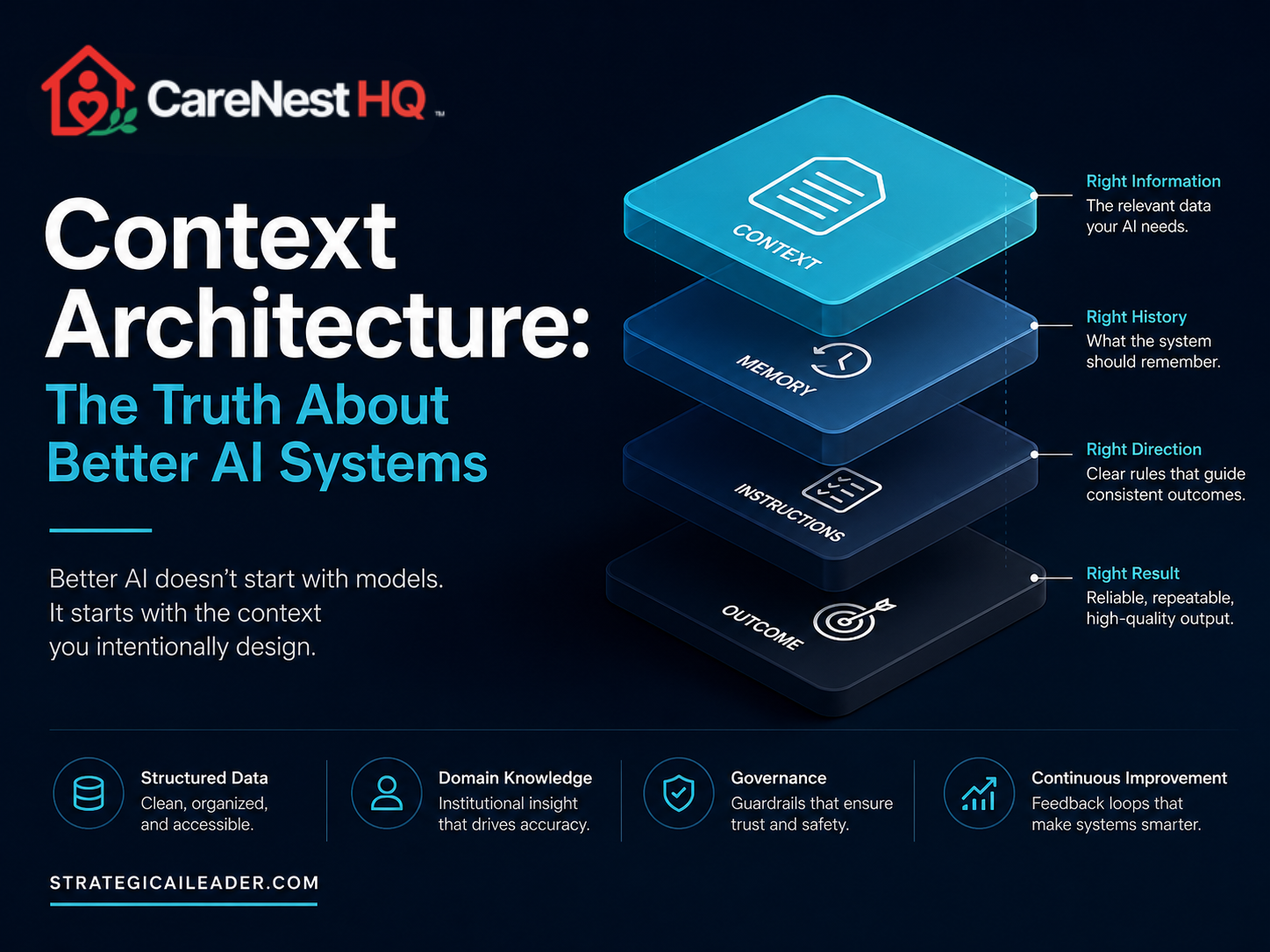
Context Architecture: The Truth About Better AI Systems
AI cannot reason about information it never received.
This single principle shaped every decision we made while building CareNestHQ™. We started somewhere unexpected: not with the model, but with context architecture – the information structure underneath it.
The Bridge From Philosophy to Architecture
In the previous article, I introduced the Caregiver Authority Framework. It answers a fundamental question: What should AI do in a family care system?
While building CareNestHQ™, another question became unavoidable. If AI should organize information instead of making decisions, what information does it actually need to be useful?
That question led us to build an information architecture instead of just adding AI features to an existing product.
What Is Care Context?
Care Context is the missing information layer between healthcare records and AI reasoning.
Medical records document clinical care. But families need something different. They need to track medical information alongside family roles, decision authority, communication history, appointments, preferences, and the day-to-day workflows that hold everything together.
This is what Care Context organizes. It sits between what doctors document and what families actually need to coordinate care together.
Why Most AI Products Miss This
When building AI products, most teams ask: What model should we use?
We asked a different question: What information does the AI need before it should answer?
This reframing aligns with context engineering principles. We stopped thinking like an AI company adding intelligence to a platform. We started thinking like a care coordination company that happened to use AI as a tool.
Prompts Were Never the Bottleneck
We started like most teams do. We had Claude. We had a good prompt. We had the idea.
The prototype worked. Then we added real family data. Multiple people. Multiple responsibilities. Conflicting preferences. Permission boundaries. The system broke. The AI gave advice that ignored medication schedules. It suggested actions that violated privacy permissions. It forgot conversations from days earlier.
We spent weeks iterating on prompt language. We got modest improvements. Then we restructured how information was organized and stored. The difference was dramatic.
Restructuring the information architecture improved the quality and consistency of responses far more than additional prompt revisions.
The Six Layers of Care Context
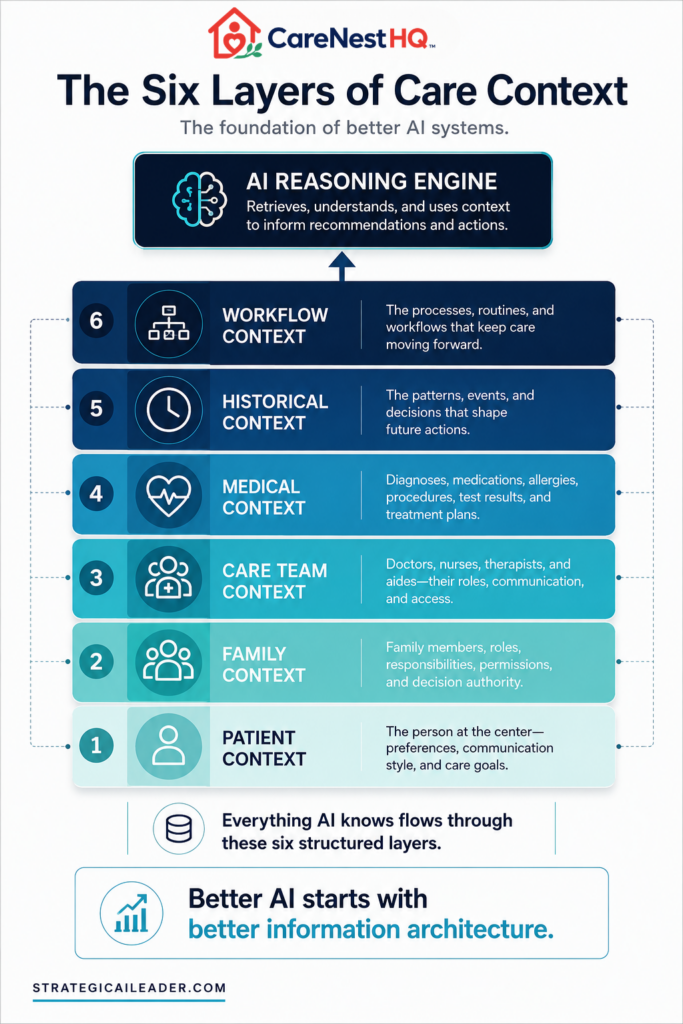
This became our architectural framework. Each layer solves a specific coordination problem.
Patient Context exists because someone sits at the center of care. Their medical reality, preferences, and communication style determine how the system should present information to family members and healthcare providers.
Family Context exists because care is rarely solo. Siblings have different roles. Financial arrangements are complex. Decision authority varies by situation. This layer codifies who makes what decisions about what.
Care Team Context exists because professional care isn’t invisible to family coordination. Doctors, nurses, therapists, and aides need access to information too. This layer manages communication protocols and information boundaries.
Medical Context exists because clinical information is essential but incomplete. According to AARP caregiving research, families often lack access to complete medical information. Diagnoses, medications, allergies, procedures, test results, and treatment plans inform decisions, yet families rarely have this information complete or current.
Historical Context exists because patterns matter. What worked before. What didn’t. What changed. Family care decisions depend on understanding how situations evolved, not just snapshots of now.
Workflow Context exists because real families don’t operate according to idealized procedures. They have actual rhythms. Actual decision-making patterns. Actual information flows. This layer captures how they actually coordinate rather than how they should.
The AI Reasoning Engine
Once these six layers are organized, the AI reasoning engine sits on top. It retrieves relevant context. It validates permissions. It understands roles and history. It surfaces options for review.
The engine consumes the architecture. It doesn’t create it. This separation is critical. The six layers exist whether or not AI is involved. Families need this structure for their own decision-making. AI simply becomes more useful when it sits on top of organized information.
How the Caregiver Authority Framework Shapes This Architecture
The principles from Article 2 directly determined how each layer is built and accessed.
| Caregiver Authority Principle | Supporting Architecture Layer |
| AI Organizes Information | Workflow Context, Historical Context |
| AI Remembers Across Time | Historical Context |
| AI Connects Information Across People | Family Context, Care Team Context |
| AI Retrieves Complete Context | All six layers organized for retrieval |
| Humans Make Decisions | Permission Model, Human Review Gate |
Care Context Debt
As we built CareNestHQ™, we discovered a useful concept for evaluating coordination systems.
| Care Context Debt: The accumulation of missing, outdated, fragmented, or inaccessible information that makes coordinating care more difficult. |
Most families operate with significant debt. Information exists but it’s scattered across conversations, appointments, paper records, memories. It’s not organized. Not current. Not accessible to everyone who needs it.
This debt manifests as coordination overhead. Someone calls the pharmacy again because the medication change wasn’t documented. A decision gets delayed because nobody knows who’s authorized to make it. Information gets rediscovered repeatedly because appointment history isn’t persistent.
Context Drift
We also noticed a related pattern.
| Context Drift: The gradual loss of shared understanding as information becomes inconsistent across family members, healthcare providers, and communication channels. |
Consider a typical family scenario. The adult son thinks Mom is on three medications. The daughter thinks it’s four. The pharmacy has five. Mom herself remembers two. This fragmentation mirrors the coordination challenges identified by the National Alliance for Caregiving. Nobody is lying. The information just drifted apart because there was no single source of truth.
This drift accumulates. By the time a critical decision needs to happen, different family members are working from different information. They make conflicting choices and blame each other instead of recognizing the structural problem.
Why Families Lose Shared Context
The typical family operates through fragmented channels. Someone notices a change and sends a text. Someone else mentions something from a doctor visit. A third person commits to calling a specialist. Nobody writes anything down.
By the next day, nobody remembers exactly what was said. Context was never structured anywhere.
A unified system does the opposite. One timeline. Persistent memory. Structured data. Shared context across the family. Permission boundaries that ensure everyone sees only what they should. Nobody loses critical information.
Traditional AI Products vs. Context-First Systems
| Traditional AI Product | Context-First Care System |
| Prompt first | Context first |
| Model-driven | Information-driven |
| Temporary conversation | Persistent history |
| Generic response | Family-specific response |
| Broad access assumptions | Permission-aware retrieval |
| AI produces the answer | Humans make the decision |
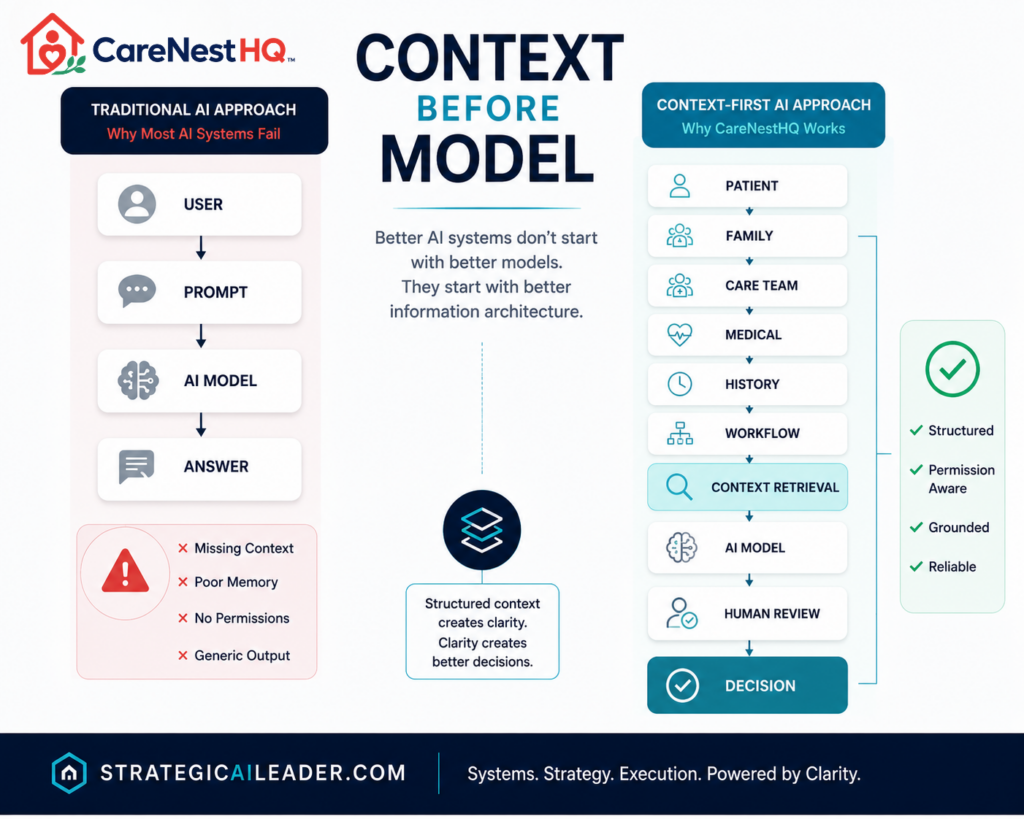
How AI Uses Care Context
When a family member asks a question, the system works through five clear stages.
Stage 1: Retrieve relevant context. What family situation is this question about? What related history exists? What information does this decision require?
Stage 2: Validate permissions. The person asking sees their authorized information only.
Stage 3: Understand roles and history. Who is making this request? What decisions are they responsible for? What happened in similar situations before?
Stage 4: Surface grounded information. Based on organized context, prepare relevant information and options. Not a generic answer. A family-specific response.
Stage 5: Present for human review. The information is presented to a human for evaluation and decision.
This workflow is where value lives. The model matters. The architecture is what makes the model useful.
The AI Stack Most Teams Never Build
Most AI startups build a simple stack. User input goes to prompt. Prompt goes to model. Model produces output.
We built something different. Reality flows into six context layers. Those layers feed context retrieval. As discussed in Anthropic’s documentation on context windows, the context available to the model determines reasoning quality. Retrieval informs the prompt. The model receives the prompt. The output becomes a recommendation. A human decides.
Every layer before the model improves reasoning quality. This is why information architecture matters more than model selection.
Why This Architecture Keeps Humans in Control
The Care Context architecture makes the Caregiver Authority Framework operationally possible.
When AI is bolted on top of poor information structure, you either give it autonomy (terrifying) or accept garbage recommendations (frustrating).
When AI sits on top of organized information, the system surfaces relevant options and humans decide. That’s not a constraint. That’s the design.
Lessons From Building This Architecture
Context beats prompts. We invested weeks refining prompt language. We invested two weeks restructuring information. The second was far more impactful.
Structure beats memory. We tried embedding everything in vector stores. It worked for recent information and failed for edge cases. Explicit structure wins.
AI amplifies organization. The best safeguard isn’t controlling the AI. It’s organizing information so humans can make better decisions.
Shared context reduces friction. We expected speed improvements to be the main win. The real win was that shared information reduces the coordination effort itself.
Architecture compounds. Each layer we added made the next layer easier. Good architecture makes each next step easier. Bad architecture creates friction everywhere.
Context Engineering Comes Home
CareNestHQ™ exists to test a core hypothesis: better AI for families starts with better information architecture, not better models.
The Context Engineering principles I write about on Strategic AI Leader became the constraints for CareNestHQ™. Building the product forced us to test every theory against real coordination challenges.
Care Context is the operating system behind every useful decision the system makes. The AI is useful because it sits on top of something solid.
Prompts influence answers. Context determines what the model has available to reason from.
Next Steps
Subscribe to Strategic AI Leader to follow the architecture decisions, product tradeoffs, and operating lessons behind CareNestHQ™.
Explore CareNestHQ™ to see how these principles are being translated into working software.
Next in the series: Building the First Version of CareNestHQ™.
Frequently Asked Questions
What is Care Context?
Care Context is the structured information families use to coordinate care. It includes family roles, permissions, medical information, history, and workflows. It provides the information AI needs to support family coordination while keeping people in control.
Why isn’t a medical record enough?
Medical records document clinical care. Families also need to coordinate appointments, responsibilities, communication, preferences, and decision authority. Care Context combines these pieces into a shared information model that supports day-to-day coordination.
What are the Six Layers of Care Context?
The six layers are Patient Context, Family Context, Care Team Context, Medical Context, Historical Context, and Workflow Context. Together they create the information foundation that supports AI-assisted care coordination.
How is Care Context different from prompt engineering?
Prompt engineering focuses on how you ask an AI model a question. Care Context focuses on ensuring the AI has the right information before it answers. Without complete context, even well-written prompts produce incomplete results.
What is Care Context Debt?
Care Context Debt is the accumulation of missing, outdated, fragmented, or inaccessible information that makes coordinating care more difficult. Reducing this debt helps families stay aligned and reduces unnecessary coordination work.
What is Context Drift?
Context Drift is the gradual loss of shared understanding as information becomes inconsistent across family members, healthcare providers, and communication channels. A shared Care Context helps prevent this problem.
Does CareNestHQ™ make care decisions?
No. CareNestHQ™ is designed to organize information, preserve history, surface relevant context, and support coordination. Care decisions remain the responsibility of families and healthcare professionals.
Why is information architecture important for AI?
AI models reason from the information they receive. A well-designed information architecture gives the model complete, organized, and permission-aware context, leading to more useful and relevant responses.
How does this relate to Context Engineering?
CareNestHQ™ applies Context Engineering principles to family care coordination. Rather than focusing on prompts alone, the platform is designed around the information architecture AI needs to support families effectively.
Why does this architecture keep humans in control?
The architecture separates information organization from decision-making. AI retrieves and organizes relevant context, while people evaluate that information and make the final decisions.
Subscribe to the Build Series
Follow the CareNestHQ build series to see how philosophy becomes architecture.
Follow the Build
CareNestHQ™ is in active development. The next article in this series covers the architecture decisions: what I built, what I deferred, and what the workflow analysis forced me to leave out of version one.
Check out our CareNestHQ™ FREE account. I would love to capture your product feedback?
Subscribe to StrategicAILeader to follow the build as it happens.
Help Support My Writing
Subscribe for weekly articles on leadership, growth, SEO, and AI-driven strategy. You’ll receive practical frameworks and clear takeaways that you can apply immediately. Connect with me on LinkedIn or Substack for conversations, resources, and real-world examples that help.
About the Author
I’m Richard Naimy, an operator and product leader with over 20 years of experience growing platforms like Realtor.com and MyEListing.com. I work with founders and operating teams to solve complex problems at the intersection of product, marketing, AI, systems, and scale. I write to share real-world lessons from inside fast-moving organizations, offering practical strategies that help ambitious leaders build smarter and lead with confidence.
I write about:
- AI + MarTech Automation
- AI Product Development
- AI Strategy
- AI Workflow Automation
- Context Engineering
- COO Ops & Systems
- Growth Strategy (B2B & B2C)
- Infographic
- Leadership & Team Building
- Marketplace Growth Strategy
- My Case Studies
- Personal Journey
- Revenue Operations (RevOps)
- Sales Strategy
- SEO & Digital Marketing
- Strategic Thinking
Want 1:1 strategic support?
Connect with me on LinkedIn
Read my playbooks on Substack