
AI to Help Caregivers: Building Technology That Supports Families
The Problem We Started With
Nobody prepares you for becoming the family coordinator.
As parents age, ordinary family communication starts carrying more weight. Appointment details live in one text thread. Medication lists live somewhere else. One sibling remembers the follow-up task. Another has the doctor’s contact information. A care update arrives in a photo. A question about side effects gets buried in group texts.
According to AARP research, approximately 63 million Americans provide unpaid family caregiving, nearly one in four adults. The coordination burden is real, distributed across siblings in different time zones, and falls heaviest on whoever becomes the de facto family coordinator. That person carries details in their head. That person manages the calendar. That person becomes the communication hub for a complex tangle of medical, family, and logistical details without any training or system designed for the job.
Caregiving is human work. Coordination is system work.
That distinction became the starting point for CareNestHQ.
I’m 53 and entering the stage of life where many adults begin helping aging parents navigate increasing care responsibilities. I have also watched more conversations among friends shift toward helping aging parents navigate appointments, medications, and daily responsibilities.
I noticed a recurring pattern in many products offering AI for family caregivers. They often start by asking how much decision-making AI should take on.
The AI industry keeps asking: “What decisions can AI make?”
We started with a different question: “What work can AI remove without taking decisions away from families?”
That question is shaping everything we choose to build, and everything we choose not to build.
I shared the personal story behind why I built CareNestHQ in the first article in this series.
The Caregiver Authority Framework
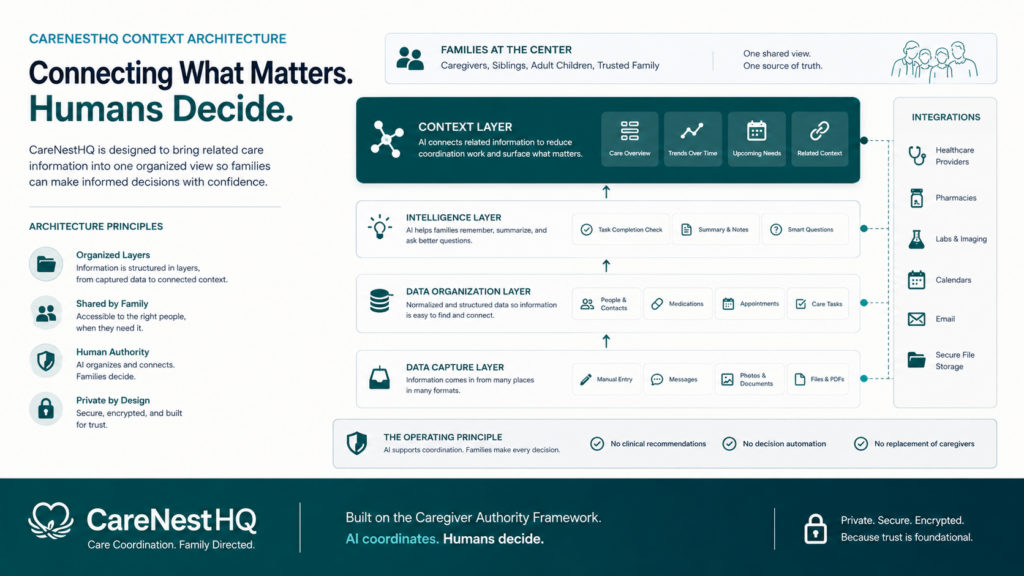
CareNestHQ is being designed around a single operating principle: humans decide.
This framework guides what we are building and what we will refuse to build.
1. AI Organizes
CareNestHQ is intended to help families organize information. Medication schedules. Doctor appointments. Care tasks. Family responsibilities. The goal is to reduce the friction of keeping track, so caregivers spend less energy remembering and more energy on actual care.
We are designing this to be searchable, accessible, and shareable within families. The caregiver sees what needs attention, but the information is available to everyone who should know it.
2. AI Remembers
We are designing CareNestHQ to help families preserve details that would otherwise be lost. A health observation. A medication note. A family update about how someone is doing. A follow-up task mentioned in passing.
One planned use case is helping families record whether a scheduled task was completed, so information does not disappear after one person completes it.
The AI does the memory work. The caregiver maintains control of what matters.
3. AI Connects Context
CareNestHQ is being designed to help families see relationships between pieces of information. A future context layer could help families bring related information into one view, such as medication lists alongside specialist visit notes, without offering clinical recommendations.
The AI connects what might be relevant. The caregiver decides what is important.
4. AI Asks Useful Questions
Instead of offering unsolicited advice, we are designing CareNestHQ to ask for information only humans can provide. Did a scheduled task get completed? Has there been a change since last time? Is this still a priority?
These questions are intended to help caregivers stay on top of what they have committed to managing.
5. Humans Decide
Every decision about care belongs to the family. Medical decisions. Treatment changes. When to escalate to a professional. How to communicate across relatives.
AI can surface information. AI can ask clarifying questions. AI cannot and should not make these decisions. This is the principle that guides what we are building.
What We Chose Not to Build
Before building features, I wrote down the boundaries.
CareNestHQ would not diagnose conditions. Families have doctors for diagnosis.
CareNestHQ would not recommend medication changes. That belongs to prescribers and families, informed by professional guidance.
CareNestHQ would not predict whether someone will decline. That kind of predictive medical claim requires evidence we do not have and belongs in conversation with healthcare providers.
CareNestHQ would not make family decisions. Caregiving is defined by judgment that only comes from knowing someone deeply. An AI that does not know this person should not override that judgment.
CareNestHQ would not automate conversations between caregivers, relatives, and professionals. Families need fewer conversations to manage, not automated ones. Important conversations should happen between humans who know and trust each other.
CareNestHQ would not become the authority in the room. No framing that positions the system as the expert. The caregiver is the expert. The caregiver knows the person.
Those boundaries are not limitations. They define the product.
We intentionally chose a narrow initial scope because doing more would have crossed a line we were not willing to cross.
Product discipline is not about what you build. It is about what you refuse to build.
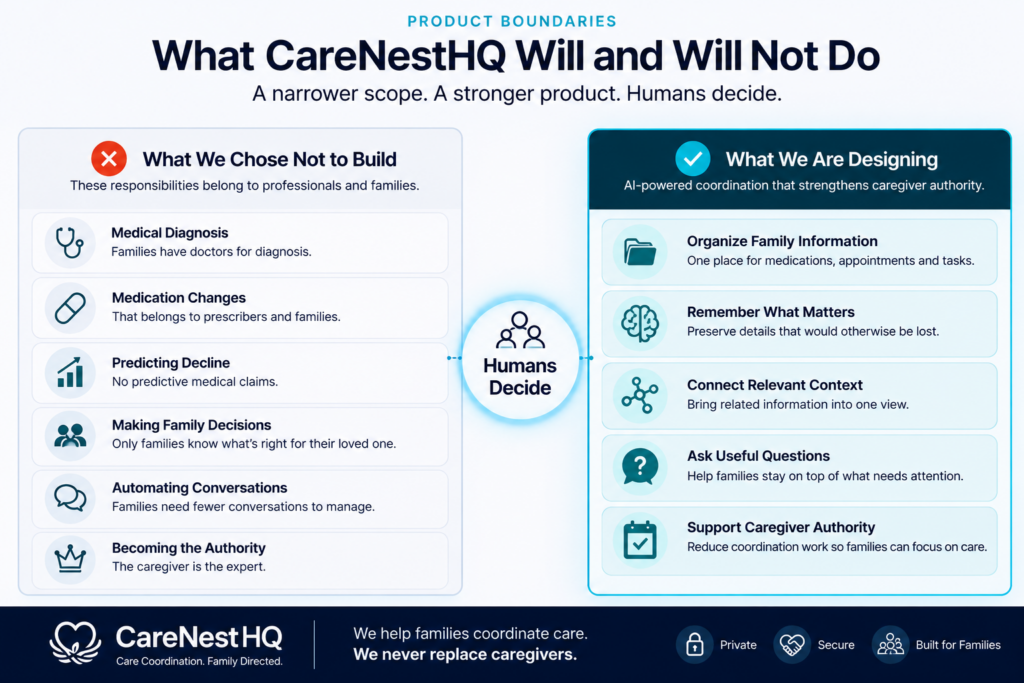
What CareNestHQ Is Intended to Do, and Not Do
| Intended to Help With | Not Intended to Provide |
|---|---|
| Organize family information | Medical diagnosis |
| Record care tasks and completion | Clinical decision-making |
| Surface relevant context | Drug interaction analysis |
| Remember details across time | Symptom interpretation |
| Reduce coordination work | Professional medical judgment |
| Prepare families for conversations | Automated care decisions |
| Support caregiver authority | Emotional presence and relationships |
Our Foundation
We help families coordinate care.
We never replace caregivers.
This is not a tagline. This is the operating principle we are designing toward. Every feature decision is measured against it.
The AI-powered family care coordination platform described in this article is still being built, so these principles represent the standard we are designing toward, not claims about completed capabilities or customer outcomes.
The Standard We Hold Ourselves To
If CareNestHQ ever starts making decisions instead of supporting the people who love someone most, we have built the wrong product.
That is the standard we will hold ourselves to.
In the next article, I will explain how this product philosophy is shaping the context architecture we are building.
Frequently Asked Questions
What is AI to help caregivers?
AI to help caregivers is technology designed to reduce the work of organizing information, tracking tasks, preserving context, and coordinating family communication. The goal is to help families spend less time managing information and more time caring for the people they love.
Can AI replace family caregivers?
No. CareNestHQ is being designed around the principle that humans make every care decision. AI organizes information, remembers important details, connects related context, and asks useful questions. Decisions about care always belong to the family.
How will CareNestHQ use AI?
CareNestHQ is being designed to help families organize care information, preserve important updates over time, connect related information into meaningful context, and reduce the coordination burden that often falls on one primary caregiver.
Will CareNestHQ provide medical advice or diagnoses?
No. CareNestHQ is not being designed to diagnose medical conditions, recommend treatments, suggest medication changes, or replace healthcare professionals. Medical decisions should always be made by families in consultation with qualified healthcare providers.
Why doesn’t CareNestHQ automate care decisions?
Caregiving requires personal judgment, family values, and knowledge of the individual receiving care. Those decisions belong to people, not software. CareNestHQ is being designed to support caregivers by reducing administrative work while preserving caregiver authority.
What is the Caregiver Authority Framework?
The Caregiver Authority Framework is the product philosophy guiding the design of CareNestHQ. It establishes that AI should organize information and reduce coordination work while leaving every care decision to the people who know their loved one best.
Why is CareNestHQ limiting what AI will do?
CareNestHQ is intentionally being designed with clear product boundaries. Rather than trying to replace caregivers or healthcare professionals, the platform focuses on helping families stay organized, informed, and connected while keeping humans in control of every important decision.
Related Reading
These articles go deeper on the frameworks referenced here:
- What Is a Context Engineer? The Truth About AI Success
- The Truth About Building a Manager Operating System with AI
- Building AI Tools with LLMs: A Practical Guide Leaders Need
- AI Task Analysis: How Top Performers Cut Workflow Time 40%
- Cognitive Compression in the AI Era
Subscribe to the Build Series
Follow the CareNestHQ build series to see how philosophy becomes architecture.
Follow the Build
CareNestHQ™ is in active development. The next article in this series covers the architecture decisions: what I built, what I deferred, and what the workflow analysis forced me to leave out of version one.
Check out our CareNestHQ™ FREE account. I would love to capture your product feedback?
Subscribe to StrategicAILeader to follow the build as it happens.
Help Support My Writing
Subscribe for weekly articles on leadership, growth, SEO, and AI-driven strategy. You’ll receive practical frameworks and clear takeaways that you can apply immediately. Connect with me on LinkedIn or Substack for conversations, resources, and real-world examples that help.
About the Author
I’m Richard Naimy, an operator and product leader with over 20 years of experience growing platforms like Realtor.com and MyEListing.com. I work with founders and operating teams to solve complex problems at the intersection of product, marketing, AI, systems, and scale. I write to share real-world lessons from inside fast-moving organizations, offering practical strategies that help ambitious leaders build smarter and lead with confidence.
I write about:
- AI + MarTech Automation
- AI Product Development
- AI Strategy
- Context Engineering
- COO Ops & Systems
- Growth Strategy (B2B & B2C)
- Infographic
- Leadership & Team Building
- Marketplace Growth Strategy
- My Case Studies
- Personal Journey
- Revenue Operations (RevOps)
- Sales Strategy
- SEO & Digital Marketing
- Strategic Thinking
Want 1:1 strategic support?
Connect with me on LinkedIn
Read my playbooks on Substack