The Story Behind CareNestHQ™ and Why I Built It
The Mistake That Started CareNestHQ™
I accidentally gave my father the wrong medication.
Not because I was careless. Because I was working from outdated information. My brother had sent an update about a dosage change two days earlier. It landed in a group text with 47 other messages. I missed it. Nobody caught it in time.
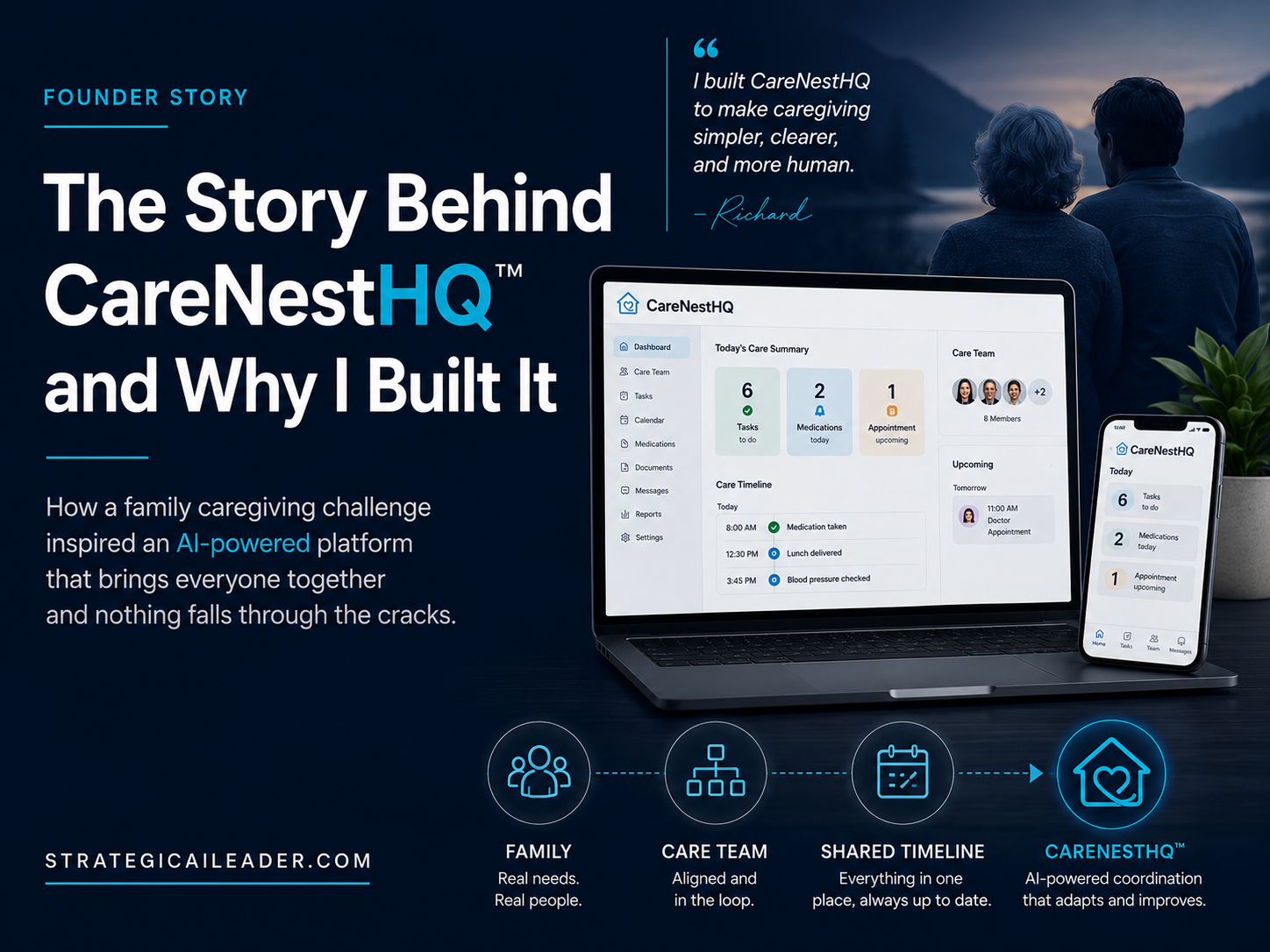
That experience ultimately became CareNestHQ™, an AI-assisted family care coordination platform built to give families one shared source of truth. But the product did not start with a feature list or a market map. It started with a question: why does this keep happening to organized, capable people?
CareNestHQ™ is now live. This article is not a product tour. It is the story behind the research, workflow analysis, and product decisions that shaped the first release.
The problem was not a communication failure. My brother communicated. The problem was the system. Information was moving through channels with no structure, no confirmation, and no shared record. A family that cared deeply about doing this right was running their most important coordination workflow through a group text thread.
| Family care coordination is the process of keeping multiple family members aligned on a shared care recipient’s needs: medications, appointments, updates, decisions, and documents, across tools and communication channels that were never designed to work together. Most families do this in fragments. The result is not a communication failure. It is a workflow failure. |
According to Caregiving in the U.S. 2025 from AARP and the National Alliance for Caregiving, 63 million Americans, nearly 1 in 4 adults, are providing care for an aging or ill family member, a 45% increase since 2015. The average family caregiver spends 27 hours per week on care.
None of those hours include the coordination overhead. The texts. The re-explanations. The same update sent three times because the first one was missed. That part is invisible to the research.
Why I Stopped Writing About AI and Built an Actual Product
Most of what I publish on StrategicAILeader is frameworks. Context engineering. Operator workflows. AI product strategy. I have built those frameworks by thinking carefully and testing ideas in low-stakes environments.
CareNestHQ™ is different. I wanted to run one of my own frameworks through a real build, with real users, real scope constraints, and real consequences if the product judgment was wrong. I wanted every idea I teach to survive contact with reality before I kept teaching it.
The caregiving coordination problem was the right test. It is a workflow problem, not a clinical problem. It does not require medical licensing or EHR integration to solve at the level I wanted to solve it. And it is personal enough that I could not fake my way through the product thinking.
What Already Exists and Why I Still Built Something
Before I wrote a line of code or sketched a single screen, I spent three weeks evaluating the leading caregiving platforms available to families. I signed up for accounts on nearly every major platform I could find. I built a comparison spreadsheet with seventeen dimensions: onboarding time, share model, update types, document handling, role structure, mobile experience. I tested onboarding flows. I tracked where each product created friction and where it delivered value. I intentionally looked for reasons not to build another product.
I want to be direct: good products exist in this space.
Caring Village offers a shared care plan with task management, a group calendar, and document storage. Lotsa Helping Hands organizes community care through a shared calendar and announcement system. CaringBridge focuses on patient journals and family updates. Honor and Papa address in-home care delivery. Hospital patient portals are steadily improving family access features.
I used several of these myself with my family. I talked to other families who used them. What I found was not that these products were bad. It was that they made different product architecture decisions than I wanted to make.
What I observed:
| Category | What It Prioritizes (and What Falls Outside Its Scope) |
| Caring Village / family care apps | Built around care plan tasks and scheduled reminders. Strong for predictable care routines. Lighter on dynamic updates and real-time decision support. |
| CaringBridge | Built for journaling and community connection. Excellent for keeping extended networks informed. Not designed as an operational coordination layer. |
| Hospital patient portals | Provides clinical data access, typically to one primary contact. Improving in family sharing features. Not built for distributed care team workflows. |
| Group messaging apps | High volume, low structure. Critical updates compete with general conversation. No confirmation, search, or role-based access. |
| Calendar tools | Tracks appointments. No connection to medication changes, care updates, or decision history. |
| Medication tracker apps | Solves medication visibility in isolation. Does not integrate with the broader care picture. |
The pattern was consistent: each tool addressed one layer of the caregiving workflow. The coordination layer, the connective tissue that links all the information a care team needs into one trusted, shared source, was consistently left to group texts and the most organized family member.
That is not a design failure. It reflects a product philosophy: most caregiving tools are built for the primary caregiver or the care recipient. I wanted to build for the care team, the distributed group of family members trying to function as a unit under stress.
That distinction drove every decision that followed.
What First-Principles Thinking Revealed
After the competitive analysis, I stopped looking at existing products entirely. I started with a single constraint: define the problem from what families actually need to do, not from what software already offers.
The questions I kept returning to:
- What information does a caregiver need to make a reliable decision at 11pm when no one is reachable?
- What does a sibling need to step in for a week without requiring a 20-minute briefing call?
- What breaks first when a care situation escalates unexpectedly?
- Where does critical information live today, and who cannot access it?
- What is the minimum shared context a care team needs to function without its most organized member?
The answers pointed to the same missing piece every time. Not a missing feature. A missing layer: a shared, persistent care context that all members of a care team could access, update, and trust.
I had been writing about context engineering on this site, the discipline of structuring the information an AI system needs to produce reliable outputs. Building CareNestHQ™ made me apply it differently. A care team is a system. The context engineering principle, that the quality of decisions depends on the quality and structure of the context feeding them, applied directly to family caregiving. If the context is fragmented, decisions will be fragmented.
I called this the Care Context: the complete set of information a family caregiver needs to make reliable decisions, covering medications, appointments, updates, documents, and care team roles. An operator workflow applied to a caregiving scenario.
Once I named it that way, product scope simplified. CareNestHQ™ was not a messaging app with medical features. It was a shared Care Context platform for distributed family care teams. That framing eliminated about half the features I had originally considered.
What I Got Wrong: Three Assumptions That Did Not Survive
Most build logs document what worked. The reversals are more instructive.
Wrong assumption 1: Medication management is the product.
My original framing centered on medication management. That is where the most dangerous failure points live, and I thought solving medication visibility would anchor everything else.
Medication management is one of the most regulated areas in health technology. Building it properly would have required a compliance layer that would have consumed the entire first version. But talking to families revealed something more useful: medication errors were a symptom of the coordination problem, not the problem itself. When families had shared context and clear role assignment, medication errors dropped on their own. The coordination layer was the fix. Medication management was downstream of it.
I removed dedicated medication management from version one.
Wrong assumption 2: More features equal more value.
AI made this assumption more dangerous than usual. Because building AI tools with LLMs had dropped the build cost significantly, I could implement in days what would have taken weeks. I built seven features in the first month. I shipped two. The other five added surface area without deepening the coordination layer. Scope discipline is harder when the build cost has dropped.
Wrong assumption 3: Families want to configure software during a caregiving crisis.
I designed the first onboarding with multiple configuration steps before first use. Testing with actual caregivers made the problem obvious: people under caregiving stress have zero patience for setup flows. They need value in the first session or they leave.
I rebuilt the onboarding to produce a working care dashboard in under four minutes, with no full account setup required. That rebuild delayed launch by three weeks. It was the right call.
Fragmented vs. Coordinated: What the Workflow Actually Looks Like
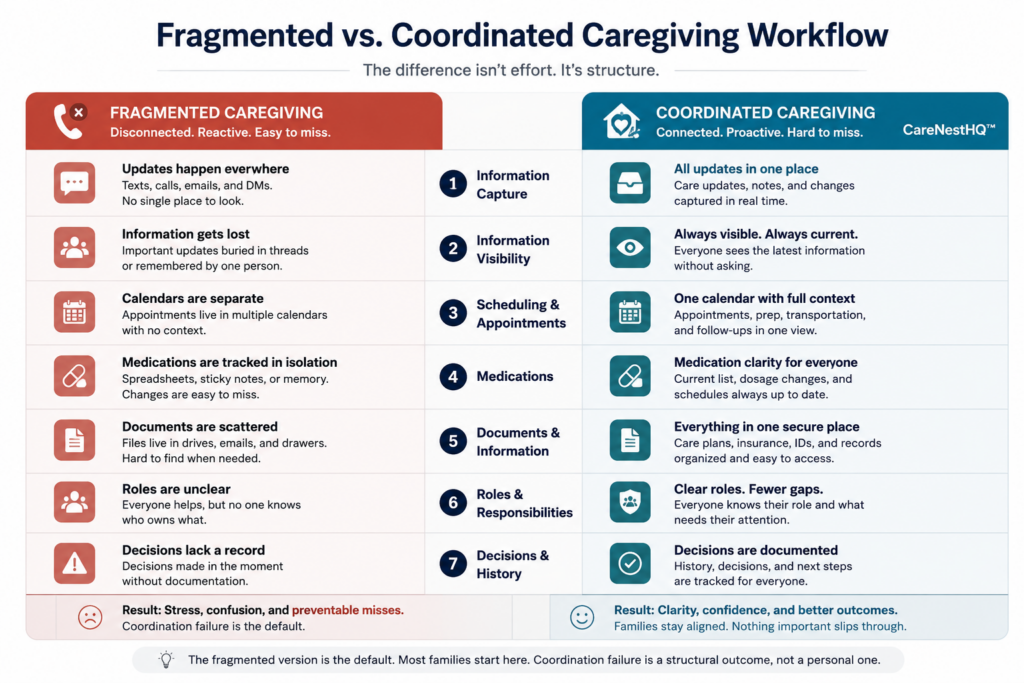
The coordinated version is not complicated. It is workflow structure applied to a high-stakes personal context. A shared source of truth. Roles defined. A change log. Confirmation that updates were seen.
These are not new ideas. Every functional operations team uses them. They simply haven’t been applied to family caregiving with the right level of simplicity.
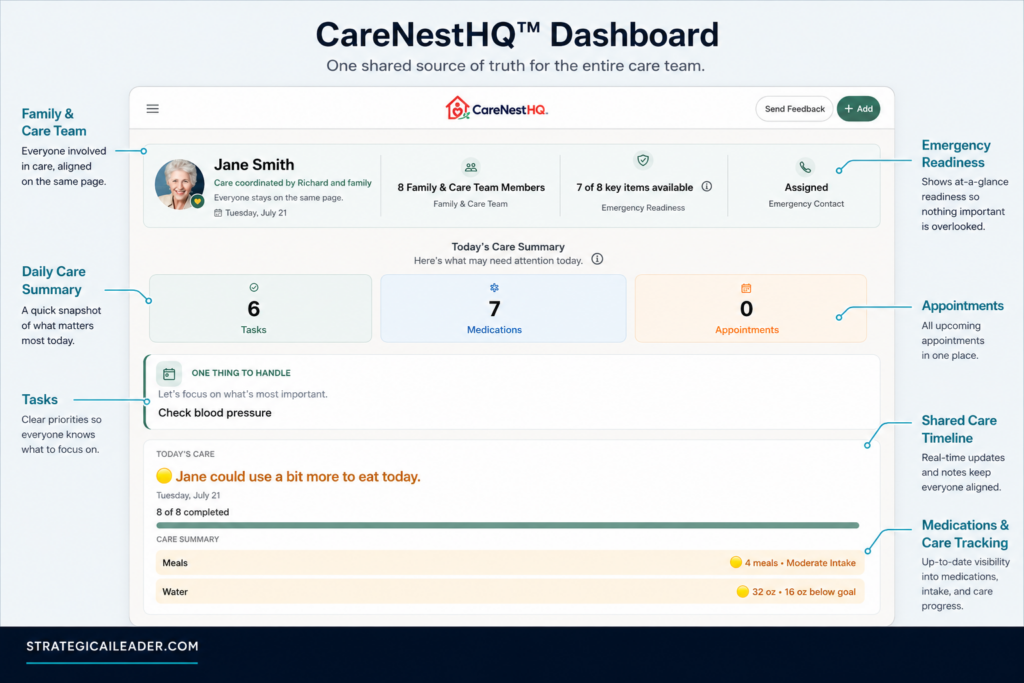
The Caregiver Workflow: Why This Is an Operator Problem
I use the term operator workflow throughout this site to describe a repeatable set of tasks, decisions, and coordination patterns that a person or team runs to produce a reliable outcome.
A caregiver workflow is that applied to care. It includes:
- Medication management: who gives what, when, at what dose, and who tracks changes
- Appointment coordination: who takes the care recipient, who attends, who follows up with the provider
- Care updates: what changed, when it changed, who needs to know, and confirmation they saw it
- Document access: discharge summaries, insurance cards, care instructions, emergency contacts
- Decision authority: who decides what, and what the care recipient’s stated wishes are
Most families run this workflow with zero infrastructure. They improvise. They rely on the most organized family member as a single point of failure. When that person burns out, travels, or gets sick, the workflow collapses.
I have written about building a personal operating system with AI, the principle that workflows need structure before they can be improved or automated. Family caregiving is one of the highest-stakes workflows most people will ever run. It is also the one least likely to have any designed structure.
That mismatch is the product opportunity.
How AI Accelerated the Build and What It Could Not Do
I think about AI-assisted work in three layers. The first is Task Execution: AI handles discrete, well-defined tasks. The second is Agent Delegation: AI manages multi-step workflows with minimal intervention. The third is System Improvement: AI identifies patterns and optimizes the systems themselves. I call this the Three Layers of AI Work. Building CareNestHQ™ made this framework concrete in ways that surprised me.
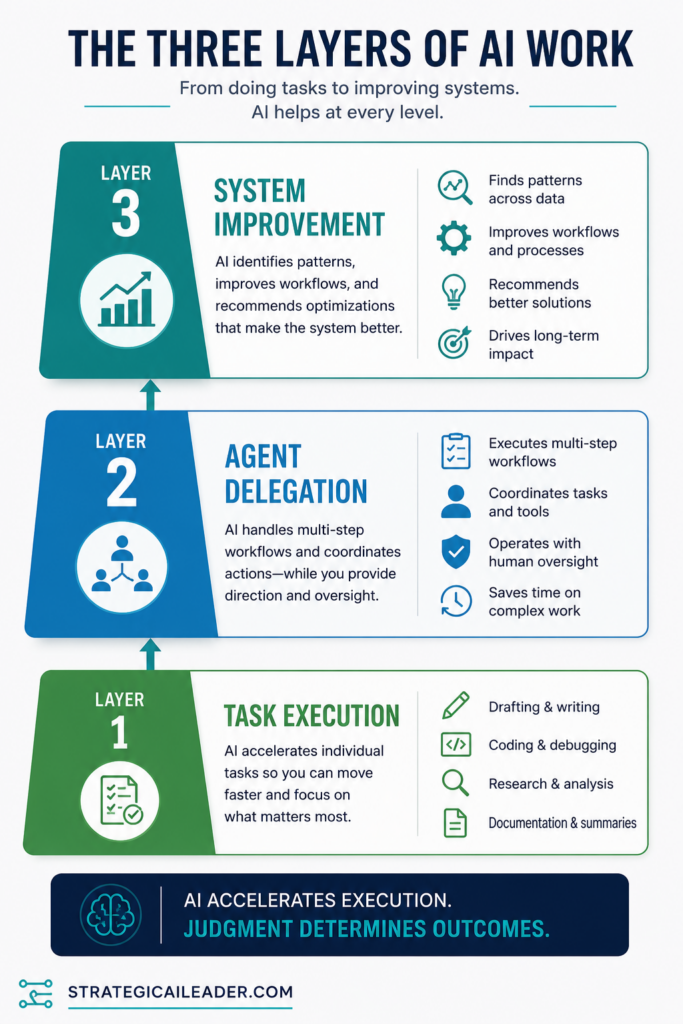
Where AI accelerated execution:
- Scaffolding code, generating component structures, writing boilerplate: weeks compressed into days
- Drafting data models, schemas, and API structure from natural language descriptions
- Surfacing edge cases I had not considered during requirements thinking
- Synthesizing caregiving workflow research quickly across dozens of sources
Where AI could not substitute for judgment:
- Deciding which problem to solve. Every AI suggestion defaulted toward feature addition. Restraint required reasoning from real experience.
- Determining scope. The model had no way to know what a caregiver under stress would tolerate in an onboarding flow.
- Validating workflow design against real behavior. That required talking to actual families.
- Making tradeoffs. Build vs. buy. Simple vs. complete. Compliance-adjacent vs. not. All judgment calls.
I have a practice of structuring my AI sessions around what I call the Context Stack: five layers of context that tell an AI model not just what to do, but what project it is working in, what the organizational constraints are, what prior decisions have been made, and what the current environment requires. When I used the Context Stack to structure sessions, output quality improved significantly. When I prompted ad hoc, I got generic suggestions that needed substantial rework. The discipline of analyzing which tasks to delegate to AI before each session saved more time than the AI itself.
Directional estimate: AI compressed the distance from problem definition to working prototype by roughly 60% compared to a solo build two years ago. The parts that required judgment took exactly as long as they always have.
What Building CareNestHQ™ Taught Me About AI Product Development
Lesson 1: Name the problem before you name the product.
“CareNestHQ™” came after the problem frame was locked. Products built the other way around tend to solve what sounds good rather than what users actually need.
Lesson 2: Workflow analysis beats user story generation.
I mapped every step, handoff, and failure point before writing a single user story. The user stories emerged from the workflow map. That sequence matters: it forces you to understand what people do before deciding what software should do.
Lesson 3: Competitive research should shape product philosophy, not feature lists.
Evaluating existing caregiving tools did not give me a feature list. It gave me a product philosophy: build for the care team, not the primary caregiver. That one shift shaped every subsequent decision.
Lesson 4: AI context quality determines AI output quality.
Sessions using the Context Stack consistently outperformed ad hoc sessions. Not surprising in theory. Impossible to ignore after forty-plus sessions in practice.
Lesson 5: Scope restraint is a product decision, not a resource constraint.
The AI era lowers build cost. That makes scope discipline harder, not easier. Everything becomes buildable. The question is what should be built. Cognitive compression in the AI era closes the gap between idea and implementation. It does not close the gap between idea and right idea. That gap is still the founder’s job.
How the Build Progressed: A Timeline

For readers interested in the actual progression from problem to product:
| Week 1 | Mapped the caregiver workflow from first principles. Identified the Care Context gap. |
| Week 2 | Evaluated leading caregiving platforms. Signed up for accounts, built a comparison spreadsheet, and documented where each product’s scope ended. |
| Week 3 | Built first prototype focused on shared care updates and document access. Removed medication management from scope. |
| Month 2 | Tested with caregiving families. Discovered onboarding friction. Rebuilt to produce a working dashboard in under four minutes. |
| Month 3 | Cut five additional features. Stabilized core coordination layer. Began alpha testing with families managing real caregiving situations. |
If You Are Building in a Workflow-Heavy Space: A Quick Diagnostic
Before writing a line of code:
- What is the workflow? Not the feature list. The actual sequence of steps someone takes to produce a reliable outcome.
- Where does it break? “Communication problems” is not a failure point. “Update sent to the wrong channel at 11 pm and missed by the one person who needed it” is.
- What is minimum viable context? The smallest amount of structured information that makes the workflow functional.
- Who is the single point of failure? Every fragmented workflow has one. That person is your first evidence of product-market fit.
- What does AI handle, and what requires judgment? The judgment-required list does not shrink because AI exists.
Build the coordination layer first. Everything else can follow once the core problem is proven.
Where CareNestHQ™ Is Today
Today CareNestHQ™ is live and helping families coordinate care. Version one focuses on the coordination layer before expanding into additional caregiving workflows. The core platform gives care teams a shared source of truth: updates, documents, care roles, and a timeline that all family members can access and trust.
Future articles in this series will document what we are learning from real users and how those lessons shape future releases.
What Comes Next
Version one solved the coordination layer. The roadmap builds from there, one workflow at a time:
- Community Meals: coordinating meal delivery and support from extended family and friends
- Transportation: scheduling and tracking care-related travel across the care team
- Medication: shared visibility into medications, dosages, and change history
- Appointments: care calendar with shared access, role assignment, and follow-up tracking
- Documents: emergency-accessible shared library for discharge summaries, insurance, and care instructions
- AI assistant: a context-aware assistant that surfaces the right information at the right moment
Each addition deepens the coordination layer rather than replacing it. The platform gets more useful as the care situation gets more complex.
What I Know After Building It
I expected AI to change how I built. I did not expect it to clarify how much of building was never about building in the first place.
I gave my father the wrong medication because the information infrastructure was not there. Not because anyone failed. Because the workflow had no structure. My family had calendars, phones, messaging apps, and document storage. They had every tool that supposedly solves communication. None of it held the coordination layer together because none of it was designed for that job.
CareNestHQ™ is my attempt to build that layer.
I do not expect every product decision to be correct. I expect to document them honestly. I expect to change my mind when users prove me wrong. I expect to explain why. That is what building in public means: not sharing wins, but sharing the thinking behind every decision, including the ones that turn out to be wrong.
“AI amplifies the judgment you bring. If you bring clear thinking, AI accelerates good execution. If you bring a vague problem and a feature list, AI accelerates the wrong thing, efficiently.”
– Richard Naimy
CareNestHQ™ exists because my family deserved better than group texts and scattered information. Millions of other families deserve better, too. We are building it one workflow at a time.
Frequently Asked Questions
What is family care coordination?
Family care coordination is the process of keeping multiple family members aligned on a shared care recipient’s needs, covering medications, appointments, updates, decisions, and documents. Most families coordinate care informally through group texts and personal calendars, which creates information gaps and handoff failures. A structured coordination layer gives the whole care team access to the same information at the same time.
What causes communication problems in family caregiving?
The core issue is not communication, it is workflow structure. Families communicate constantly during a caregiving situation. The problem is that information flows into unstructured channels with no confirmation, no shared record, and no single source of truth. Updates get missed. Decisions get made on outdated information. The solution is not better messaging. It is a shared coordination layer designed for distributed care teams.
How do families coordinate care for aging parents?
Most families rely on one primary caregiver, group texts, shared calendars, and scattered documents. This works when the care situation is predictable and stable. It breaks under stress, when care complexity increases, or when the primary coordinator is unavailable. Platforms designed for care team coordination give families a more reliable structure for managing care across multiple people.
Related Reading
These articles go deeper on the frameworks referenced here:
- What Is a Context Engineer? The Truth About AI Success
- The Truth About Building a Manager Operating System with AI
- Building AI Tools with LLMs: A Practical Guide Leaders Need
- AI Task Analysis: How Top Performers Cut Workflow Time 40%
- Cognitive Compression in the AI Era
Follow the Build
CareNestHQ™ is in active development. The next article in this series covers the architecture decisions: what I built, what I deferred, and what the workflow analysis forced me to leave out of version one.
Check out our CareNestHQ™ FREE account. I would love to capture your product feedback?
Subscribe to StrategicAILeader to follow the build as it happens.
Help Support My Writing
Subscribe for weekly articles on leadership, growth, SEO, and AI-driven strategy. You’ll receive practical frameworks and clear takeaways that you can apply immediately. Connect with me on LinkedIn or Substack for conversations, resources, and real-world examples that help.
About the Author
I’m Richard Naimy, an operator and product leader with over 20 years of experience growing platforms like Realtor.com and MyEListing.com. I work with founders and operating teams to solve complex problems at the intersection of product, marketing, AI, systems, and scale. I write to share real-world lessons from inside fast-moving organizations, offering practical strategies that help ambitious leaders build smarter and lead with confidence.
I write about:
- AI + MarTech Automation
- AI Product Development
- AI Strategy
- AI Workflow Automation
- Context Engineering
- COO Ops & Systems
- Growth Strategy (B2B & B2C)
- Infographic
- Leadership & Team Building
- Marketplace Growth Strategy
- My Case Studies
- Personal Journey
- Revenue Operations (RevOps)
- Sales Strategy
- SEO & Digital Marketing
- Strategic Thinking
- Uncategorized
Want 1:1 strategic support?
Connect with me on LinkedIn
Read my playbooks on Substack