What Is Executive Sponsorship? The Name That Stands Behind the Work
Kickoff slides love a sponsor line. The bet still has no one who can fund it, and the first Legal hold lands back on the team that cannot move it.
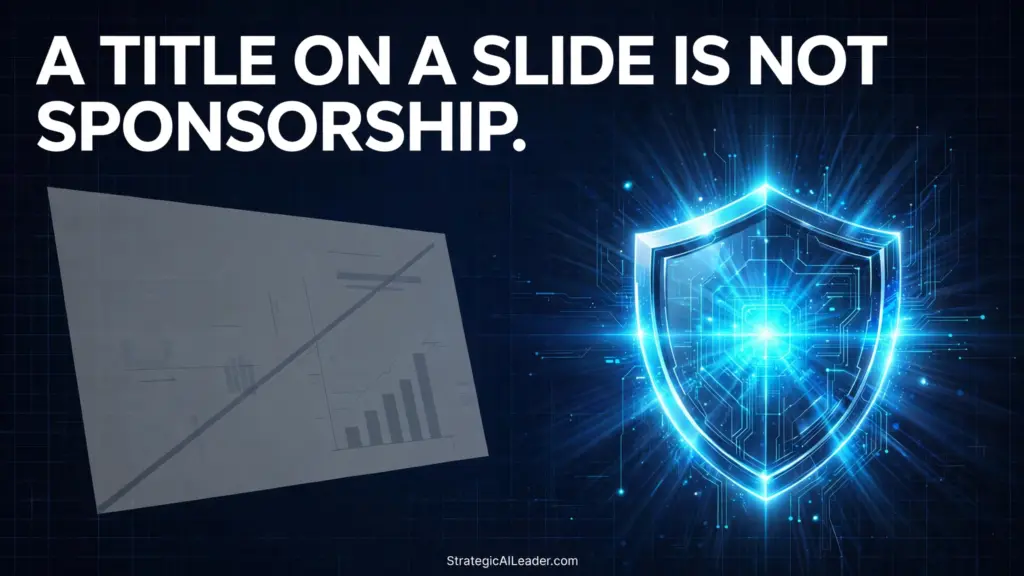
A title on a slide is not executive sponsorship. Sponsorship exists when one named person has enough authority to stand behind one funded bet, remove blockers the operating team cannot remove, and leave observable evidence that the sponsor remained accountable for the result.
This is for operators, marketers, founders, and builders. The company size doesn’t change the test. If you’re the one expected to deliver the bet, you need to know whether anyone with real authority stands behind it.
What Is Executive Sponsorship?
Executive sponsorship is the named authority that funds one bet, removes blockers the team cannot, and stays accountable for the result, with observable stand-behind evidence.
Sponsorship attaches to one funded bet, not to the operating system. A billing cutover, a vendor contract, or a stop on an old spreadsheet can be the bet. The sponsor holds decision rights the operating team does not have: commit funding, defend a priority, resolve cross-functional conflict, clear an executive-level blocker, accept an exception, defend a stop, or hold another function accountable. The operating leader still runs the work.
If the team cannot show the named sponsor, the one funded bet, the unblock path, and stand-behind evidence in the work record, the team does not have executive sponsorship.
What Leaders Get Wrong About Executive Sponsorship
Next week the hold still sits with the people who cannot move it.
Operational leadership, change leadership, an operator workflow, and a steering committee get stacked as if they were the same job. None of those jobs is air cover and decision rights for one funded bet.
A COO can run a tight system and still leave a bet unsponsored. Ops hears “the CFO is the sponsor.” Leaders still have to fund one bet, publish the unblock path, and leave evidence the sponsor will defend.
What This Looked Like at Realtor.com
At Realtor.com, we were building Neighborhood and City Hubs designed to help people understand an area before deciding where to live.
The opportunity was clear. We had housing data, demographic information, local market data, and emerging AI capabilities that could turn those inputs into useful descriptions of a neighborhood or city.
Then Legal raised the question that changed the conversation. Real estate operates under fair housing laws that govern discrimination, advertising, and steering. If an AI-generated description started calling one neighborhood “better,” “safer,” “more desirable,” or more appropriate for a certain type of person, we were no longer dealing with a product-copy problem. We were dealing with legal and reputational risk.
The technology team could work on the model. Product could change prompts. We could remove inputs, tighten language, create review rules, test outputs, and build safeguards. What we could not do was decide where Realtor.com’s risk boundary should sit.
My team owned the product. We owned the customer experience. We owned the work required to make the experience function. We did not own the authority to decide how much legal risk the company should accept.
My team owned the outcome, and I remember realizing we were being asked to solve a decision we did not have the authority to make.
Once we reached that point, the project stopped being an execution problem. Someone with enough authority had to bring the business opportunity, customer value, fair housing obligations, and company risk together and make a decision.
That is where executive sponsorship becomes real. The sponsor has to create the unblock path. What risk are we willing to accept? What guardrails are required? What information should the system never use? What language crosses the line?
Without those decisions, the team keeps circling a blocker it has no authority to remove. I have seen this pattern many times since. Sometimes the team does not need more analysis, another meeting, or a better recommendation. Sometimes the team needs someone above them to make the decision.
A sponsor is not the executive whose name appears on the kickoff slide. A sponsor is the person who steps in when the team reaches the edge of its authority, makes the decision the team cannot make, and stands behind the result.h. Nobody takes the Legal hold. Naming a champion does not create sponsorship. Leaders still have to fund one bet, publish the unblock path, and leave evidence the sponsor will defend.
The Four Parts of Executive Sponsorship
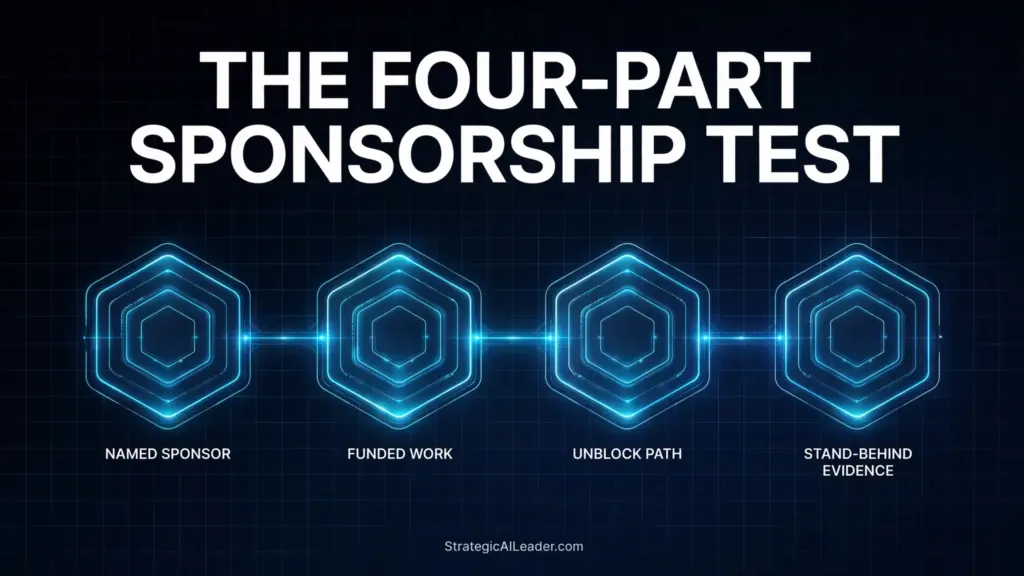
Use the four-part test as a presence check. Each part is there or it is not. A missing part is a fragment, not sponsorship.
| Term | Definition |
|---|---|
| Named sponsor | One person with decision rights on this bet |
| Funded work | One bet with committed organizational capacity |
| Unblock path | How a blocker above the team reaches the sponsor and returns as a decision |
| Stand-behind evidence | Recorded actions showing the sponsor stayed accountable for the result |
Named sponsor
Decision rights sit on one named person for that bet. The role might be a founder, a CEO, a CFO, or another executive who can actually spend and decide. A department label is not a sponsor. The person who runs daily ops is not the sponsor unless that person also holds those rights.
Funded work
A funded bet has committed organizational capacity, not only a wish on a roadmap. Depending on the bet, that capacity can include money, people, time, priority, or permission to stop an existing process. “We should prioritize this” is a wish. “The billing cutover has a budget line, a named Friday, and a stop on the old spreadsheet” is a funded bet. If two leaders would describe different work as paid for, sponsorship has nothing safe to cover.
Unblock path
Air cover is the path a blocker takes when the team cannot move it. “Escalate if needed” is a wish. A real unblock path answers four questions: which blocker qualifies for sponsor escalation, who takes it to the sponsor, what authority the sponsor exercises, and how quickly the decision returns to the operating team. “When Legal holds the vendor contract, the sponsor takes that hold the same week” is an unblock path. If the hold still sits with the people who cannot move it, the name on the slide is decoration.
Stand-behind evidence
Sponsorship becomes observable through actions recorded in the work. Attendance on a kickoff invite is not evidence. Stand-behind evidence can look like a blocker the sponsor resolved, an exception the sponsor approved, a funding decision the sponsor defended, a stop the sponsor upheld, a missed result the sponsor owned, or a review where the sponsor made the required decision. If the team cannot tell stood-behind from abandoned without a slide, the bet has no done-state.
Do not turn the extras into a way to run the ops system. For a live record where a named sponsor set expectations and removed blockers, see Case Study: High-Trust Teams With Proven Results.
Executive Sponsorship vs Operational Leadership and a Slide Title
Air cover does not replace operational leadership. Daily practice does not replace the sponsor of the bet. A titled name with no decision rights still leaves Legal sitting on the contract.
| Question | Executive sponsorship | Operational leadership | Slide title |
|---|---|---|---|
| What is it? | Authority behind one funded bet | Owned daily practice after approved direction | A name printed in a deck |
| What does it require? | Named sponsor, funded bet, unblock path, stand-behind evidence | Approved direction, leader, operating standard, results | A slide and a title |
| What proves completion? | Funded bet, removed blocker, stand-behind evidence | Closed miss, changed practice, or reused exception | The name appeared |
| What does it support? | Authority behind one bet | How ops leaders run the system | Appearance of a name |
| Common failure | Title on a slide with no funding or evidence | Offsite direction with no owner or result | Footer has a sponsor, contract still sits |
Change leadership turns an approved change into adopted daily practice, and an operator workflow moves an approved decision to finished work. Both still matter. Neither one is air cover and decision rights for a funded bet.
An Executive Sponsorship Example
The billing cutover below shows all four parts in one compact scenario.
| Part | In the billing cutover |
|---|---|
| Named sponsor | The CFO holds decision rights on this bet. Head of Billing runs the cutover route. |
| Funded work | Every invoice leaves the old spreadsheet for the new billing system by a named Friday, with a budget line and a stop on the old path. |
| Unblock path | When Legal holds the vendor contract, the sponsor takes that hold the same week and returns a decision to Billing. |
| Stand-behind evidence | A resolved Legal hold, a signed exception, or a miss owned in the work record. |
| Failure state | The slide says “CFO sponsor.” Finance keeps the spreadsheet. Legal holds the contract. Nobody owns the miss. |
Operators already know the same pattern from operator workflow: a decision can exist and still fail as execution.
How to Test Executive Sponsorship This Week
One week is enough to test one bet. The exercise should produce four artifacts: a named sponsor, a visible funded bet, a written unblock path, and recorded stand-behind evidence.
Ask these six questions first
- What is the funded bet?
- Who holds the decision rights?
- What blocker exceeds the team’s authority?
- Where does that blocker go?
- What evidence shows the sponsor stood behind the bet?
- What happens when the sponsor is unavailable?
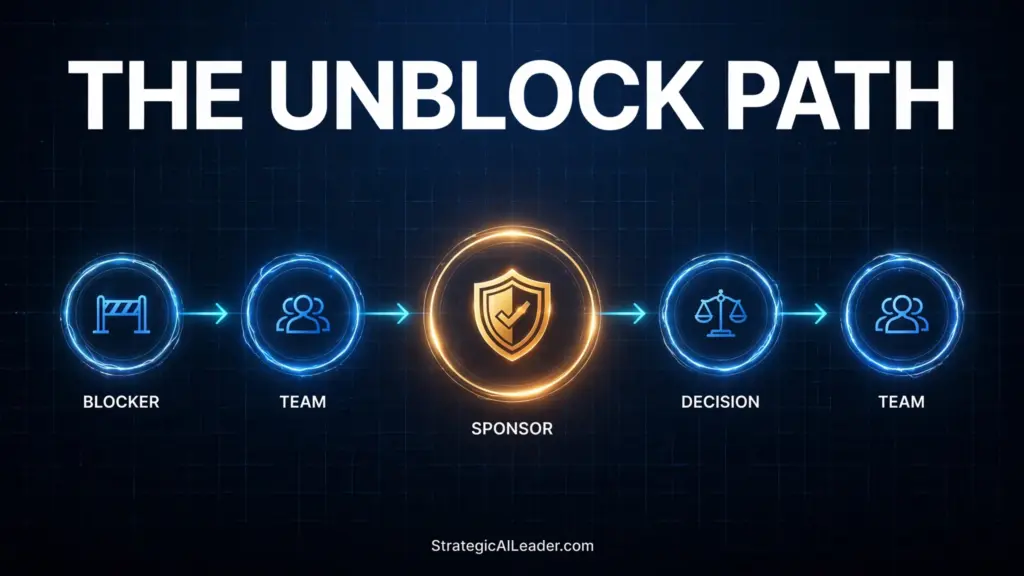
Founders hear three answers to “who sponsors that cutover.”
Run the questions above against the work record, then complete these steps before anyone reprints the steering deck.
- Choose one funded bet and write it in one sentence.
- Name the person with decision rights on it.
- Write what committed capacity looks like for this bet (money, people, time, priority, or a stop) and point to where that commitment is visible.
- Write the unblock path: which blocker qualifies, who takes it, what authority the sponsor uses, and how fast the decision returns.
- Define stand-behind evidence for this bet.
- Run one review with the sponsor present.
- Record the stand-behind evidence in the work record.
- Review misses and write any exception or absence rule those misses needed.
Score is not the goal. The team needs stand-behind evidence it can defend on Monday.
FAQ
What is executive sponsorship?
Executive sponsorship is the named authority that funds one bet, removes blockers the team cannot, and stays accountable for the result, with observable stand-behind evidence.
How is executive sponsorship different from a title on a slide?
Slide titles name a person in a footer. Executive sponsorship funds one bet, publishes the unblock path, and leaves stand-behind evidence the sponsor will defend. A deck can exist while the bet still has no air cover.
How is executive sponsorship different from operational leadership?
Operational leadership turns approved direction into owned daily practice. Executive sponsorship is air cover and decision rights for one funded bet, not the job of running the system.
How is executive sponsorship different from change leadership?
Change leadership turns approved change into owned daily practice. Executive sponsorship funds that bet, removes blockers the team cannot, and stays accountable for the result. Shared parts do not make the jobs the same.
How is executive sponsorship different from an operator workflow?
An operator workflow is the repeatable path from an approved decision or trigger to finished work. Executive sponsorship sits above that route. The sponsor funds the bet, unblocks what the operator cannot, and stands behind the result.
Who should be the named sponsor?
Name one person with decision rights on the live bet. That person funds the work, takes the blocker the team cannot remove, and leaves stand-behind evidence. Finance, product, or a founder can hold the seat. A department label is not a sponsor.
What proves executive sponsorship is working?
Look for a funded bet, a removed blocker, and a result the sponsor will defend. A title is not proof. If last week’s review left no stand-behind evidence, the cover is not yet visible.
Can a steering committee be the sponsor?
A committee may review, advise, coordinate, or hold some decision authority. Executive sponsorship still needs one named person who funds the bet, removes a blocker the team cannot, and stays accountable for the result. Committee participation does not replace that named person.
Continue Learning
Executive sponsorship is authority behind the bet. Operator workflow is how a sponsored bet becomes finished work. For a live operating record of a named sponsor who set expectations and removed blockers, see Case Study: High-Trust Teams With Proven Results. For research on clarifying decision roles, see McKinsey’s explainer on decision making.
Subscribe to the Strategic AI Leader newsletter for practical systems covering AI, operations, and growth.