
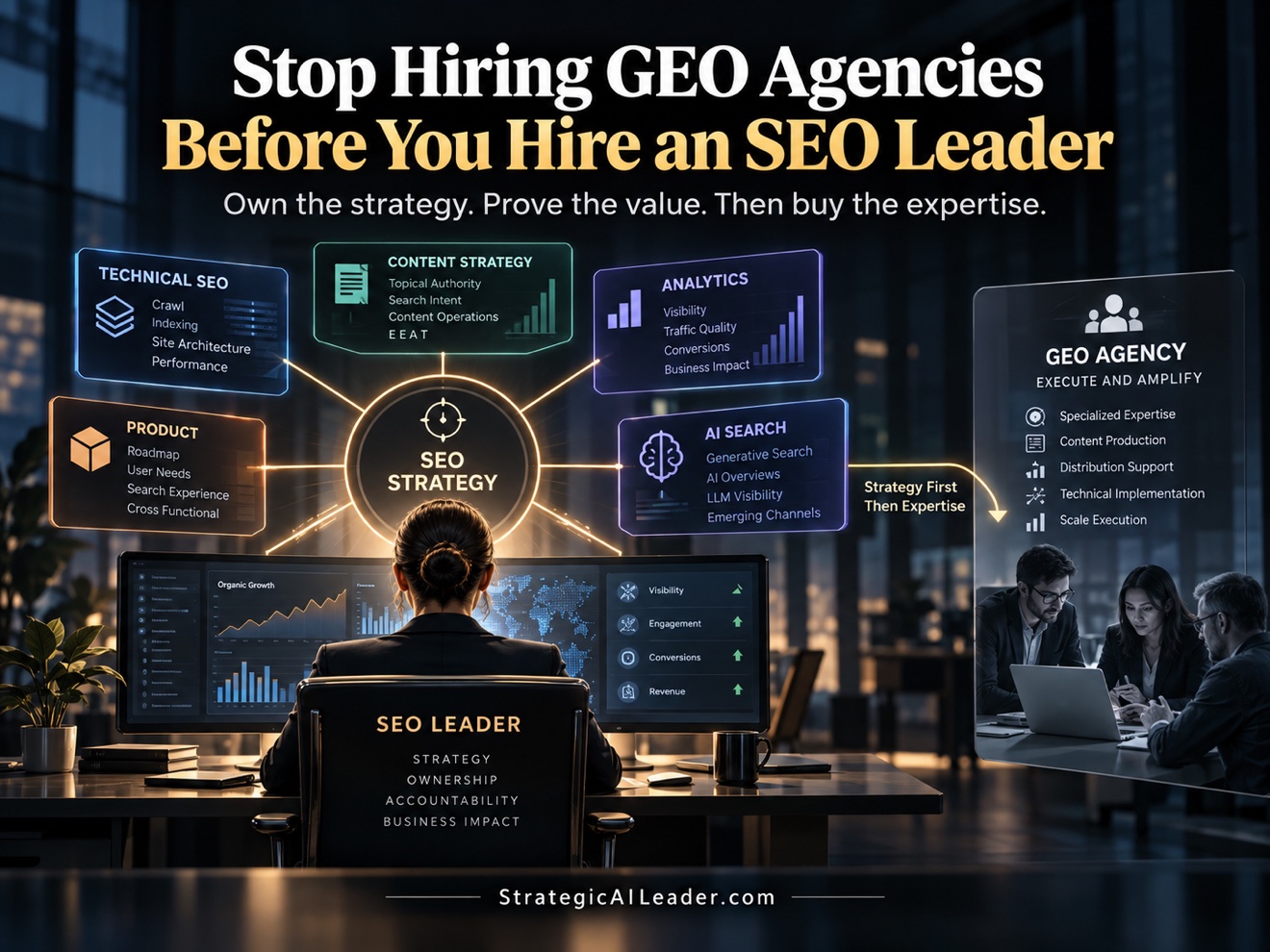
Stop Hiring GEO Agencies Before You Hire an SEO Leader
If your marketing team recommends a GEO agency tomorrow, who is responsible for the search strategy the agency is supposed to improve?
That is the first question I would ask before signing a contract. Agencies bring valuable expertise. But without an owner for priorities, technical tradeoffs, customer experience, and results, they inherit a problem they cannot solve alone.
I’d hire an SEO leader before hiring a GEO agency when the scale and complexity of the business justify a dedicated role. For a smaller company, a fractional Head of SEO or an accountable executive might be better. Someone still needs to own priorities, results, and outside spending.
My position is simple: own the strategy, prove the value, then buy the expertise.
The Problem Isn’t the GEO Agency. It’s the Missing SEO Leadership.
In his article about the limitations of AI search RFPs, Michael King makes a useful argument. Companies struggle to compare GEO, AEO, and AI search proposals because providers define the work and measure progress differently. His focus is on how executives should evaluate outside partners in an unsettled services market.
I agree with the underlying concern. But I’d ask a question before the RFP ever reaches procurement: who inside the company is qualified to decide what the agency should accomplish?
Without an accountable owner, a company risks buying whatever the strongest pitch promises. A content vendor proposes pages, a monitoring vendor proposes reports, and a technical agency proposes audits. None necessarily identifies the biggest customer-acquisition constraint.
An SEO leader should be accountable for connecting organic discovery to customer outcomes, setting priorities across teams, evaluating evidence, and deciding where outside expertise adds value. That responsibility is broader than managing rankings or supervising a vendor.
What AI Search Changed, and What It Didn’t
I do not treat SEO, AEO, and GEO as competing departments. I treat them as related ways to improve how customers find reliable information and move toward a decision.
- SEO: Improve the technical access, relevance, usefulness, and performance of content found through search.
- AEO: Structure accurate answers to important questions and assess whether answer surfaces select or reference them. I explain the approach in my guide to answer engine optimization.
- GEO: Improve the clarity, consistency, and accessibility of source material used in generated answers, then evaluate observed mentions and citations. My practical GEO guide covers those operating decisions.
These are working definitions. The industry does not use the terms consistently, and no one controls whether an AI system quotes, mentions, or cites a particular website.
More importantly, AI search did not erase traditional SEO. Google’s official guidance for AI features says established SEO practices remain relevant for AI Overviews and AI Mode. Google does not require a special AI-only optimization technique or schema type for inclusion. Crawlable, indexable, useful pages and accurate site information still matter, and eligibility does not guarantee selection.
Customers encounter brands through conventional results, generated summaries, comparisons, and cited sources. The leader must understand those encounters without confusing mentions with sales.
My Marketplace Experience Changed How I Evaluate SEO
Working across Realtor.com and MyEListing shaped my view of organic growth. In a marketplace, the job does not end when a page ranks. The product must connect a person with relevant information or inventory and make the next action worthwhile.
Consider an illustrative commercial real estate scenario. A business owner asks an AI assistant, “What should I consider before leasing a 5,000-square-foot warehouse in Austin?” The answer discusses zoning, access, lease structure, and location. The assistant references a marketplace guide. The buyer visits, filters current listings, and sends an inquiry about a suitable property.
A GEO vendor might report a citation win. A search dashboard might report a visit. Neither proves a qualified prospect.
I would ask a different set of questions. Was the guide accurate? Did the buyer reach relevant listings? Were those listings current? Did the inquiry reach the right person? Was the prospect qualified? What happened after the handoff?
Those questions involve content, engineering, product, inventory operations, analytics, and sales. An agency can improve one part of the journey. An accountable leader connects the parts and decides which constraint to fix first.
I’d rather improve one high-intent journey than celebrate content volume without customer value.
The OWN, PROVE, BUY Framework for AI Search Leadership
I use three decisions before expanding search spending.
1. OWN: Who Has the Authority to Lead Search?
Name one accountable owner for the organic discovery program. Give the role access to product, engineering, content, analytics, and commercial leadership. Define which decisions the owner makes, which require executive approval, and who implements the work.
Document the owner, target journeys, budget, and escalation path. A title without influence over website changes means little.
A large marketplace might need a dedicated leader. A smaller B2B company might need an executive sponsor and a fractional specialist. Ownership matters more than employment status.
2. PROVE: What Evidence Justifies the Investment?
Establish a baseline before commissioning a broad GEO campaign. Start with the customer questions worth answering, the pages associated with those questions, and the actions that indicate commercial progress.
Separate three evidence levels:
- Discovery evidence: Search impressions, clicks, sampled AI-answer appearances, cited URLs, and source accuracy.
- Behavior evidence: Relevant visits, listing engagement, demo requests, inquiries, or other qualified actions.
- Business evidence: Accepted leads, opportunities, revenue, or other outcomes tied to an agreed attribution method.
Citations show representation, not visits. Visits show interest, not pipeline. Revenue needs records and explicit attribution assumptions.
Microsoft’s AI Performance reporting in Bing Webmaster Tools offers citation counts, cited pages, sample grounding queries, and trends across supported experiences. Microsoft explicitly cautions that citation activity does not indicate placement or ranking. Meanwhile, Google’s guidance on combining Search Console and Analytics shows why search clicks and on-site behavior require separate measurement systems and careful interpretation.
I explain these limits further in my AI search measurement guide.
3. BUY: Which Capabilities Should Come From Outside?
After defining ownership and priorities, I would buy specialist help for migrations, AI-answer monitoring, digital PR, technical work, editorial capacity, or analytics.
Every engagement should specify the problem, deliverables, decision owner, evidence required, and knowledge transfer. I would reject contracts built around vague promises of AI visibility or guaranteed citations.
The funding question belongs to the company. My framework for evaluating funded AI work applies the same discipline: name the result, define the scope, assign accountability, examine evidence, and record whether to keep, revise, or stop the investment.
Five Capabilities I’d Look for When Hiring an SEO Leader
I’d assess five capabilities, not the number of tools on a resume.
Technical SEO and Product Judgment
The candidate should understand crawling, indexing, rendering, templates, and the product choices affecting discoverability. They should prioritize by business impact.
My interview question: “You have duplicate marketplace pages, broken inventory filters, and a small metadata backlog. Engineering has one sprint. What gets fixed first, and what evidence supports your choice?”
AI Search and Information Architecture
I expect fluency in source quality, answer accuracy, entity consistency, and citation monitoring. Outdated product information might matter more than low visibility.
My interview question: “Three assistants answer an important customer question differently. How would you determine which claims are wrong, where the correct source lives, and what to change?”
Content Strategy and Customer Intent
A credible leader separates search volume from commercial value and knows when to improve a page, publish a resource, clarify inventory, or decline a request.
My interview question: “You have ten topic ideas and budget for three. Which three deserve investment, and why?”
Analytics and Experimentation
The leader should define baselines and tests, separate citations from qualified acquisition, and report inconclusive results.
My interview question: “Citations increased this month, but qualified leads did not. Is the program working? What would you investigate before asking for more funding?”
Cross-Functional Leadership
A recommendation has little value if nobody ships it. The leader must negotiate tradeoffs with engineering, content, finance, and sales.
My interview question: “Product will not prioritize your highest-impact SEO fix this quarter. What alternative would you propose, and when would you escalate?”
I’d value structured reasoning, compromises, and the ability to reject low-value work.
What I’d Expect in the First 90 Days
I wouldn’t demand a guaranteed traffic or citation increase in the first quarter. I would demand clearer ownership, a defensible baseline, shipped improvements, and a documented funding decision.
| Window | Leadership outcome | Evidence I’d expect |
|---|---|---|
| Days 1 to 30 | Understand the business and establish the baseline | Priority buyer journeys, technical and content inventory, AI-answer samples, funnel metrics, stakeholder map |
| Days 31 to 60 | Select priorities and start execution | Ranked backlog, decision owners, engineering commitments, first changes shipped, agency capability gap analysis |
| Days 61 to 90 | Evaluate early results and decide next funding | Change log, early outcome indicators, unresolved risks, keep/revise/stop judgment, next-quarter roadmap |
By day 30, identify where the journey breaks. By day 60, ship a useful change. By day 90, make a defensible next-quarter decision. Pipeline and revenue often need longer.
SEO Leader vs. GEO Agency: Which Should You Hire First?
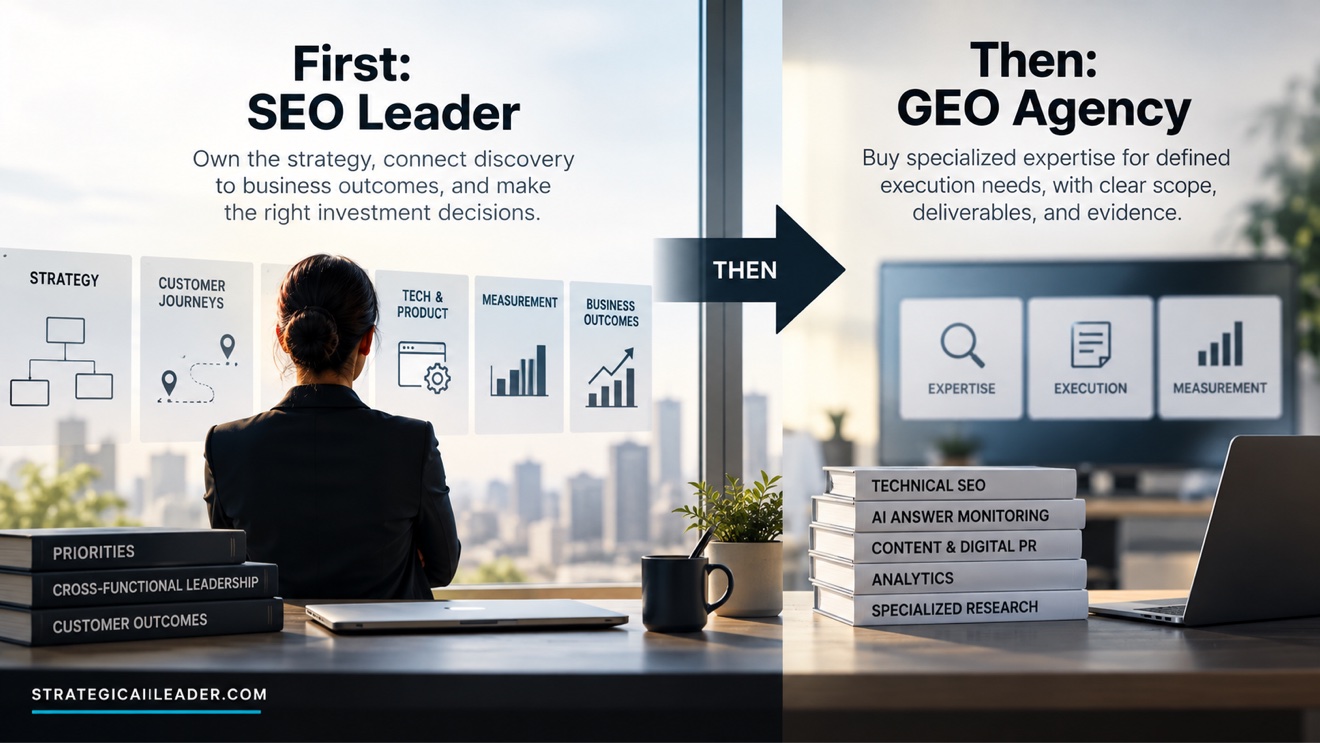
The right answer depends on scale, internal capability, and the problem you need to solve.
| Business situation | First move | Why |
|---|---|---|
| Large or complex site with recurring technical and product dependencies | Hire or designate a dedicated SEO leader | Continuous prioritization and cross-functional authority matter |
| Smaller company without enough work for a full-time search executive | Name an internal sponsor and engage a fractional SEO leader | Preserves accountability without building an oversized function |
| Company already has credible search leadership but lacks a specialized capability | Hire a scoped GEO or SEO agency | Expertise fills a defined execution gap |
| Company needs an urgent migration or technical review | Fund a narrow specialist engagement with an internal decision owner | Time-sensitive work should not be delayed by a lengthy executive search |
An agency or fractional specialist might lead much of the strategy. An internal sponsor must still approve priorities, control funding, and retain the learning.
Stop Hiring SEO Leaders to Manage Keyword Reports
Keyword research, technical audits, and rank tracking remain useful. But a job description built only around those activities attracts channel managers rather than leaders accountable for business outcomes.
I’d use one practical hiring exercise. Give the candidate a short packet with a technical backlog, five buyer questions, several sampled AI answers, funnel data, and a fixed quarterly budget. Ask for a two-page decision memo.
The memo should identify the top priorities, the measurements needed, the work they would outsource, and the projects they would decline. Then ask who must approve each decision and how they would respond if engineering capacity disappears.
I’d favor a candidate who exposes assumptions and connects decisions to customer value over one promising a visibility score.
Your Search Function Must Outlast the Vendor
One final test: what stays with your company when the agency contract expires?
I would expect an authoritative page and fact inventory, buyer-question taxonomy, search and conversion baselines, AI-answer sampling methodology, prioritized backlog, experiment log, decision history, reporting definitions, and documented playbooks. Owners should maintain these assets instead of leaving them in a vendor’s private workspace.
Review shipped work, customer outcomes, and spending regularly. Without implementation access, a search leader cannot be accountable for delivery.
My Recommendation: Hire the Strategy, Then Buy the
Expertise
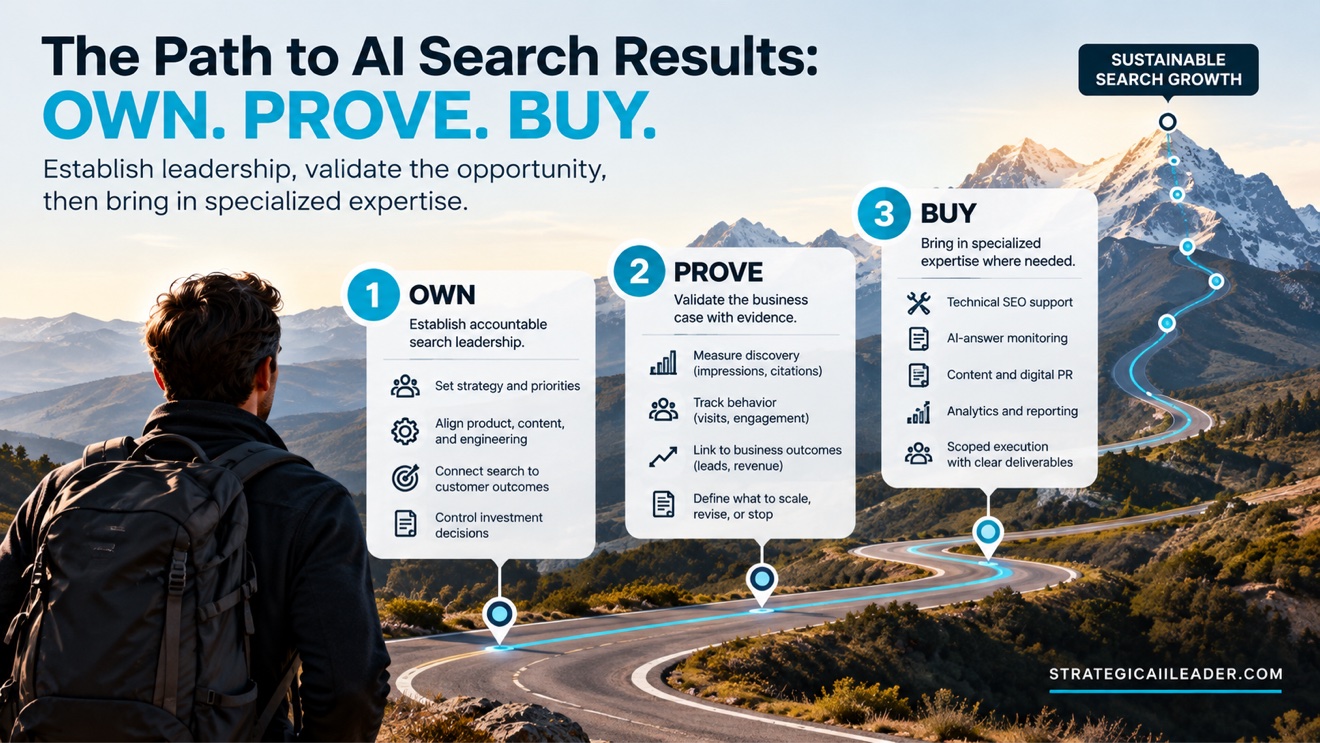
If I were responsible for organic growth, I would follow a simple order: OWN the decisions. PROVE the business case. BUY specialized execution where it fills a real gap.
A full-time title is not the objective. Neither is avoiding agencies. Fund the work that removes meaningful customer-acquisition constraints.
Before asking which GEO agency to hire, ask whether your company has the SEO leadership needed to make the agency successful.
For more practical frameworks on SEO, AI search, leadership, and growth, subscribe to the Strategic AI Leader newsletter.
Frequently Asked Questions About SEO Leadership and GEO Agencies
Should I hire an SEO leader or a GEO agency first?
Establish accountable SEO leadership first. For complex sites, that might mean hiring a dedicated leader. Smaller organizations might appoint an internal executive and engage a fractional specialist. Hire a GEO agency when you can define its scope, business purpose, and evaluation criteria.
What is the difference between an SEO leader and a GEO agency?
An SEO leader owns search priorities, organizational decisions, and the connection between discovery and business outcomes. A GEO agency supplies specialized research, monitoring, technical, content, or advisory capabilities. An agency might help set strategy, but the company must retain accountability for funding and implementation.
Does GEO replace traditional SEO?
No. GEO extends the work of making reliable source information available to generated-answer systems. Technical access, useful content, internal linking, and page quality continue to matter for Google’s AI search features. AI-answer visibility does not remove the need for foundational SEO.
What skills should a Head of SEO have in the AI search era?
Look for technical SEO and product fluency, AI-answer and information architecture judgment, customer-intent strategy, analytics discipline, and cross-functional leadership. Test prioritization and decision quality with a realistic business exercise instead of relying only on platform certifications.
Is a fractional SEO leader enough for a small business?
A fractional leader may be a good fit when a company lacks the workload or budget for a full-time Head of SEO. The arrangement needs a named internal sponsor, access to decision-makers, an implementation team, and documented knowledge transfer.
How should an SEO leader measure AI search performance?
Use separate measures for discovery, behavior, and business outcomes. Track a consistent sample of buyer questions and observed citations alongside qualified visits, inquiries, opportunities, and revenue where attribution supports the claim. Document sampling limits and avoid treating AI mentions as proof of sales.