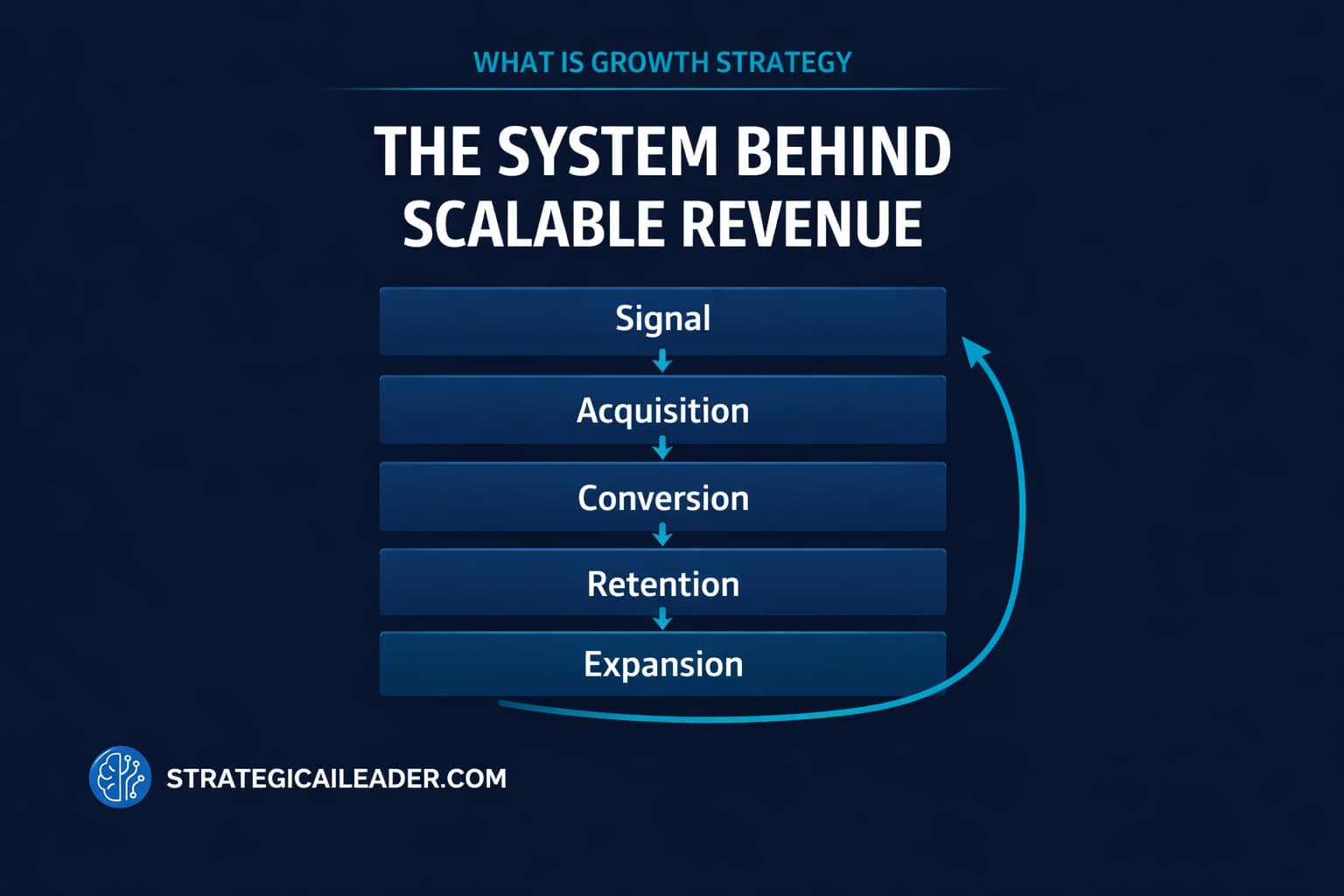
What Is Growth Strategy? The System Behind Scalable Revenue
Most teams think they have a growth strategy. They don’t.
They have a channel plan. A campaign calendar. A list of experiments they’re running this quarter. Those are tactics wearing a strategy costume.
Growth strategy is something different. It’s the architecture beneath the activity. The system determines whether your tactics compound over time or cancel each other out.
I used to confuse the two. When I was building the growth engine at MyEListing, I thought having a clear acquisition focus and a weekly experiment cadence meant we had a strategy. We didn’t. We had momentum without structure. When channels performed inconsistently, I couldn’t explain why. When retention lagged, I patched it with more acquisition spend. That’s what strategy confusion looks like in practice.
This article defines growth strategy as a system: a five-layer operational system called the Growth Strategy System Stack. It explains how the layers sequence, why most teams stall when they skip one, and what it takes to build a growth motion that actually compounds.
| What is growth strategy? Growth strategy is a structured system for designing, sequencing, and compounding revenue growth through acquisition, conversion, retention, and expansion levers. It is distinct from marketing execution. It is not a channel plan or a campaign calendar. It is the operational architecture that determines whether growth tactics compound or cancel each other out. |
What leaders get wrong about growth strategy
The most common mistake is treating growth strategy as a synonym for marketing strategy. They’re related but not the same.
Marketing strategy answers the question: how do we reach and persuade our target audience? Growth strategy answers a different question: in what sequence do we instrument each layer of our growth system so that spending compounds instead of leaks?
You can have excellent marketing execution and still have a broken growth strategy. If your conversion layer isn’t instrumented, every dollar you spend on acquisition disappears into a funnel you can’t read. If your retention layer isn’t activated, you rebuild your customer base from scratch every quarter. Good ads don’t fix a leaky system.
The second mistake is conflating growth strategy with the growth team. Growth strategy is not a function. It’s an architecture. A COO owns it as much as a VP of Growth. Brian Balfour’s Four Fits framework makes this point well: growth to $100M requires Product-Market Fit, Product-Channel Fit, Channel-Model Fit, and Model-Market Fit to work together as a system, not as independent decisions made by separate teams. Operators designing measurement stacks, founders deciding where to invest next, executives explaining inconsistent results to a board: they all need to understand the system, not just the tactics.
| How is growth strategy different from marketing strategy? Marketing strategy defines how you reach and persuade your audience. Growth strategy defines the sequence in which you must instrument acquisition, conversion, retention, and expansion before scaling spend. Marketing executes within the growth system. Growth strategy designs the system itself, including the measurement infrastructure, experimentation protocols, and decision logic that make growth repeatable. |
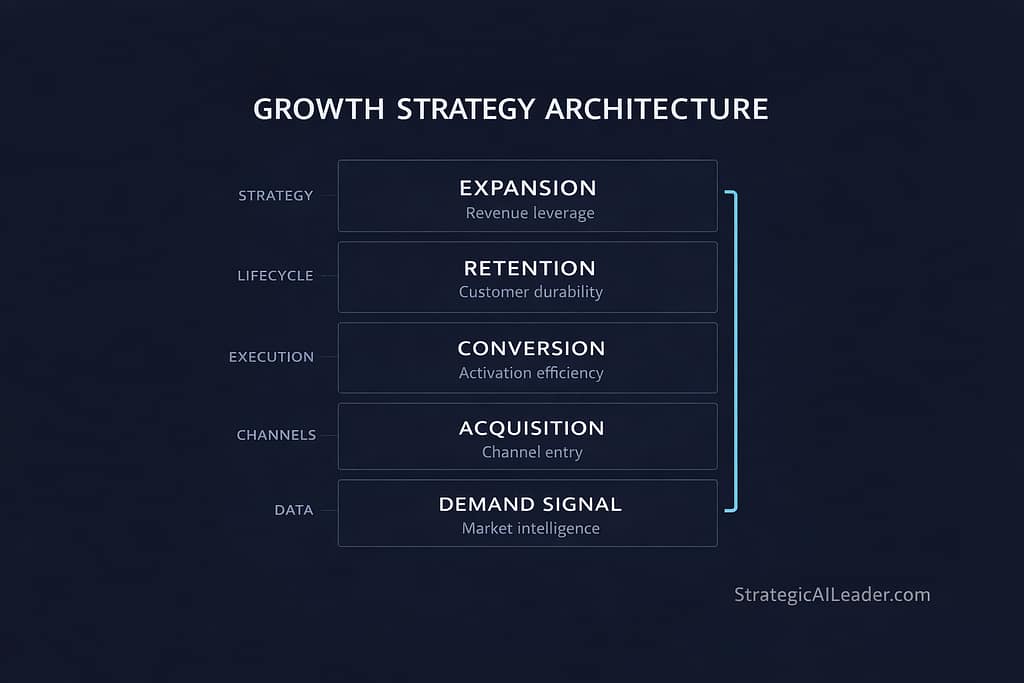
The Growth Strategy System Stack: five layers, one system
Growth strategy, properly defined, is a five-layer operational system. Each layer must be instrumented before the next one can compound reliably. Skipping layers doesn’t accelerate growth. It creates the illusion of progress while building invisible debt.
Here’s the model.
Channel plan vs growth strategy system
Before walking the layers, one distinction worth making explicit. Most teams already have a channel plan. They think that is the strategy. It’s not. For a deeper look at where this confusion originates, see Marketing vs Growth: The Strategic Difference Every Leader Must Know.
| Dimension | Channel Plan | Growth Strategy System |
| Primary question | Where do we allocate spend? | In what sequence do we instrument each layer? |
| Unit of optimization | Campaign performance | System architecture |
| Time horizon | Short-term results | Long-term compounding efficiency |
| Success signal | Traffic and lead volume | Layer-to-layer conversion and retention |
| Failure mode | Inconsistent ROAS | Can’t diagnose which layer is limiting growth |
| Owner | Marketing team | Founder, COO, VP of Growth together |
Channel plan vs growth strategy system — six dimensions. Growth strategy is the architecture the channel plan operates inside.
What does instrumentation actually include?

structured attributes and classification layers
Before walking the five layers, one term needs a sharper definition. Instrumentation appears throughout this article because it does the structural work. But it’s also the word most often nodded past without implementation clarity.
Instrumentation means building the measurement stack that makes each growth layer legible. Not a dashboard. Not analytics access. A specific set of capabilities that let you read system behavior and act on it.
A fully instrumented growth system requires five things:
- Event-level funnel tracking: individual user events mapped across the funnel, not just aggregate conversion rates. You need to see where specific users drop, not just that some percentage does.
- Activation threshold definition: a specific behavioral signal that marks a user as ‘activated’ in your product. Time-on-site is not activation. A user completing a core workflow, reaching a value moment, or returning within a defined window: those are activation signals.
- Cohort retention visibility: the ability to segment users by acquisition cohort and track their retention curve independently. Aggregate retention hides what cohort-level data reveals.
- Channel attribution alignment: connecting acquisition source to downstream conversion and retention outcomes, not just top-of-funnel cost. CAC calculated without retention context is incomplete.
- Expansion signal capture: tracking which users upgrade, refer, or return to buy again, and feeding that behavior back into ICP and acquisition modeling.
Without these five capabilities, you can run growth tactics. You can’t run a growth system. The difference shows up in your ability to diagnose: when results are inconsistent, instrumentation tells you which layer is failing. Without it, you guess.
What layer sequencing failure actually looks like
The sequencing logic is easy to agree with conceptually. Here’s what it looks like when a team skips it.
A SaaS company hits early PMF signals. User interviews are positive. NPS is strong. The board pushes for growth. The team scales acquisition, paid search, content, and outbound, before defining what ‘activated’ means in the product.
Traffic rises. Conversion looks acceptable on a top-level basis. CAC appears within range. The team increases spend.
Three months later, the numbers stop making sense. Retention is collapsing in the 30-to-60-day window. The team can’t tell which acquisition channels are producing retained users versus single-session visitors. Expansion never activates because too few users reach the product depth where referral or upsell is relevant.
The team audits the problem. They find no activation threshold was ever defined. Channel attribution never connected to retention data. Cohort-level visibility didn’t exist. They were running Layer 2 acquisition tactics on top of a Layer 1 signal gap and a Layer 3 instrumentation gap they couldn’t see.
The fix required pausing acquisition optimization, rebuilding the measurement stack, defining activation, and re-evaluating channel performance with the new data. That took eight weeks. The compounding cost of skipping the sequencing was far larger than the cost of doing it right the first time.
| What does a growth strategy include? A complete growth strategy includes five operational layers: Signal (ICP definition, demand measurement, activation probability by segment), Acquisition (channel design, CAC management, efficiency targeting), Conversion (activation threshold definition, funnel instrumentation, source-to-outcome attribution), Retention (cohort visibility, loop design, LTV extension), and Expansion (upsell systems, referral activation, feedback into signal). It also includes the measurement stack: event tracking, cohort analysis, and channel attribution that makes each layer legible. |
Layer 1: Signal — knowing who you’re actually growing for
Every growth system starts with signal clarity. Not brand positioning. Not target persona documents. Signal clarity means you can measure demand, validate ICP fit, and detect when the market is telling you something new.
Teams that skip this layer build acquisition engines pointed at the wrong audience. I watched this happen at MyEListing. Early acquisition campaigns hit volume targets, but conversion lagged because the signal layer wasn’t instrumented. We were measuring traffic, not fit. That distinction cost us months of wasted spend before we redesigned the targeting logic.
Signal layer work produces four specific outputs. A validated ICP definition, behavioral not just demographic. A qualified demand ratio: what share of your traffic or pipeline actually matches that ICP. Activation probability by segment, so you know which user types reach the product value moment and which don’t. Expansion probability by segment, so you know which cohorts eventually upgrade or refer. Those four outputs turn signal from philosophy into measurable system input.
Signal layer investment isn’t glamorous. It means building the measurement infrastructure to know who is actually converting, retaining, and expanding. Before you scale anything. Expansion is where that investment eventually compounds: when the system feeds expansion behavior back into your signal layer, you get progressively sharper targeting over time. That feedback loop is what separates a growth system from a campaign calendar.
Layer 2: Acquisition — designing for efficiency, not volume
Acquisition is the most visible layer of any growth system. It’s also the most commonly over-invested layer when the layers below it aren’t ready.
Acquisition strategy at this layer means: channel design, CAC management, and optimization logic. Not just ‘run more ads.’ The question isn’t how much you can spend. It’s what efficiency ratio you’re targeting, and whether your conversion layer can justify the investment. Products are built to fit with channels. Channels don’t mold to products. That principle applies at the strategy layer too: acquisition channels must be selected based on system fit, not just top-of-funnel volume potential.
When the MyEListing team rebuilt its marketing infrastructure, one of the most important shifts was treating acquisition as an instrumented system rather than a spend allocation. Moving from intuition to structured measurement drove measurable improvement in marketing ROI. The data came out of a structured experimentation program, not channel volume alone.
| What are the layers of a complete growth strategy system? A complete growth strategy system has five layers: Signal (ICP clarity and demand measurement), Acquisition (channel design and CAC management), Conversion (funnel instrumentation and activation), Retention (loop activation and LTV extension), and Expansion (upsell systems and referral activation). Each layer must be instrumented before the next can compound reliably. Skipping layers creates invisible systemic debt. |
Layer 3: Conversion — the layer most teams skip
Conversion is where most growth strategies quietly fall apart.
Teams invest in acquisition, see traffic numbers climb, and interpret that as growth momentum. Then they wonder why revenue doesn’t follow. The gap is almost always conversion instrumentation. Without it, you can’t tell which acquisition channels are sending quality users, which onboarding steps are creating friction, or at what point new users decide whether to stay.
Conversion layer work isn’t just A/B testing landing pages. It’s building the measurement stack that tells you what ‘activated’ actually means for your specific product, and tracking whether each acquisition source reaches that threshold. This is where the growth strategy connects directly to decision infrastructure: the ability to act on signal requires that the signal exists and is legible.
Layer 4: Retention — where growth either compounds or collapses
Retention is the layer that separates growth from churn replacement.
A team with strong acquisition and weak retention isn’t growing. It’s on a treadmill. New users come in the front door at the same rate existing users leave through the back. Revenue appears flat or inconsistent. Experiments show promising results in week one, then fade. That’s the signature of a broken retention layer.
Retention loop activation means building the product behaviors, communication triggers, and value reinforcement that increase the probability a user returns after their first experience. It’s not a re-engagement email sequence. It’s a system architecture question. Lenny Rachitsky’s retention benchmarks research reinforces why: retention is the single most important factor in product success, the primary indicator of PMF, and the enabler of the best acquisition strategies. High retention increases LTV, which raises the ceiling on what you can spend to acquire the next user.
The signal that your retention layer is working: the gap between new user cohort performance and overall revenue starts closing. For a practical look at how LTV and CAC optimization interact with this, the LTV/CAC guide in this cluster goes deeper on the mechanics. Retention lift produces compounding effects over time in a way that acquisition optimization alone cannot.
Layer 5: Expansion — when the system compounds
Expansion is the layer that most growth strategies never reach in a structured way.
Expansion means upsell systems, referral activation, and revenue compounding from existing users. When the layers below it are instrumented, expansion becomes a multiplier. When they’re not, it becomes noise.
The reason expansion sits at the top of the stack, and feeds back into the signal layer, is that expansion data is the highest-quality demand signal available. Who upgrades, who refers, who buys again: that data tells you more about actual ICP fit than any top-of-funnel research. Teams that close the feedback loop between expansion and signal get progressively more efficient at acquisition over time. For the mechanics of how self-reinforcing expansion loops work, see the growth loop strategy guide in this cluster.
What this looks like in practice: the MyEListing build
The clearest example I can draw from is the growth system rebuild at MyEListing, a B2B commercial real estate marketplace.
When the experimentation program started, the team was running high-volume experiments without a structured growth strategy underneath them. Experiments were producing results, but the results weren’t compounding. Each successful test felt isolated. Growth stayed inconsistent.
The first thing that changed was signal layer instrumentation. Instead of optimizing for traffic, the team started measuring qualified demand: users who matched a validated ICP and reached defined activation thresholds. That single shift changed how acquisition was evaluated.
The second change was conversion instrumentation. The team built measurement into the funnel at each layer rather than relying on aggregate conversion rates. That revealed which acquisition channels were producing real activation versus surface-level signups.
I expected the conversion work to be the hardest part. It wasn’t. The hardest part was the signal layer: agreeing on what ‘fit’ actually meant before any measurement could start. That debate took longer than the technical implementation.
The outcome: conversion rate lift of 47% and retention improvement of 22% measured across the experimental program period, with marketing ROI reaching 133%, sourced from the AI Digital Marketing Strategy case study data in the MyEListing experimentation archive. These figures reflect structured experimentation conditions, not general campaign performance. The environment was controlled; the methodology was systematic. The numbers improve when tactics run on top of an instrumented system rather than guesswork.
What breaks when you try to build this system
The Growth Strategy System Stack looks clean on paper. In practice, four constraints surface quickly.
Layer sequencing pressure
Boards and investors pressure teams to scale acquisition before the system is ready. The temptation is to skip the signal and conversion layers to hit near-term numbers. This works for one or two quarters and then produces the inconsistent results that board decks can’t explain.
Measurement infrastructure debt
You can’t instrument conversion without a measurement stack. Most early-stage teams inherit analytics tooling that was set up for traffic reporting, not growth layer analysis. Rebuilding that infrastructure mid-growth is disruptive. The right time to build it is before you need it. That is almost always earlier than it feels.
ICP drift
As companies scale, the Ideal Customer Profile (ICP) definition drifts. Sales teams expand targeting. Marketing adjusts messaging. Acquisition channels shift. Each change creates signal noise that makes conversion and retention data harder to interpret. The teams that manage this well rebuild the signal layer on a scheduled basis rather than waiting for the data to degrade.
The Post PMF transition
The shift from product-market fit discovery to systematic growth execution is where most teams stumble. PMF discovery rewards intuition, speed, and conviction. Post-PMF growth rewards instrumentation, sequencing, and patience. The skills aren’t the same. The Post PMF Transition Ladder is a framework I’ll publish next to address exactly this transition. It deserves a full treatment.
| When should companies build a growth strategy system? Companies should build a growth strategy system before scaling acquisition spend — not after. The right trigger is early PMF validation: when you have signal that the product works for a defined user type, that is the moment to instrument conversion and retention before accelerating channels. Teams that wait until growth stalls face the same rebuild under performance pressure, which is significantly more expensive than building the system while growth still feels optional. |
Growth strategy readiness: operator checklist
Use this as a diagnostic. Each unchecked item is a layer gap and a compounding cost if left unaddressed before scaling.
Growth Strategy Readiness Checklist
- ☐ Layer 1: Signal. ICP definition is documented and measurable, not only described.
- ☐ Layer 1: Signal. Demand measurement exists. You can quantify qualified demand, not only traffic.
- ☐ Layer 2: Acquisition. You have a target CAC and an efficiency ratio target, not only a budget.
- ☐ Layer 2: Acquisition. Channels are evaluated against conversion rate, not only volume.
- ☐ Layer 3: Conversion. Activated is defined as a specific product behavior.
- ☐ Layer 3: Conversion. Conversion rates map to individual acquisition sources.
- ☐ Layer 4: Retention. A retention loop design exists, not only for re-engagement emails.
- ☐ Layer 4: Retention. Cohort retention tracking exists, not only aggregate retention.
- ☐ Layer 5: Expansion. Upsell and referral systems exist and are measured.
- ☐ Layer 5: Expansion. Expanded data feeds back into signal-layer analysis.
- ☐ Cross-layer. You can identify which layer limits growth right now.
- ☐ Cross-layer. Your experimentation program connects to a specific layer objective.
| Why do growth teams stall after product-market fit? Most teams stall after PMF because they continue operating with intuition-driven tactics in an environment that now requires systematic instrumentation. PMF discovery rewards speed and conviction. Post-PMF scaling requires sequencing layers: measure activation before optimizing acquisition, activate retention before scaling channels. Teams that skip this sequencing create the appearance of a strategy while running disconnected tactics. |
Growth strategy is architecture, not activity
The teams that scale reliably aren’t running more experiments than everyone else. They’re running experiments on top of an instrumented system.
Growth strategy is the design work that makes that possible. Five layers. A specific sequence. A feedback loop that makes each layer smarter over time.
Most teams already have pieces of this. They have acquisition channels that work sometimes. They have retention metrics they check monthly. They have an experiment backlog. What they’re missing is the architecture that connects those pieces into a system in which output from one layer feeds into the next.
That’s the difference between a channel plan and a growth strategy. Channel plans tell you where to spend. A growth strategy tells you the order in which to build the system that makes spending compound.
The next article in this cluster, Why Most Growth Teams Stall After Product-Market Fit, goes deeper on the Post PMF Transition Ladder, the specific shift most teams struggle to make when moving from discovery to systematic execution. That’s where the architecture decision becomes personal.
Want the frameworks before the articles are published? Subscribe to StrategicAILeader. Operators building real systems get the model before the post. Connect with me on LinkedIn or Substack for conversations, resources, and real-world examples that help.
Explore the Strategy Library
This article is part of a broader operator framework library covering AI execution, growth systems, and revenue infrastructure.
- Case Studies
Applied AI product launches, evaluation frameworks, and deployment decisions. - AI Strategy
Model selection, guardrails, automation architecture, and enterprise AI readiness. - AI + MarTech Automation
Workflow automation across acquisition, attribution, and lifecycle systems. - Growth Strategy
Compounding revenue systems across positioning, channels, retention, and expansion. - Revenue Operations
Pipeline architecture, forecasting reliability, and GTM infrastructure. - Sales Strategy
Deal velocity, qualification frameworks, and enterprise conversion mechanics. - SEO & Digital Marketing
Search-driven growth, authority building, and technical visibility systems. - COO Ops & Systems
Execution infrastructure, process scaling, and operating cadence design. - Leadership & Team Building
Organizational alignment, hiring systems, and operator capability development. - Strategic Thinking
Decision frameworks for complex product, platform, and market environments. - Framework Visuals
Operator diagrams, system stacks, and execution maps. - Personal Journey
Lessons from building platforms, shipping AI products, and leading execution teams.
Want 1:1 strategic support?
Connect with me on LinkedIn
Read my playbooks on Substack