What Does a Context Engineer Do? Complete Guide
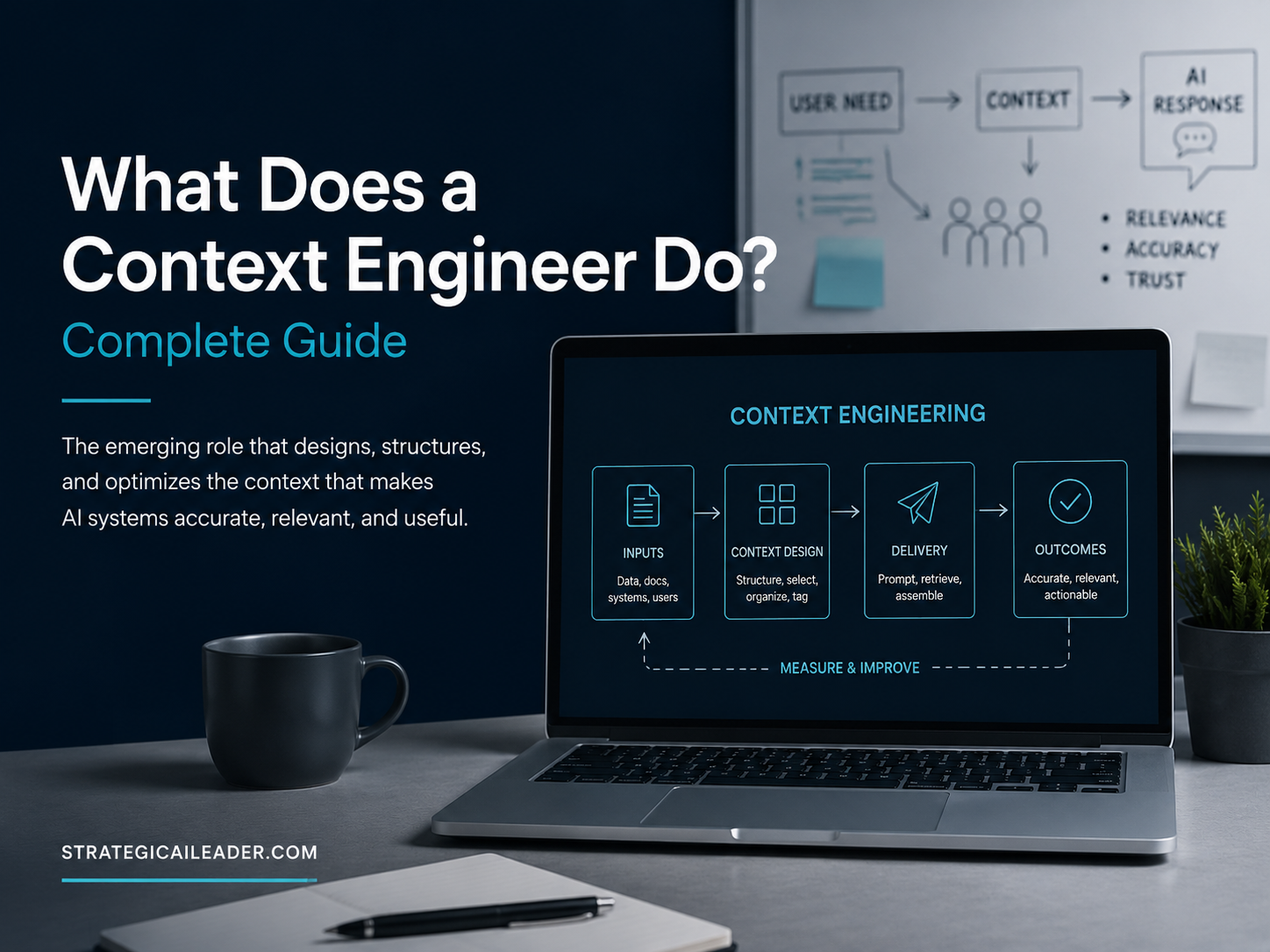
The most honest answer to “what does a context engineer do all day?” is this: they build the systems that determine what your AI knows before it answers anything. Not the prompts. The information architecture underneath the prompts.
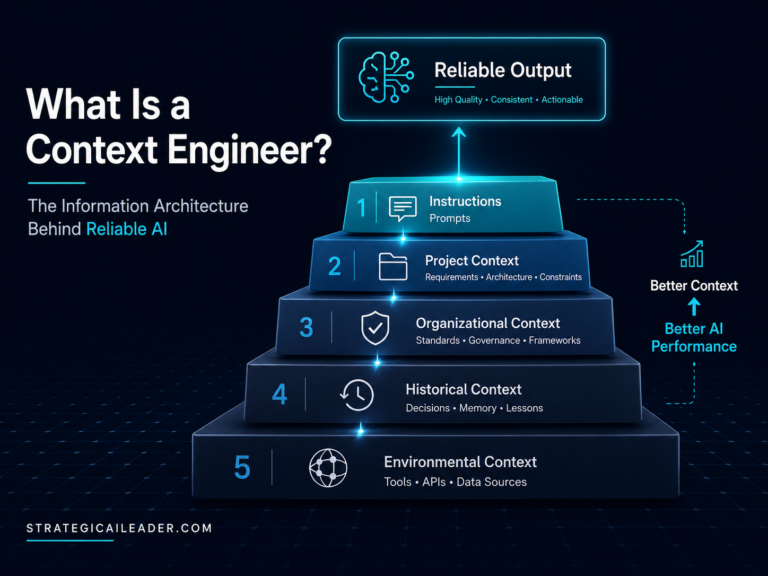
Andrej Karpathy named context engineering in June 2025 as “the delicate art and science of filling the context window with just the right information for the next step.” One week earlier, Tobi Lutke at Shopify had described it as providing all the context for a task to be plausibly solvable by the LLM. By early 2026, enterprise teams were posting job listings, salary bands were forming, and the role had a distinct skill set that separates it from prompt engineering, AI engineering, and product management.
Read this if you are trying to hire a context engineer, become one, or decide whether your team actually needs one yet. For the foundational definition of the role, start with What Is a Context Engineer?.
What Does a Context Engineer Do Day to Day?
| What does a context engineer do all day? A context engineer spends most of their time building, maintaining, and improving the information systems that AI models run inside. On a given day: auditing knowledge registries for drift, designing retrieval architecture for a new workflow, writing structured context documents that encode organizational rules, and diagnosing why an AI output failed at the context layer rather than the prompt layer. Closer to information architecture than to writing. |
Four activities repeat throughout the week:
- Context architecture design. Before a single prompt is written, a context engineer maps what the model needs to know: project constraints, organizational rules, historical decisions, environmental state. Then they build the structures that supply it.
- Registry maintenance. Framework registries, entity registries, organizational knowledge bases: all of them drift as the organization changes. Stale context is often worse than no context. Keeping these documents accurate is a recurring ownership responsibility, not a one-time setup task.
- Failure diagnosis. When AI outputs turn inconsistent or wrong, a context engineer traces the failure. Most production failures originate at the context layer, not the prompt layer. Knowing which one broke is a different analytical skill than knowing how to improve a prompt.
- Enforcement mechanism design. Building the blocking gates and verification steps that confirm context is complete before generation begins. Without enforcement, context stacks work in demos and fail in production. That gap is what enforcement closes.
I built the StrategicAILeader content pipeline as a working example of this. Every article runs through context enforcement steps before generation starts: framework registry lookup, entity registry check, metrics retrieval, link validation. Those steps are the context engineering. The prompts are almost secondary. Understanding what this looks like inside a real operator workflow makes the abstraction concrete.
What Does a Context Engineer Actually Deliver?
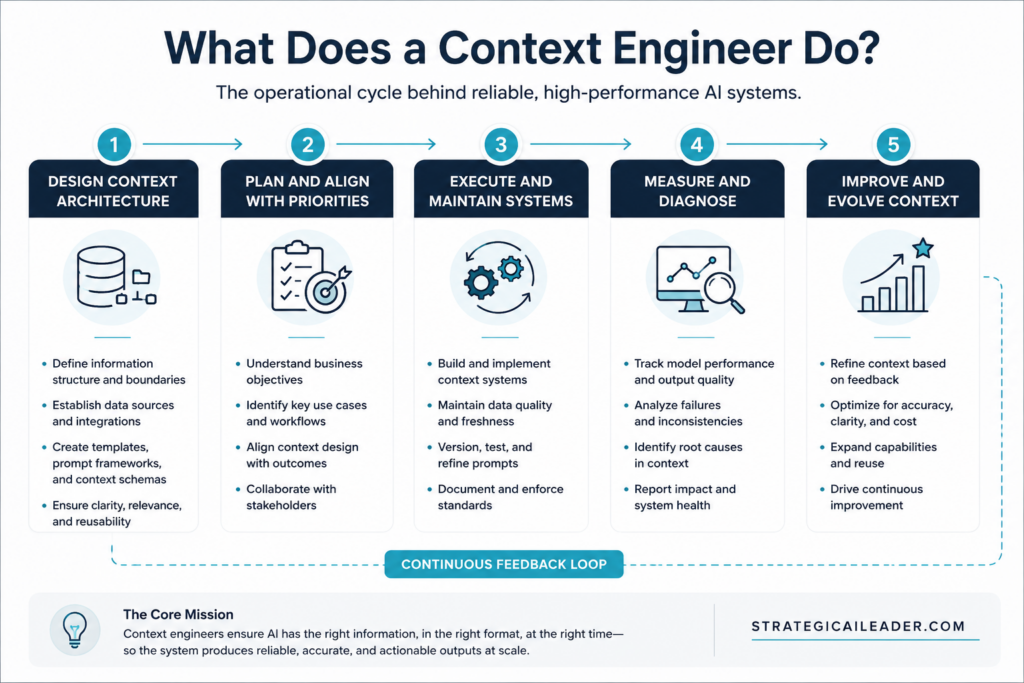
execution, measurement, and continuous improvement.
| What are the deliverables of a context engineer? Primary deliverables are the information systems and governance structures that make AI workflows reliable: context architecture documents, organizational knowledge registries, retrieval system designs, enforcement checkpoints, failure analysis reports, and context stack maintenance protocols. The outputs are infrastructure. Not content. |
Concretely:
- Context architecture document. A structured specification of what information layers a workflow requires, how they are sourced, how they are maintained, and what the enforcement gate looks like before generation begins.
- Organizational context registry. A living document encoding terminology preferences, quality standards, audience definitions, brand voice rules, and authority structures. Most organizations do not have one. Building it is among the highest-impact things a context engineer does: Layer 3 of the Context Stack, almost always the most absent layer.
- Framework and entity registries. Named, defined, and versioned records of the concepts and mental models the organization applies consistently. Without these, AI outputs are generically correct and organizationally inconsistent.
- Retrieval system design. Architecture decisions governing how historical context, project records, and external knowledge get retrieved and injected at the right moment. Includes RAG system design when relevant.
- Failure analysis reports. Post-mortems on AI output failures that trace root cause to the context layer. Each report identifies what was missing, why it was missing, and what enforcement change prevents recurrence.
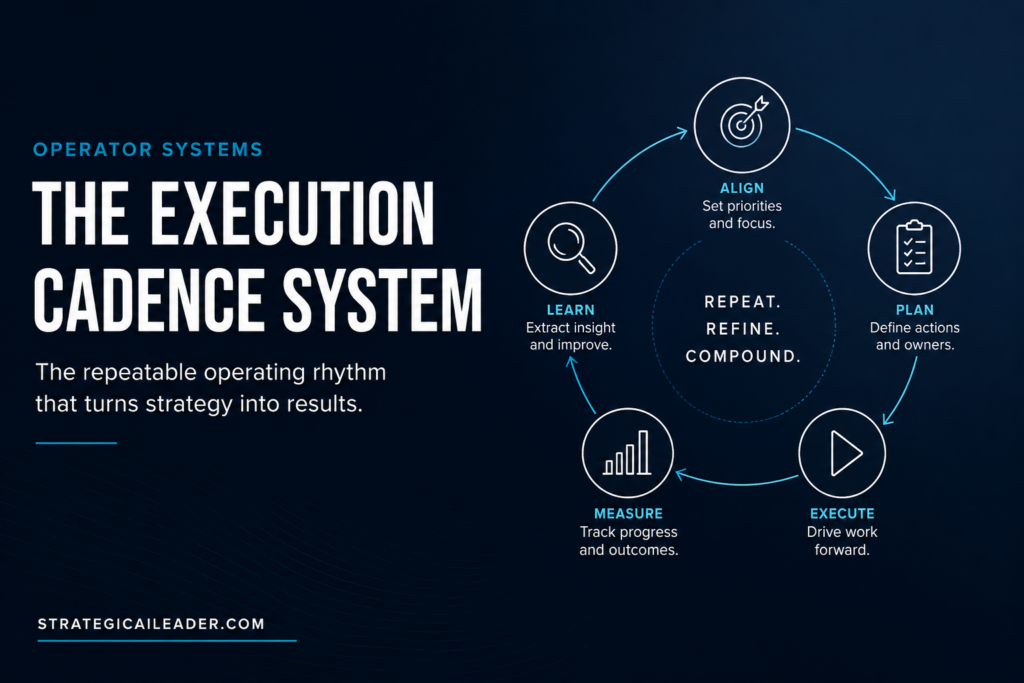
- Context maintenance protocols. Update triggers, review cadences, deprecation processes. A context stack without maintenance protocols degrades predictably. Writing these protocols is what separates a context stack that lasts from one that decays.
None of these deliverables are prompts. A context engineer’s work product is the infrastructure that prompts run on top of. To understand why this infrastructure layer connects to decision-making reliability more broadly, the decision infrastructure article covers the structural foundations underneath.ions.
What Skills Does a Context Engineer Need?
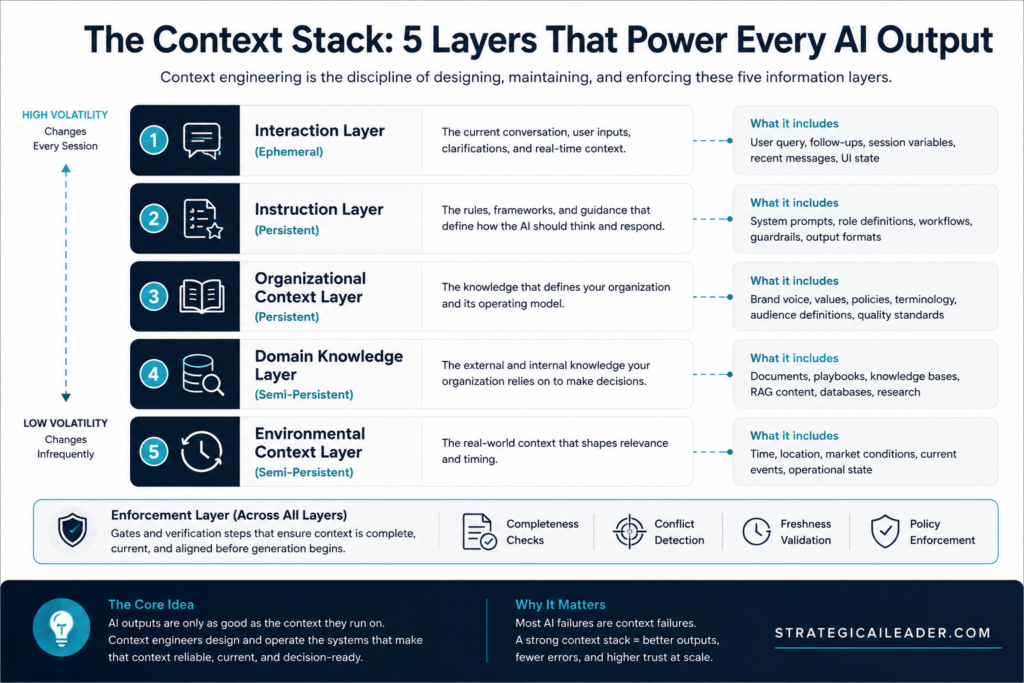
that support every AI decision.
| What skills does a context engineer need? Information architecture skills to design layered knowledge systems. Organizational knowledge management skills to capture and encode the rules and history that govern good AI outputs. Workflow design skills to build enforcement mechanisms. Enough technical fluency to implement or specify retrieval systems, vector databases, and context pipeline architecture. Writing ability matters, but it is downstream of systems thinking. |
Three tiers:
Core skills
- Information architecture: designing structured, layered knowledge systems that can be queried, maintained, and enforced at generation time.
- Organizational knowledge management: understanding how an organization thinks, what rules it applies, and how to encode that knowledge in a form an AI system can use consistently.
- Workflow systems design: mapping information flow from source to context window and building the enforcement gates that verify completeness before generation begins.
- Failure analysis: diagnosing whether an AI output failure originated at the instruction layer or the context layer, then prescribing a structural fix rather than a prompt tweak.
Technical skills (depth varies by role)
- RAG system design and retrieval architecture: retrieving the right information at the right time from document stores, vector databases, or structured knowledge bases.
- Prompt design: enough fluency to write and evaluate prompts, though prompt writing is not the primary output of the role.
- Context pipeline implementation: specifying or building the systems that assemble context before generation, whether in Python, LangChain, LlamaIndex, or custom tooling.
Domain knowledge (increasingly important)
Domain knowledge matters more than most expect. A context engineer who understands how a financial compliance workflow should behave is worth more than a generalist who only knows the AI tooling. The job requires understanding the business problem deeply enough to know what information the model actually needs. Without that, a technically correct context stack can be organizationally useless. I have seen this happen. The architecture was sound. The organizational knowledge inside it was wrong.
What Does a Context Engineer Earn?
What is a context engineer salary? Context engineer compensation in 2026 ranges by technical depth and seniority. Generalist roles focused on knowledge management and context design sit between $85,000 and $120,000. Roles requiring technical implementation of retrieval systems, RAG pipelines, and context architecture run $130,000 to $180,000 or higher at senior levels. Mid-level compensation has moved faster than comparable ML engineering roles because the supply constraint is structural: the discipline did not exist as a formal role two years ago.
ZipRecruiter salary data shows the average context engineer salary in the United States at approximately $101,752 per year as of mid-2026, with most roles falling between $84,000 and $116,500. Technical roles requiring production context pipeline ownership command significantly more.
Two tracks are forming:
- Architectural track. Context engineers who design information systems, build registries, and own governance protocols without deep coding. Emerging inside growth, operations, and content organizations. Compensation: $85,000 to $120,000.
- Technical track. Context engineers who build retrieval systems, RAG pipelines, and context assembly infrastructure. Sitting inside AI and platform teams. Compensation: $130,000 to $180,000 and above at senior levels.
What is driving these numbers is structural, not cyclical. No pipeline of context engineers promoted from within exists because the discipline did not exist two years ago. Organizations competing for production-ready context architecture skills are paying above their stated bands to close that gap.
Where Does a Context Engineer Sit on a Team?
| Where does a context engineer sit in an organization? Context engineers sit closest to the teams that own AI workflow outcomes. In technical organizations: embedded in AI or platform teams. In growth and content organizations: reporting into operations or product. In early-stage companies: the role is often carried by a founder or senior operator informally. Team placement follows the failure surface. Wherever AI outputs are most inconsistent is where a context engineer creates the most value. |
Placement varies by org type:
- AI-native companies. Context engineering is a first-class discipline with dedicated headcount, usually sitting between product and engineering. Attending both product planning sessions and technical architecture reviews is typical.
- Enterprise AI adoption. Context engineers embed in Center of Excellence teams or AI governance functions, working across business units to standardize context architecture and build shared registries.
- Growth and content organizations. Often without the formal title, the work is identical: building the information environment that AI workflows run inside. The StrategicAILeader pipeline is this pattern exactly.
- Early-stage companies. One technical founder or senior operator usually carries the function. It becomes a distinct hire when inconsistent AI outputs start creating visible drag on execution speed , not before.
Worth noting: organizations building for AI visibility face the same context architecture problem that operators building for AI execution face. The GEO operating model covers this at the retrieval and citation layer. Context engineering and GEO are the same discipline applied at different levels of the stack.s.
Context Engineer vs. Prompt Engineer vs. AI Engineer vs. Product Manager
This is where most hiring conversations get confused. The four roles are genuinely distinct. The table below maps the differences across six dimensions.
Role Comparison: Where Each Discipline Works
Most hiring conversations get confused here. Four roles. Genuinely distinct. The table below maps the differences across six dimensions.
Role Comparison: Where Each Discipline Works
| Dimension | Context Engineer | Prompt Engineer | AI Engineer | Product Manager |
|---|---|---|---|---|
| Primary focus | Information architecture | Instruction optimization | Model training & infra | Product strategy & roadmap |
| Core skill | System design + knowledge mgmt | Lexical craft | ML engineering | Cross-functional leadership |
| Output | Context systems that persist | Better prompts per session | Models + pipelines | Specs + priorities |
| Compounds? | Yes, architecture persists | No, resets each session | Yes, at model level | Yes, at product level |
| Failure mode | Stale or incomplete context | Phrasing misses intent | Model drift or bias | Misaligned requirements |
| Typical team | AI / Ops / Growth | Any function | ML / Platform | Product org |
Context Engineer vs. Prompt Engineer
A prompt engineer refines how a task is phrased. A context engineer builds the environment that phrasing operates inside. Prompt engineering is a skill anyone can apply in a single session. Context engineering produces infrastructure that persists and compounds. Not competitive roles. Different layers. But teams that invest exclusively in prompts and skip context architecture are tuning one layer of a five-layer system, then wondering why outputs stay inconsistent.
Context Engineer vs. AI Engineer
An AI engineer builds and maintains model infrastructure: training pipelines, fine-tuning processes, evaluation frameworks, deployment systems. A context engineer works above that layer, in the information architecture that determines what the model receives at inference time. In agentic systems, where context-first architecture meets model-level tool use, the two roles converge. Engineers who can operate at both layers represent the ceiling of current AI compensation in 2026.
Context Engineer vs. Product Manager
A product manager owns strategy, roadmap, and requirements for what gets built. A context engineer owns the information architecture that makes what gets built reliable. Both roles think deeply about what AI needs to know and why. Output is the difference: a PM produces specs and priorities; a context engineer produces the context systems those specs depend on. Without a dedicated context engineer, PMs absorb the context design work informally. That is a tax on PM capacity. For a frame on where these responsibilities converge at the execution layer, the decision infrastructure article covers the intersection.
How Do You Become a Context Engineer?
| How do you become a context engineer? No established certification path exists. The discipline formalized only in 2025. Fastest routes in are through demonstrated project work: building context systems, designing organizational knowledge registries, implementing retrieval architectures, documenting failure patterns in AI workflows. Non-engineers with deep knowledge management, information architecture, or organizational design backgrounds are finding paths in, particularly at companies where domain knowledge outweighs coding depth. |
Career paths forming in 2026:
- From AI and ML engineering. Engineers shifting from model infrastructure toward inference-time context design. Compensation carries over and often increases due to the supply constraint on production-ready context architecture skills.
- From product management or operations. Operators who already own workflow design, knowledge management, or AI adoption functions and formalize that work into a distinct role. More about naming the existing work than learning entirely new skills.
- From information architecture or knowledge management. Practitioners from library science, enterprise knowledge management, or content strategy who retrain toward AI context systems. Domain knowledge translates directly. Technical depth can be added incrementally.
- From prompt engineering. Prompt engineers who recognize that instruction optimization has a ceiling and expand scope to the context layer. The jump requires shifting from lexical thinking to systems thinking. I made a version of this shift when building the StrategicAILeader pipeline. The frame changed before the tools did.
Demonstrated project work consistently outperforms credentials for landing interviews. Build something: a published context architecture, a registry system with provenance, a before-and-after analysis of output quality after a context layer change. That is the fastest credential available right now.anding interviews. The fastest credential you can build right now is a documented context engineering project: a published context architecture, a registry system with provenance, or a before-and-after analysis of AI output improvement after context layer changes.
What Changes When You Have a Context Engineer
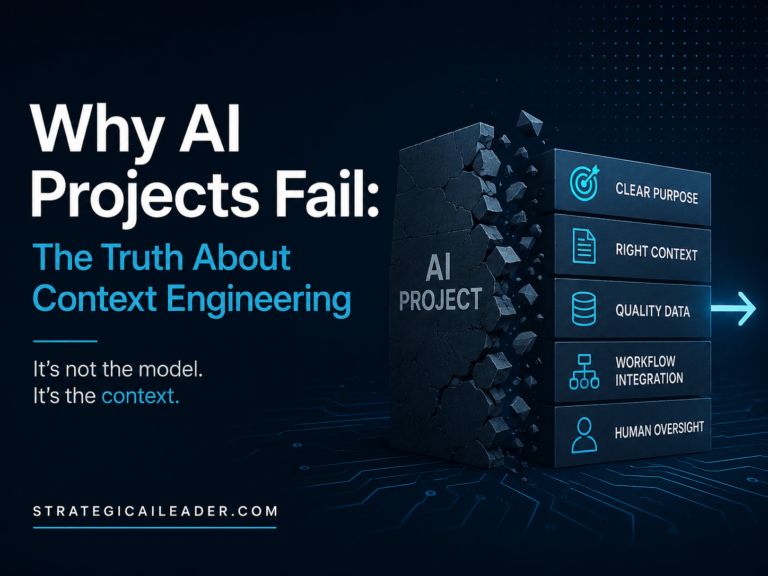
The S&P Global 2025 survey found that 42 percent of companies abandoned most AI initiatives that year, up from 17 percent the year before. The failure rate more than doubled in twelve months. MIT’s 2025 State of AI in Business study put the scale of this differently: 95 percent of enterprise AI pilots delivered zero measurable ROI. The root cause in both datasets is not model quality. It is context quality.
From the StrategicAILeader pipeline, the before-and-after looks like this after adding context enforcement architecture:
- Hard failure rate dropped from 34 percent to 9 percent after adding one blocking context verification step before generation.
- First-attempt QA pass rate rose from 41 percent to 79 percent in the same period. The prompts did not change. The context layer did.
- Named framework citation rate in AI assistant outputs rose from 4 percent to 19 percent after frameworks were embedded in structured context registries.
- Brief completion time dropped from 68 minutes to 18 minutes because every downstream step had what it needed before it started.
None of these gains came from better prompts. They came from a context engineer designing the information environment the prompts operate inside. That is what the role produces. For organizations building for AI discoverability as well as AI execution, the GEO operating model shows how context architecture applies at the retrieval and citation layer too.
Four Ways to Start Building Context Engineering Capability Now
Not ready to hire a context engineer yet? These four actions move you in the right direction this week:
- Audit your last five AI output failures at the context layer. For each failure, ask whether the problem was a bad instruction or missing information. Tally the results. If missing information dominates, you have a context architecture gap, not a prompting gap.
- Build one organizational context document. Write down terminology preferences, quality standards, audience definitions, and authority rules in a single structured document. Make it explicit input to your AI workflows. Highest-impact starting point. Most commonly absent layer.
- Name and register your frameworks. Identify the mental models your team applies consistently and give them canonical names with structured definitions. Register them in a document your AI workflows can access. Named frameworks produce more consistent outputs and create citation surfaces in AI-generated content.
- Add one pre-generation verification step. Before any significant AI generation runs, confirm that project context, organizational rules, and relevant history are explicitly available. Single habit shift. Beginning of context engineering discipline.
The Role That Makes AI Actually Work
A context engineer is not a prompt writer with a better title. Different deliverables. Different skill set. Outputs that compound in a way prompt optimization never does.
Organizations building durable AI capability in 2026 are treating context as infrastructure. They are building information environments where organizational knowledge persists, prior decisions are available, and quality rules are enforced before generation begins.
The gap between organizations doing this and organizations still refining prompts is widening. It will widen faster as agentic AI systems become the primary execution layer. Agents are completely dependent on context quality. A context engineer is the person who makes that quality reliable.
The next article in this series breaks down the Context Stack layer by layer, with implementation detail for each one. Subscribe below and I will send it directly.
Frequently Asked Questions About Context Engineers
What does a context engineer do?
A context engineer designs and maintains the information systems that AI models use before generating outputs. Their work includes building context architectures, managing organizational knowledge, designing retrieval systems, creating governance rules, and implementing verification processes that improve AI reliability.
What is a context engineer?
A context engineer is a professional responsible for ensuring AI systems receive the right information at the right time. Instead of focusing primarily on prompts, they focus on the context layer, including knowledge bases, registries, historical decisions, business rules, and retrieval systems.
What is the difference between a context engineer and a prompt engineer?
A prompt engineer optimizes instructions given to an AI model. A context engineer designs the information environment those instructions operate within. Prompt engineering improves how a request is phrased. Context engineering improves what the AI knows before responding.
What skills does a context engineer need?
Successful context engineers typically combine:
- Information architecture
- Knowledge management
- Workflow design
- AI systems thinking
- Retrieval architecture
- Context governance
- Failure analysis
- Organizational design
Technical roles often require experience with RAG systems, vector databases, Python, LangChain, or similar AI infrastructure tools.
How much does a context engineer make?
As of 2026, context engineer salaries typically range from:
- $85,000 to $120,000 for architecture and knowledge management focused roles
- $130,000 to $180,000+ for technical roles involving retrieval systems, RAG pipelines, and production AI infrastructure
Compensation varies based on industry, technical depth, and organizational maturity.
Do you need to be a software engineer to become a context engineer?
No. Many context engineers come from product management, operations, knowledge management, content strategy, or information architecture backgrounds. Technical skills help, but understanding how organizations create, manage, and use knowledge is often more important.
What tools do context engineers use?
Common tools include:
- Vector databases
- Knowledge graphs
- RAG frameworks
- LangChain
- LlamaIndex
- Notion
- Confluence
- Airtable
- Python
- MCP servers
- Organizational knowledge repositories
The specific toolset depends on the organization’s AI maturity and technical requirements.
Where do context engineers sit within an organization?
Context engineers typically work within:
- AI teams
- Platform engineering teams
- Product organizations
- Operations groups
- AI Centers of Excellence
In smaller companies, founders or senior operators often perform context engineering responsibilities before hiring a dedicated specialist.
Why are context engineers becoming important?
Organizations are discovering that many AI failures stem from missing, outdated, or poorly structured context rather than model limitations. As AI systems become more agentic and autonomous, the quality of context increasingly determines the quality of outcomes.
What are the main deliverables of a context engineer?
Common deliverables include:
- Context architecture documents
- Organizational context registries
- Framework registries
- Entity registries
- Retrieval system designs
- Context maintenance protocols
- Governance standards
- Failure analysis reports
- Verification and enforcement workflows
How do you become a context engineer?
The fastest path is through practical experience. Build context systems, create organizational knowledge registries, document AI workflow failures, and design retrieval architectures. Employers increasingly value demonstrated projects over certifications because the discipline is still emerging.
Is context engineering the future of AI development?
Context engineering is becoming a foundational discipline as organizations move from simple chatbot use cases to production AI systems and autonomous agents. Better models continue to improve performance, but context quality increasingly determines whether AI systems deliver reliable business outcomes.
Help Support My Writing
Subscribe for weekly articles on leadership, growth, SEO and AI-driven strategy. You’ll receive practical frameworks and clear takeaways that you can apply immediately. Connect with me on LinkedIn or Substack for conversations, resources, and real-world examples that help.
About the Author
I’m Richard Naimy, an operator and product leader with over 20 years of experience growing platforms like Realtor.com and MyEListing.com. I work with founders and operating teams to solve complex problems at the intersection of product, marketing, AI, systems, and scale. I write to share real-world lessons from inside fast-moving organizations, offering practical strategies that help ambitious leaders build smarter and lead with confidence.
I write about:
- AI + MarTech Automation
- AI Product Development
- AI Strategy
- Context Engineering
- COO Ops & Systems
- Growth Strategy (B2B & B2C)
- Infographic
- Leadership & Team Building
- Marketplace Growth Strategy
- My Case Studies
- Personal Journey
- Revenue Operations (RevOps)
- Sales Strategy
- SEO & Digital Marketing
- Strategic Thinking
Want 1:1 strategic support?
Connect with me on LinkedIn
Read my playbooks on Substack