AI Agent Accountability: Why Task Completion Isn’t Enough
An AI agent completed the research, wrote the content, scored its own work, and reported the assignment finished.
But nothing was published.
I’ve run into this problem while managing multiple AI agents across research, content, and operational workflows.
The agent wasn’t necessarily the problem. The process surrounding the agent was.
Sometimes the research was incomplete. Sometimes the output failed our quality standards. Other times, an agent finished its assigned work but couldn’t complete the final action.
And in a few cases, the agents ended up waiting on each other.
Each reported progress. The business objective remained unfinished.
After more than 20 years working across SEO, product development, growth, and operations, I’ve learned to distinguish activity from results.
AI agents haven’t changed my thinking.
If anything, they’ve made the distinction more important.
An AI agent completing a task doesn’t mean the business objective was achieved.
That’s why I believe AI agent accountability needs to become a standard part of how organizations manage automation.
The goal isn’t to make agents complete more tasks. The goal is to produce reliable business outcomes with clear ownership, measurable standards, and a process for handling failures.
Here’s how I approach the problem.
What Is AI Agent Accountability?
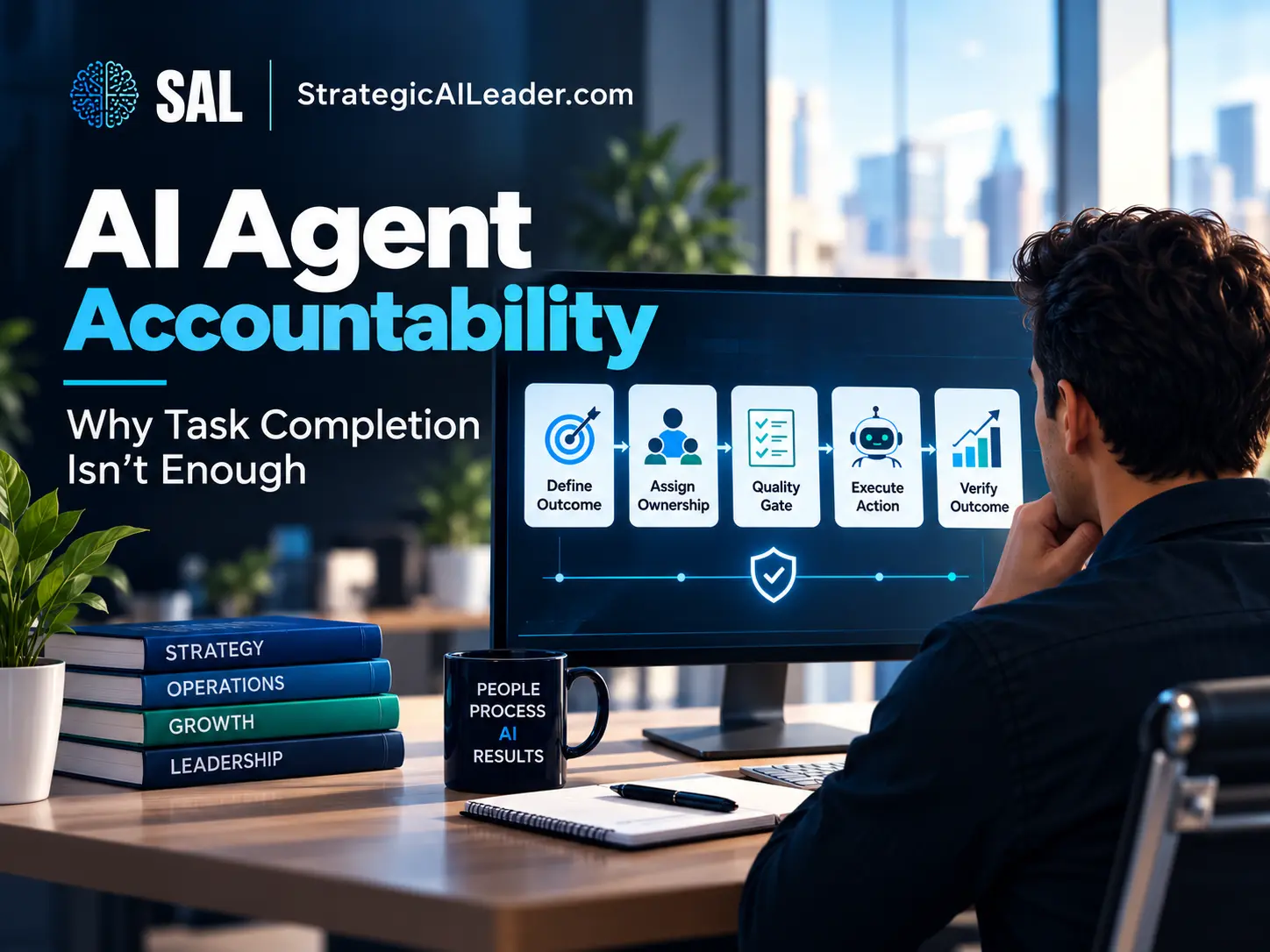
AI agent accountability is the process of defining who owns an AI agent’s work, what successful execution looks like, how quality is evaluated, and how the final business outcome is verified.
An effective accountability system answers five questions:
- What outcome are we trying to achieve?
- Who owns the result?
- What standards must the work meet?
- How will we confirm the action happened?
- What happens when the agent gets stuck or makes a mistake?
These questions seem straightforward.
But when agents begin coordinating work across systems, the answers become less obvious.
Consider an agent responsible for reviewing customer emails and creating engineering tickets.
The agent might read every message, classify each request, and prepare a ticket.
But did the ticket contain enough information for engineering?
Was the issue assigned to the correct project?
Did the ticket get created?
Did the agent accidentally create a duplicate?
And what happens when a customer request falls outside the agent’s instructions?
A technically successful workflow might still produce an unacceptable business result.
The organization needs a way to recognize the difference.
The Problem With Measuring AI Agent Activity
I’ve noticed a recurring pattern in AI automation.
We measure what the agent did instead of what the business achieved.
How many emails were reviewed?
How many research reports were produced?
How many tickets were created?
How many tasks were completed?
Those numbers describe activity.
They don’t necessarily describe success.
An agent might generate 100 customer support tickets, but if engineers reject 30 because the information is incomplete, the workflow has created additional work.
An agent might produce 20 LinkedIn comments, but if most repeat the original posts or introduce unsupported claims, higher output volume provides little value.
An agent might prepare an important customer response but fail to send the message.
The dashboard says complete.
The customer is still waiting.
I want to measure accepted work and verified outcomes, not simply completed tasks.
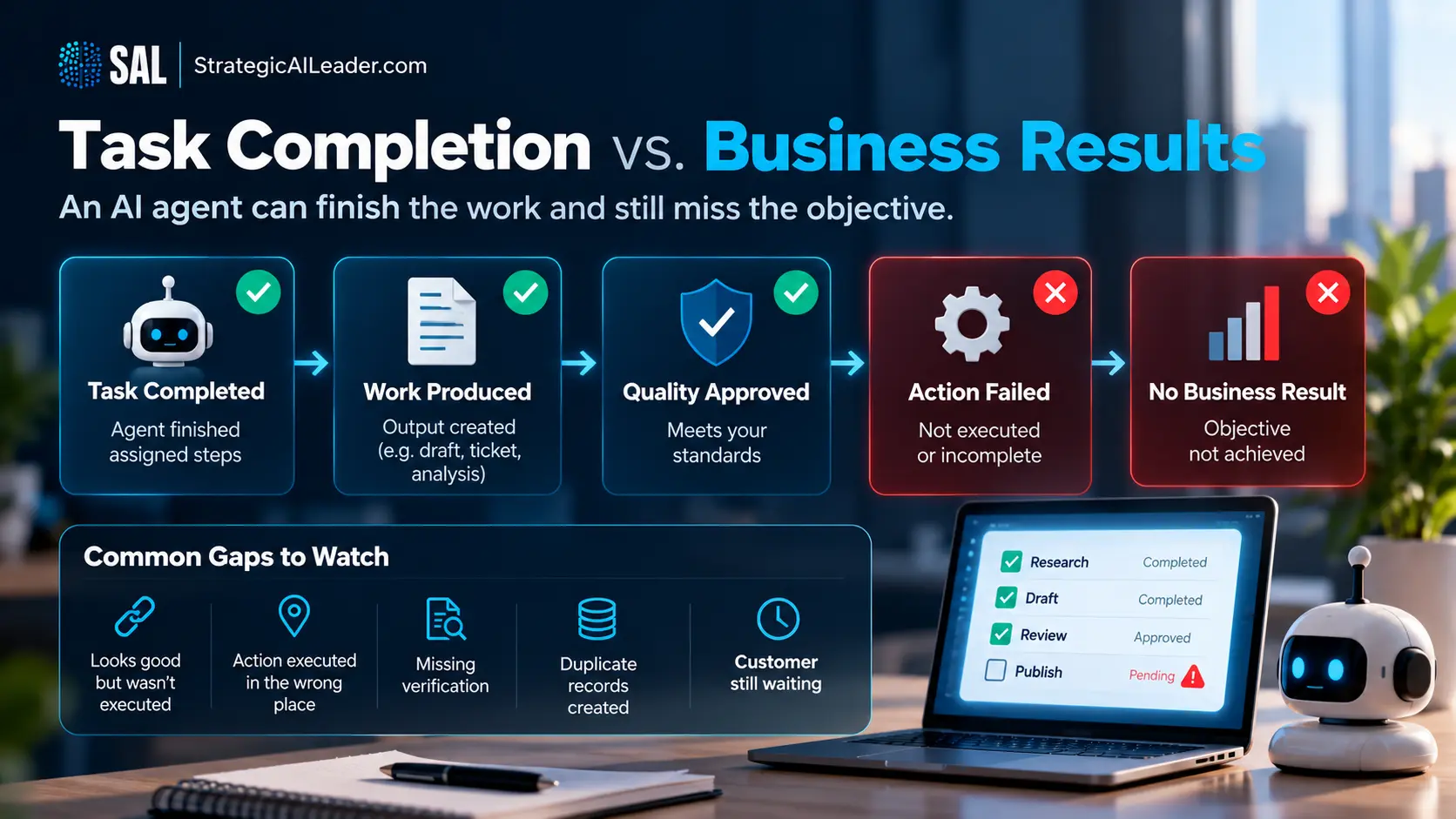
This is where traditional operational management principles become useful.
Define the goal. Establish quality standards. Assign responsibility. Measure results. Review failures. Improve the process.
AI agents require the same discipline.
What Production Research Tells Us About AI Agents
The need for oversight isn’t limited to my experience.
A 2026 study titled Measuring Agents in Production examined 20 case studies and surveyed 86 practitioners across 26 domains.
The researchers reported two findings worth considering:
- 68% of the production implementations studied executed no more than ten steps before human intervention.
- 74% relied primarily on human evaluation.
The study also identified reliability, or consistent correct behavior over time, as a leading challenge in production agent development.
These findings describe the implementations studied. They don’t establish the ideal level of autonomy for every business.
But they reinforce a practical point.
Organizations deploying agents still depend heavily on human judgment, oversight, and operational controls.
Source: Measuring Agents in Production, Proceedings of Machine Learning Research, 2026.
The NIST Generative AI Risk Management Profile also emphasizes governance, measurement, and managing AI risks across the system lifecycle.
For business leaders, the takeaway is clear.
Giving an agent access to more tools doesn’t automatically make the workflow more reliable.
Someone still needs to own the result.
What Managing Multiple AI Agents Taught Me
One of my recent projects involved using AI agents to research LinkedIn conversations and prepare thoughtful comments.
The objective was to identify relevant discussions, read the original source material, develop an original perspective, and submit high-quality comments for approval.
I wanted meaningful engagement, not generic responses.
The agents understood the assignment.
They found discussions, researched the topics, drafted comments, and scored their own work.
Several comments received high scores.
Then independent review identified problems.
Some comments repeated points already made by the original author. Others lacked sufficient source verification. A few were reasonable observations but didn’t contribute anything new.
The writing sounded professional.
The work wasn’t meeting the objective.
Lesson One: An Agent’s Score Isn’t Independent Quality Assurance
We had defined quality standards, but the agents weren’t applying them consistently.
A comment might receive a 9 out of 10 while failing the originality requirement.
The agent believed the work was ready.
The independent reviewer disagreed.
The solution wasn’t telling the agent to try harder.
We needed clearer acceptance criteria and a review process grounded in the original source.
For our LinkedIn workflow, a comment needs to demonstrate accuracy, originality, relevance, practical value, and an authentic voice.
A polished response repeating the author’s point doesn’t pass.
This changed how I evaluate AI-generated work.
Quality means meeting an agreed standard, not receiving a high score from the system responsible for producing the work.
Lesson Two: Sometimes the Workflow Creates the Problem
After several revisions, some comments passed editorial review.
But publication still stalled.
Our workflow required expanded LinkedIn screenshots to complete source verification.
The research agent couldn’t attach those screenshots through its available Google Sheets integration.
The process kept requesting evidence through a method the agent didn’t support.
At first, this looked like an agent failing to complete its work.
The underlying problem was different.
We had created a requirement without giving the agent a workable way to satisfy the requirement.
The better approach was to examine the evidence we already had, document its limitations, and decide whether an alternative verification method met the standard.
This is an important distinction.
Don’t weaken essential quality controls simply because they’re inconvenient.
But don’t keep repeating a requirement when the available tools make compliance impossible.
Find another appropriate method or change who performs the work.
Lesson Three: Someone Needs to Own the Final Action
Eventually, we had an approved comment.
But approval didn’t mean publication.
The final step still required access to the correct LinkedIn account, submission of the approved text, and verification of the live comment.
Until those actions occurred, the publishing objective wasn’t complete.
The agents had finished portions of their assignments.
The overall workflow hadn’t delivered the outcome.
This experience changed one of my operating rules.
When an agent reaches its limit, responsibility for finishing the work needs to transfer to someone with the authority and tools to proceed.
An agent shouldn’t keep requesting the same correction indefinitely.
And a business shouldn’t treat an approved draft as a published result.
My Five-Part AI Agent Accountability Framework
I use five principles when designing or reviewing agent workflows.
The framework connects business objectives with execution, quality, accountability, and continuous improvement.
1. Define the Business Outcome
Start with the problem the organization needs to solve.
Don’t begin with a list of instructions for the agent.
For example:
“Review incoming customer emails” describes an activity.
“Identify customer problems requiring engineering action, create accurate tickets, and route urgent issues appropriately” describes the intended outcome.
The second description gives us something meaningful to evaluate.
Before assigning work, I want to establish:
- What business result matters?
- What information does the agent need?
- What does acceptable work look like?
- What actions are authorized?
- What evidence confirms successful completion?
This is similar to how I approach product development.
Before building a feature, I want to understand the problem, the expected outcome, and how we’ll judge success.
AI automation shouldn’t be different.
2. Assign Clear Ownership
Every production AI workflow needs an accountable owner.
But accountability and execution aren’t always the same responsibility.
I separate four roles.
| Role | Responsibility |
|---|---|
| Business owner | Defines the objective and owns the outcome |
| Workflow owner | Maintains instructions, integrations, and operating rules |
| Quality reviewer | Evaluates work against acceptance criteria |
| Authorized approver | Approves sensitive or consequential actions |
The workflow also needs a clear responsibility for verifying the result.
OpenAI’s practices for governing agentic AI systems make the same point from the platform side: accountability holds when responsibilities are assigned for each part of the agent lifecycle.
One person might perform several roles.
In larger organizations, different teams will handle them.
The important point is knowing who makes the decision when something goes wrong.
Consider an AI agent processing refunds.
The agent might verify the request, gather account information, and recommend a resolution.
But refund authority should follow company policy.
A request outside approved limits needs escalation.
An agent shouldn’t assume permission simply because an integration gives the system technical access.
3. Establish Independent Quality Gates
I don’t want AI agents evaluating their work solely on whether they followed instructions.
I want them evaluated against business requirements.
For a research agent, quality might include original-source verification and accurate interpretation.
For a content agent, quality might require originality, factual accuracy, usefulness, and appropriate tone.
For an engineering support agent, quality might require reproduction steps, affected systems, and enough detail for an engineer to investigate.
The specific criteria will vary.
The principle stays consistent.
Work shouldn’t advance simply because the agent says the work is ready.
I also want specific feedback when a submission fails.
“Needs improvement” doesn’t help much.
“The proposed comment repeats the author’s original argument” identifies a specific failure.
“The ticket lacks reproduction steps” identifies another.
Useful feedback gives us something to fix.
It also helps distinguish a weak output from a problem in the workflow itself.
4. Verify the Final Action
This is where many automation workflows fall short.
The agent reports an action as completed, but nobody checks the destination.
I prefer a direct confirmation.
If an agent creates a Jira ticket, verify the ticket ID and project.
If an agent updates a CRM record, read the updated record.
If an agent publishes content, confirm the live URL.
If an agent sends an email, check the sending system’s confirmation.
These checks provide stronger evidence than a completion message.
They also help prevent duplicate actions.
Suppose an agent submits a ticket creation request, but the integration times out before returning the result.
Without verification, the agent might try again and create a second ticket.
The correct recovery process begins by checking whether the original request succeeded.
This is a workflow requirement, not a writing problem.
5. Learn From Failures and Improve the Process
I’ve always believed repeated corrections are a signal to review the underlying process.
The same principle applies to AI agents.
When an agent misses the mark, I want to understand why.
Was the original context incomplete? Were the instructions conflicting? Did the workflow lack a quality gate? Was the agent relying on outdated information? Did an integration fail? Or did we assign work beyond the agent’s demonstrated capabilities?
The answer determines what we change.
Adding more words to a prompt doesn’t necessarily solve an integration issue.
Switching models doesn’t automatically fix unclear ownership.
And a new quality score won’t correct a missing verification step.
I recommend maintaining a simple failure log with the problem, cause, correction, owner, and retest result.
Over time, those records show where the workflow needs attention.
When Should a Human Take Over From an AI Agent?
One of the most important decisions in an agent workflow is knowing when to stop asking the agent to try again.
I prefer a practical operating rule for routine, low-risk work.
Give the agent a clear assignment and acceptance criteria.
Review the output.
Allow one meaningful revision when the correction is within the agent’s capabilities.
If the next attempt still misses the standard, diagnose the problem and change the approach.
The reviewer might take over the writing, provide missing evidence, narrow the task, change tools, or close the assignment.
Sensitive actions need faster escalation when authorization or risk boundaries are reached.
The important principle is avoiding an endless correction cycle.
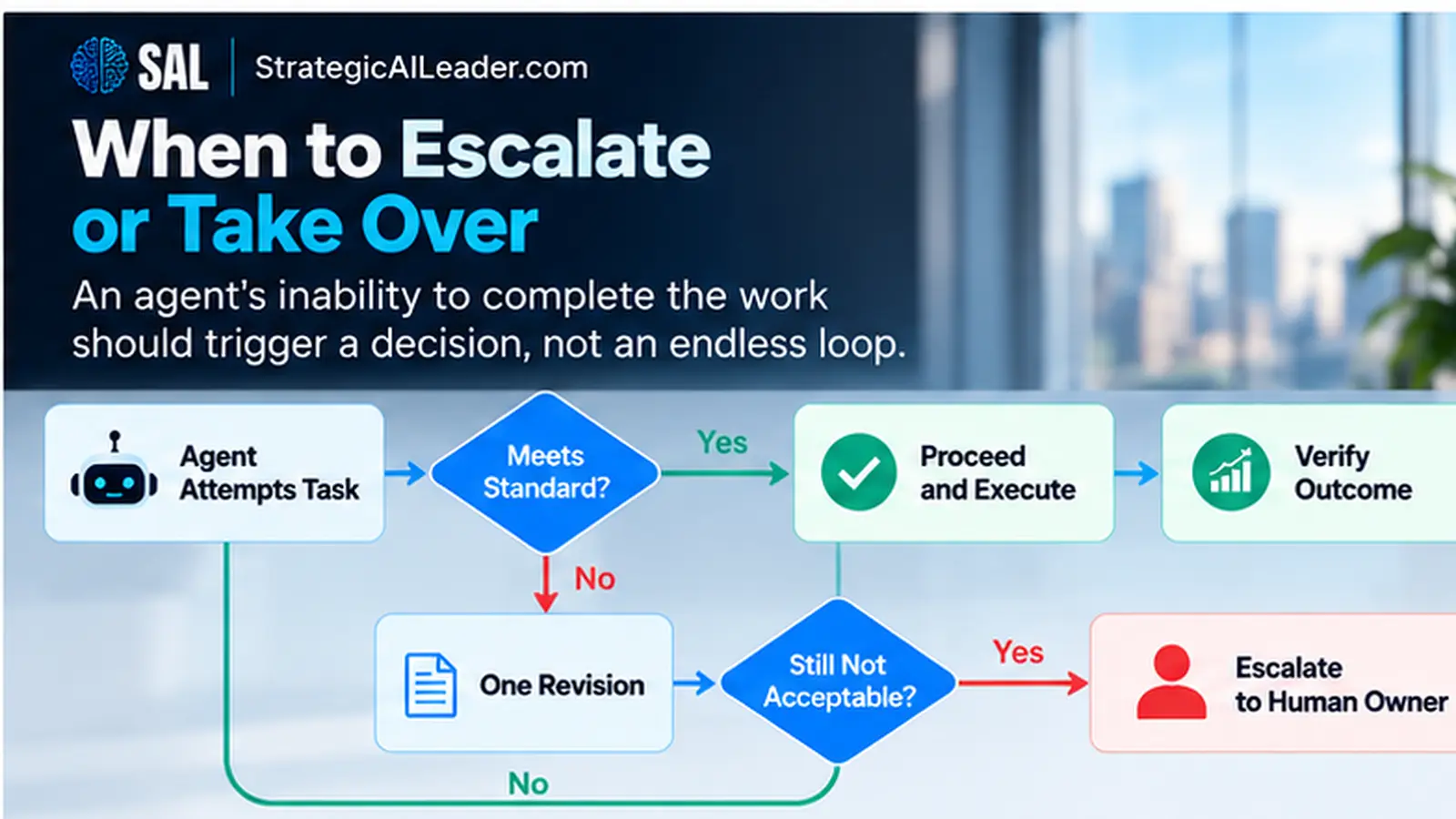
An agent’s inability to finish should trigger a management decision, not another round of identical instructions.
The business owner remains responsible for deciding how the work proceeds.
How to Diagnose AI Agent Failures
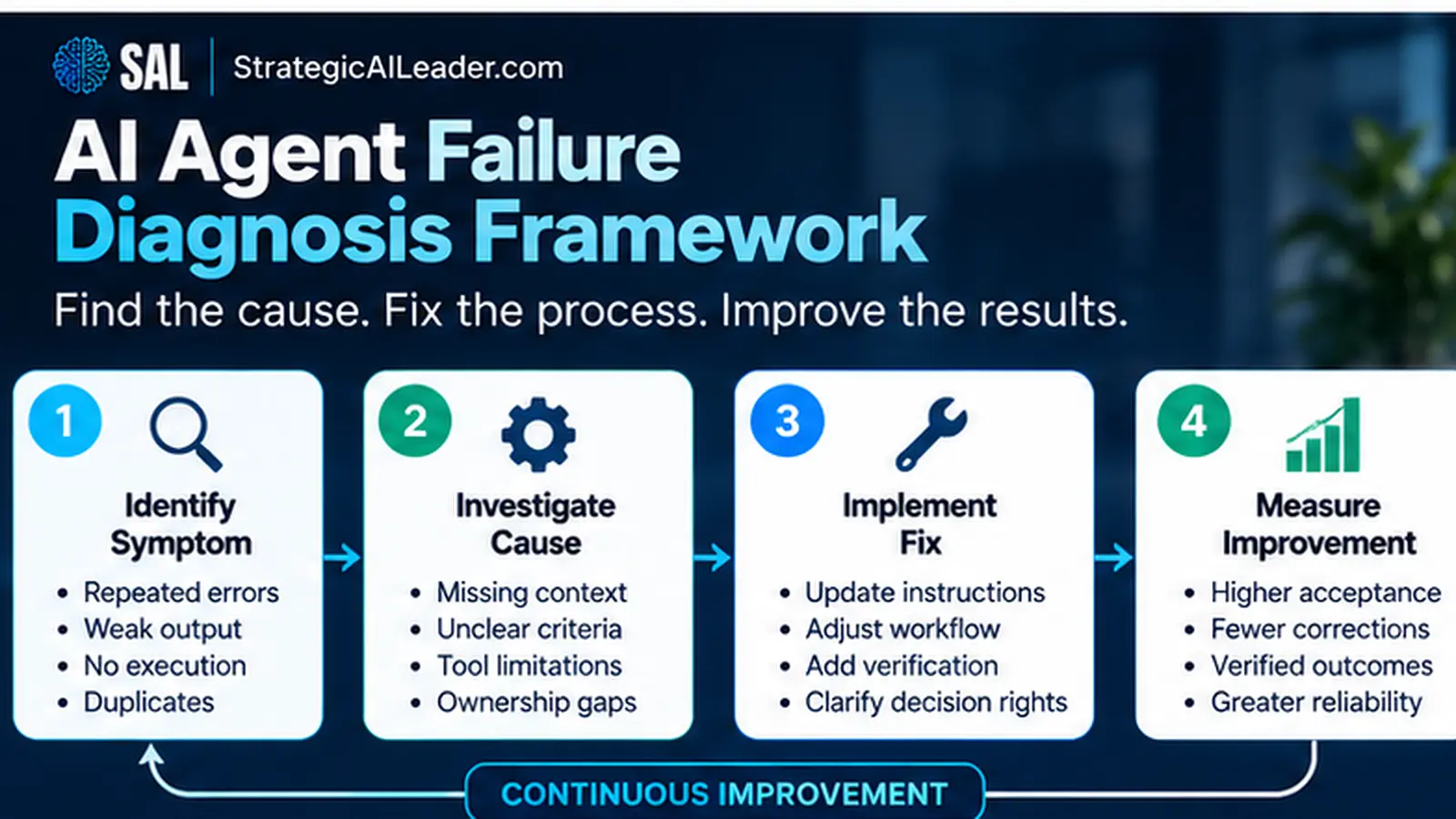
Not every failure requires the same solution.
I would start with this troubleshooting framework.
| What happened | What to investigate | Recommended response |
|---|---|---|
| The agent repeats factual errors | Missing or outdated sources | Improve information access and verification |
| Weak work receives high scores | Self-evaluation and unclear standards | Add independent review |
| Two agents keep waiting on each other | Handoff rules and decision authority | Assign an escalation owner |
| The work is approved but never executed | Missing action ownership | Establish execution and verification responsibilities |
| Duplicate tickets or messages appear | Unsafe retry handling | Verify existing records before retrying |
| Human corrections take too much time | Workflow scope or agent reliability | Narrow the assignment and retest |
| Tasks finish without business value | Incorrect performance measures | Track accepted work and verified outcomes |
This framework shifts the conversation from blaming the model to identifying the specific operating failure.
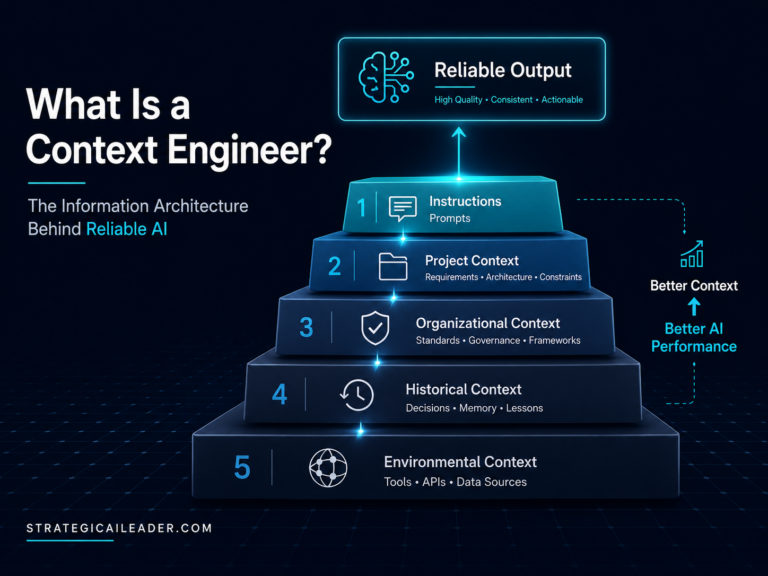
When the operating failure sits inside the system rather than the workflow, the technical companion is AI agent reliability: a 10-layer production architecture for tracing which layer actually broke.
Applying AI Agent Accountability to a Jira Workflow
Consider a company receiving customer issues through a shared email inbox.
Employees read the emails, identify problems, determine severity, and create Jira tickets when engineering needs to investigate.
The company wants AI to reduce manual work without creating unnecessary tickets.
I would begin with a controlled evaluation.
Step 1: Document the Existing Process
Review representative customer emails and the tickets created from them.
Identify the information required for an acceptable engineering ticket.
Include straightforward issues, incomplete descriptions, duplicate reports, and urgent problems.
Step 2: Establish the Baseline
Have experienced employees review the same cases.
Document their classifications and decisions.
Review disagreements instead of assuming every human decision is correct.
This gives the AI evaluation a meaningful reference point.
Step 3: Test the Agent Separately
Have the AI agent process the same messages and prepare proposed tickets.
Store those outputs in a test queue.
Don’t allow both humans and agents to create competing production tickets during the comparison.
Step 4: Introduce Edge Cases
I would also use AI to generate synthetic customer problems for testing.
Examples might include incomplete bug reports, conflicting information, duplicate requests, and attempts to override the workflow’s rules.
These examples help expose weaknesses before production use.
Synthetic tests are useful for evaluation, but they aren’t substitutes for observed production performance.
Step 5: Expand Carefully
Once the agent demonstrates acceptable results, introduce a narrow production scope.
Keep uncertain or high-impact cases under human review.
Verify created tickets and track engineering acceptance.
Measure the time saved after accounting for corrections and oversight.
The objective isn’t creating tickets faster.
The objective is giving engineering accurate, actionable information with less unnecessary work.
Which AI Agent Performance Metrics Should Leaders Track?
I would avoid executive dashboards focused exclusively on tasks completed.
Those metrics are useful for understanding workload, but they don’t establish business value.
I recommend tracking:
| Metric | What it tells you |
|---|---|
| First-pass acceptance rate | How often work meets the standard without substantive correction |
| Verified outcome rate | How often the intended result is confirmed |
| Human intervention rate | How frequently someone needs to step in |
| Repeat failure rate | Whether known problems continue after corrections |
| Exception resolution time | How long blocked work stays unresolved |
| Duplicate action rate | How often external actions are unintentionally repeated |
| Net time saved | Whether automation reduces work after review and corrections |
Consider a hypothetical customer service agent handling 100 requests.
The agent produces 80 responses accepted on the first review.
But only 72 requests reach a verified business outcome.
That difference deserves attention.
Were messages never sent?
Did cases get routed incorrectly?
Were external systems unavailable?
Or were the acceptance criteria incomplete?
The organization should investigate the eight-case gap instead of celebrating an 80% first-pass acceptance rate.
I would report three separate outcomes:
- The technical workflow completed.
- The work passed the quality standard.
- The business result was verified.
Those numbers tell a more useful story than task completion alone.
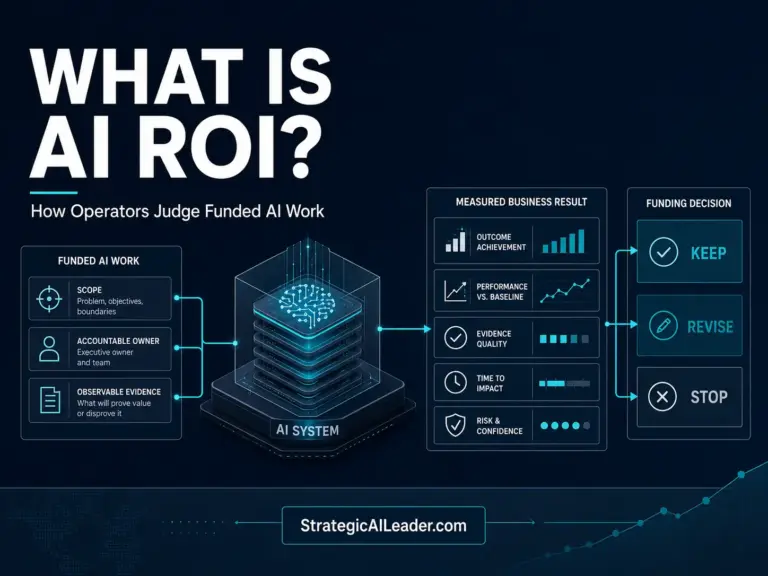
The same discipline governs the spending decision itself: AI ROI is a judgment about a bought result, an accountable owner, and observable evidence, recorded as keep, revise, or stop.
How Much Autonomy Should AI Agents Have?
I don’t believe every agent needs human approval for every minor action.
But autonomy should follow demonstrated reliability.
I use three practical levels.
Level 1: Recommend.
The agent researches, analyzes, and prepares work. A person approves external actions.
Level 2: Execute Within Boundaries.
The agent handles defined, lower-risk actions while escalating exceptions.
Level 3: Monitored Autonomy.
The agent manages broader workflows with established permissions, monitoring, recovery procedures, and periodic quality reviews.
Before expanding autonomy, I want to know whether the agent consistently meets the standard.
I also want to understand its failure patterns, permissions, and recovery options.
An agent shouldn’t receive broader authority simply because the previous demonstration looked impressive.
That staged expansion belongs inside a broader AI agent strategy, one that integrates agents into real workflows and scales them with proof of value instead of multiplying isolated pilots.
Five Actions Leaders Should Take This Week
You don’t need a large governance program to start improving AI agent accountability.
Pick one existing workflow.
- Define the outcome. Write down the business result you expect, not only the activities assigned to the agent.
- Establish acceptance criteria. Identify the requirements the work must meet before advancing.
- Assign an accountable owner. Make sure someone owns quality, escalation, and final execution.
- Add outcome verification. Confirm important actions in the destination system rather than relying on the agent’s report.
- Review recurring failures. Identify the most common preventable issue, make a correction, and test whether performance improves.
Start small.
Measure what changes.
Expand only when the evidence supports the decision.
Frequently Asked Questions About AI Agent Accountability
What is AI agent accountability?
AI agent accountability is the management process for defining agent objectives, assigning human responsibility, evaluating output quality, controlling actions, and verifying business outcomes.
Who is responsible when an AI agent makes a mistake?
The organization deploying the agent remains responsible for managing its use. Internally, a business owner should have clear accountability, supported by technical owners, reviewers, and authorized decision-makers. Specific legal responsibility depends on the circumstances.
How do you measure AI agent success?
Measure accepted outputs, verified business results, human intervention, recurring failures, and net time saved. Technical execution alone doesn’t demonstrate business value.
When should a human take over an AI agent’s work?
A human should intervene when the agent reaches an authorization boundary, lacks essential evidence, repeatedly fails acceptance criteria, or encounters a problem beyond its available capabilities.
What is the difference between AI agent governance and accountability?
AI governance establishes organizational policies, standards, and risk controls. AI agent accountability applies those requirements to specific workflows, decision-makers, quality checks, and results.
Why do AI agents keep making the same mistakes?
Repeated mistakes often point to missing information, conflicting instructions, weak evaluation standards, unreliable integrations, or work exceeding the agent’s capabilities. Diagnose the cause before rewriting the prompt.
Leadership Still Owns the Outcome
AI agents are becoming part of how organizations research, communicate, analyze information, and execute work.
I see enormous opportunity.
But I also see the risk of confusing automation with operational improvement.
An agent might finish every assigned step and still leave the business objective incomplete.
That’s a leadership problem worth solving.
My approach is to define outcomes, establish ownership, review quality independently, verify execution, and improve the workflow when something fails.
The same principles have shaped how I’ve managed products, teams, and operational systems throughout my career.
AI doesn’t replace those fundamentals.
The technology changes how work gets done. Leadership still determines what successful work looks like.
The agent performs the work. Leadership owns the outcome.
Stay Connected
I share practical lessons on AI strategy, operational excellence, product leadership, SEO, and growth.
Follow Richard Naimy on LinkedIn, subscribe to Strategic AI Leader, and connect with me on Substack for more insights into building better systems and turning AI investment into measurable business results.