
The Ultimate 10-Layer Architecture That Prevents AI Failures in Production
Production AI agent reliability is a systems problem. Yet, most teams blame the model when the failure sits in one of nine other layers.
The Problem Isn’t Usually the Model
When AI agents fail in production, teams spend weeks tuning prompts and testing better models. This rarely solves the problem.
Production agents operate within ten distinct system layers. Model capability is one component; production reliability depends on all ten layers.
This article walks through all ten layers, shows where each typically fails, and provides a decision tree to identify which one actually broke. The MyEListing case study demonstrates the approach: a production system improved across multiple layers simultaneously, resulting in measurable outcomes across CRM accuracy, response time, and conversion rates.
Why Better Prompts Don’t Fix Broken Architecture
Most guidance treats agent failures as prompt problems. Rewrite the instruction. Be clearer about the task. Add reasoning steps.
This misses the real issue. Prompt engineering optimizes one layer. Production agents depend on nine others.
When an agent produces incorrect outputs, the failure could be due to missing knowledge. Could be retrieval gaps. Could be incomplete context. Could be execution constraints unclear. Could be evaluation rigor missing. Could be governance rules unenforced. Could be learning signals absent.
Rewriting the prompt typically doesn’t address any of those problems.
What Production AI Systems Actually Depend On
Production AI agents are systems with ten distinct responsibility layers. Each transforms inputs into structured outputs. Each can be strong or weak on its own. An agent fails when any single layer is weak, not just when the model is weak.
The 10-Layer Production AI System
Production agents succeed or fail based on architecture choices across ten coordinated layers.
Thus, this outcome reflects AI agent reliability.
- Layer 1: User Input . The request enters the system
- Layer 2: Knowledge . Required information exists in the organizational system
- Layer 3: Retrieval . The system finds and surfaces relevant information
- Layer 4: Context Engineering . Retrieved information is enriched and structured
- Layer 5: Agent Decision-Making . The system determines which actions are needed
- Layer 6: Tool Routing . The correct tool is selected and the call is structured
- Layer 7: Tool Execution . External systems are called and results are captured
- Layer 8: Evaluation . Outputs are checked against success criteria
- Layer 9: Governance . Constraint violations trigger human review or system halt
- Layer 10: Learning . Corrections and patterns feed back to improve future decisions
Each layer transforms information. Each layer has failure modes. Finding which layer failed is the entire diagnostic task.
Why Separating Knowledge From Retrieval Matters
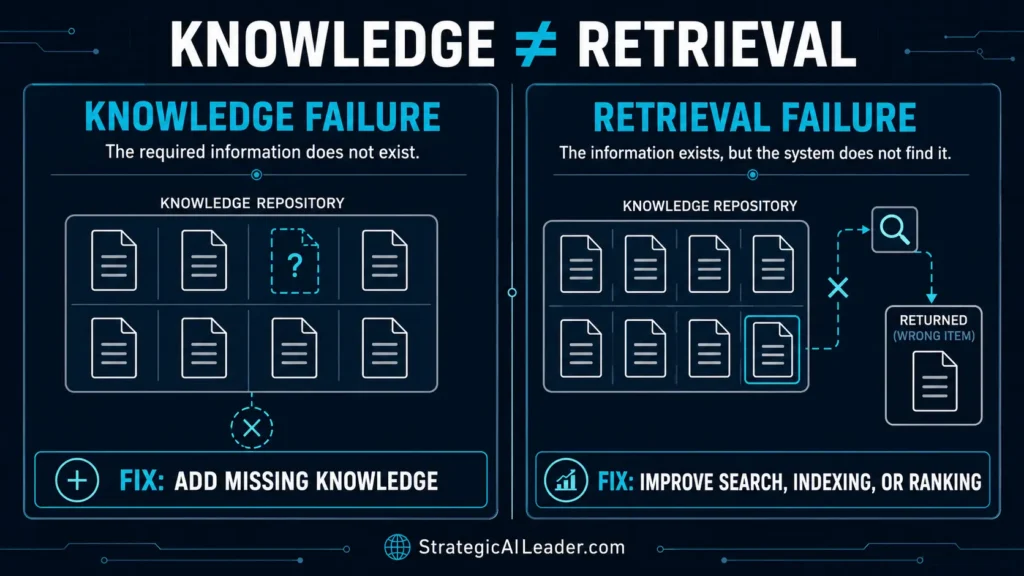
A common mistake: treating knowledge and retrieval as one problem.
They are architecturally distinct.
Knowledge failure: The required information does not exist in the organizational system. Fix: Create or add missing knowledge.
Retrieval failure: The knowledge exists, but the system fails to find it. Fix: Improve search, indexing, or ranking.
These require different solutions. Separating them prevents wasted effort fixing the wrong problem.
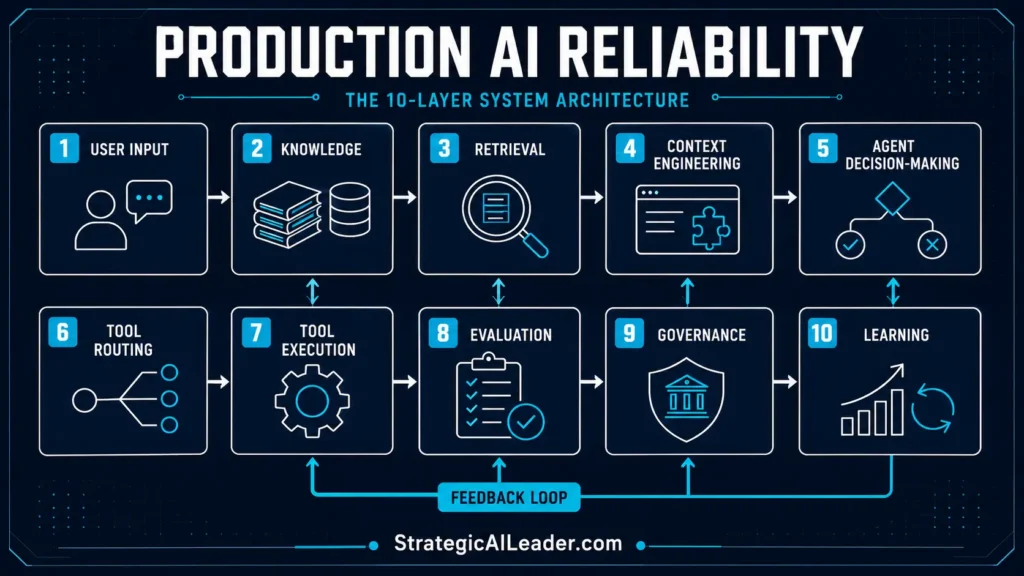
This diagram shows the complete production AI system from user input through knowledge, retrieval, context, decision-making, tool routing, execution, evaluation, governance, and learning feedback loops. The architecture shows how information flows through each layer and where feedback flows return to earlier layers for continuous improvement.
| What Is AI Agent Reliability? AI agent reliability measures how consistently an AI agent produces accurate, compliant, traceable, and useful outcomes under real production conditions. |
Where Each Layer Typically Fails
Layer 1: User Input
The agent receives a request. If the input is vague, downstream layers struggle to recover. This layer fails when interfaces accept requests without forcing clarity.
Layer 2: Knowledge
Before reasoning about a problem, the agent needs organizational knowledge: business rules, entity definitions, constraints, historical patterns. This layer fails when required knowledge doesn’t exist or isn’t documented. Fix: Create or add the missing knowledge.
Layer 3: Retrieval
Knowledge exists. Now the system must find it. This layer fails when retrieval is imprecise, returns irrelevant documents, or misses important context. Fix: Improve search, indexing, ranking, or query structure.
Layer 4: Context Engineering
Raw retrieved knowledge isn’t immediately usable. Context engineering structures, prioritizes, and enriches information. This layer fails when context is incomplete, outdated, or poorly structured. Fix: Add enrichment, establish versioning, improve prioritization.
Layer 5: Agent Decision-Making
Given clear input and good context, the agent determines what actions are needed. This layer includes task decomposition, tool selection, parameter decisions, and state transitions. This layer fails when the planner selects incorrect actions or contradicts known constraints. Fix: Improve prompt clarity, enforce constraints, or enhance context quality.
Layer 6: Tool Routing
The agent decides which tool to call. Now the router structures the call correctly: validates parameters, enforces schema, handles optional fields. This layer fails when the call is misconstrued despite correct selection. Fix: Add schema validation before tool calls.
Layer 7: Tool Execution
The call is valid. Now the executor runs it. The tool is called. The response is captured. This layer fails when execution times out, returns unexpected formats, or swallows errors. Fix: Add timeout handling, response validation, and error logging.
Layer 8:Evaluation
The tool executed. Did it produce what we needed? Does the output satisfy the original intent? Are constraints violated? This layer fails when evaluation is missing or vague. Fix: Add explicit success criteria and validation rules.
Layer 9: Governance
Evaluation determined the output is problematic. Governance decides what happens next. Can the agent retry? Does this need human review? This layer fails when rules are missing or unenforced. Fix: Define escalation rules and monitor adherence.
Layer 10 . Learning
Every execution produces signals: successes, failures, human corrections. Learning means feeding these back to improve future decisions. This layer fails when feedback loops don’t exist. Fix: Build feedback systems that feed corrections back to knowledge, retrieval, and decision-making layers.
What Is the 10-Layer Production AI System?
A production AI system comprises ten layers: user input, knowledge, retrieval, context, decision-making, tool routing, execution, evaluation, governance, and learning. Each layer transforms information. Each layer can fail independently. Diagnosing which layer failed is how operators improve system reliability beyond model selection or prompt changes.
| What Is a Production AI System? A production AI system combines the model with the knowledge, retrieval, context, decision, tool, evaluation, governance, and learning components required to complete real business tasks. |
You Cannot Diagnose What You Cannot Observe
The 10-layer framework helps identify which layer failed. But diagnosis requires evidence. Production traces must capture the signals that show each layer’s behavior.
Minimal observability checklist:
- Input: The request and workflow version
- Knowledge sources: Which documents or rules were relevant
- Retrieved data: What information was actually found
- Context: What was enriched or combined from retrieval
- Decisions: What actions the agent selected
- Tool calls: Which tool was chosen and with what parameters
- Execution: Did the tool succeed, and what did it return
- Evaluation: Did the output meet success criteria
- Governance: Was escalation triggered if needed
- Outcome: What was the final result and cost
- Corrections: What did humans change or approve
Without this visibility, you diagnose by guessing. With it, you trace failures to the exact layer.
Production Example: MyEListing Marketplace
MyEListing is a commercial real estate marketplace. Investors browse deals. The platform uses AI to score lead quality and match opportunities to investor interests, AI agent reliability.
Initial system performance was poor. Investor recommendations were weak. Adoption was low.
The team diagnosed across all ten layers, not just the model. The result:
- CRM accuracy: 60% → 95%
- Lead response time: 48 hours → 4 hours
- Pipeline conversion: 12% → 27%
- Deal throughput per rep: +20%
- Investor match accuracy: +28%
These improvements came from strengthening multiple layers simultaneously: better knowledge documentation (Layer 2), improved retrieval (Layer 3), enriched context (Layer 4), clearer decision rules (Layer 5), schema validation (Layer 6), feedback loops (Layer 10). No single layer fix caused these outcomes. The system work across multiple layers did.
Why Did Better Models Fail to Help?
Better models can’t fix missing knowledge, weak retrieval, thin context, unclear decision rules, or absent feedback loops. The model operated within an incomplete architecture. Strengthening multiple surrounding layers improved system performance without relying on model changes. It just operated inside incomplete architecture. Fixing the architecture across multiple layers improved performance more than model changes could have.
The Diagnostic Decision Tree
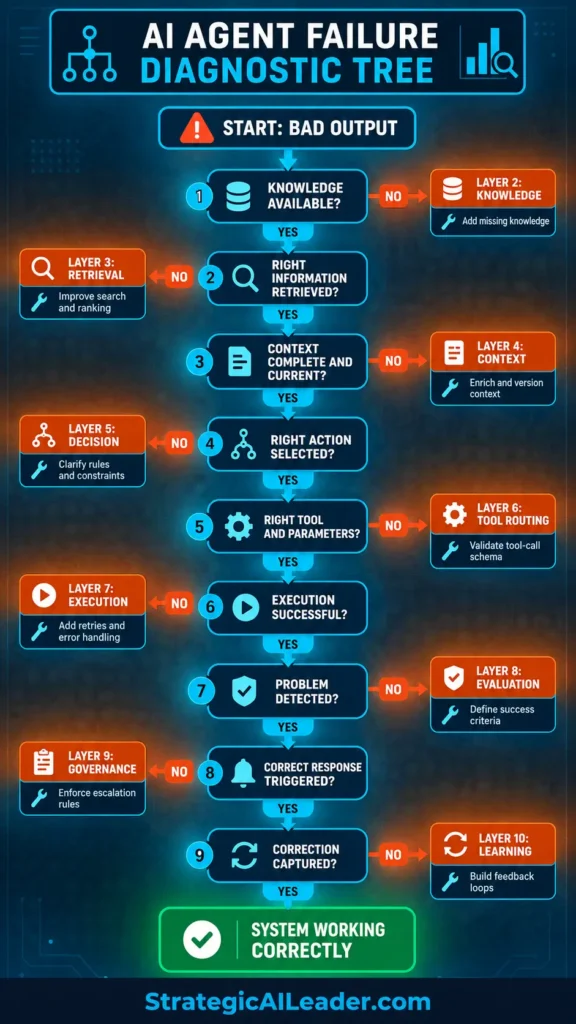
When an agent produces bad output, use this tree to identify which layer failed:
START: Agent produced bad output
How Do You Actually Use This Tree?
Trace each failure through the tree using production observability data. Did retrieval surface the right documents? Check logs. Did context include relevant market data? Check enrichment pipeline. Did the agent select the right tool? Check decision logs. Work through the tree methodically. The first “NO” answer identifies your layer to fix.
Production Readiness Checklist
Before deploying a production agent, guarantee strength across all ten layers.
Once your checklist is complete, the Master AI Workflows with REPEAT Framework
provides a structured approach to operationalizing these layers as repeatable
business workflows.
- Layer 1: Input interface enforces structured requests
- Layer 2: Required knowledge is documented and current
- Layer 3: Retrieval is tested and returns relevant results
- Layer 4: Context enrichment includes necessary comparables and context
- Layer 5: Agent decisions are traceable and follow decision rules
- Layer 6: Tool calls are validated against schema before execution
- Layer 7: Tool execution is monitored for timeouts and errors
- Layer 8: Outputs are evaluated against explicit success criteria
- Layer 9: Governance rules are defined and enforced for high-risk decisions
- Layer 10: Feedback loops feed human corrections back to earlier layers
Systems Thinking Is Where AI Strategy Begins
Production AI reliability depends on both model capability and system architecture, with many production failures originating outside the model. Model capability matters. Production reliability depends on the ten-layer architecture surrounding the model.
The next time an agent fails in production, resist the instinct to blame the model. Trace through the decision tree. Use observability data. Identify which layer actually broke. Then fix the system, not the prompt.
The MyEListing example demonstrates the outcome: systematic architecture work improved performance by addressing problems model selection alone would not solve. Reliable AI comes from doing systems work across all ten layers. Knowledge engineering. Retrieval optimization. Context enrichment. Decision clarity. Tool validation. Execution safety. Evaluation rigor. Governance enforcement. Learning loops.
Each layer matters. None can be skipped. This is where AI strategy stops being about model selection and starts being about architecture.
When Should You Shift From Prompt Tuning to Architecture?
When prompt changes stop producing measurable improvements, diagnose the surrounding system. Check knowledge, retrieval, context, decision rules, tools, evaluation, governance, and learning before continuing to tune the prompt. If better models don’t improve performance, architecture is your lever. Switch from prompt engineering to systems thinking.
What Comes Next
This 10-layer framework is a foundation. Each layer deserves deeper exploration:
For business impact and AI strategy: Read The Ultimate AI Agent Strategy for Leaders Who Want ROI to understand why agent architecture determines business outcomes.
https://www.strategicaileader.com/why-ai-projects-fail-the-truth-about-context-engineering/For knowledge and context work: Read Why AI Projects Fail: The Truth About Context Engineering to understand layers 2-4 in depth.
For evaluation and governance: Read What Is Decision Infrastructure: The Layer That Makes AI Execution Reliable to understand layers 8-9.
Frequently Asked Questions About AI Agent Reliability
Why do AI agents fail in production?
AI agents fail when one or more system layers lack the information, controls, or validation needed for reliable execution. Common causes include missing organizational knowledge, weak retrieval, incomplete context, poor tool routing, execution errors, vague evaluation criteria, unenforced governance rules, and absent feedback loops.
What is AI agent reliability?
AI agent reliability measures how consistently an agent produces accurate, compliant, and useful outcomes under real production conditions. Reliable agents retrieve the right information, make traceable decisions, execute tools correctly, validate results, escalate risky cases, and learn from human corrections.
What are the ten layers of a production AI system?
The ten layers are user input, knowledge, retrieval, context engineering, agent decision-making, tool routing, tool execution, evaluation, governance, and learning. Each layer performs a separate responsibility and introduces distinct failure risks.
Why do better AI models fail to solve production problems?
A stronger model does not replace missing knowledge, repair weak retrieval, complete incomplete context, validate tool parameters, enforce governance policies, or create feedback loops. Model capability supports one part of the system. Production reliability depends on the complete architecture.
What is the difference between a knowledge failure and a retrieval failure?
A knowledge failure occurs when required information does not exist in the organization’s documented systems. A retrieval failure occurs when the information exists, but the AI system fails to locate or rank the correct source. Knowledge failures require new documentation. Retrieval failures require improvements to search, indexing, query design, or ranking.
How do you diagnose an AI agent failure?
Start with production traces and follow the diagnostic decision tree. Confirm whether the required knowledge existed, whether retrieval found the right information, whether context was complete, whether the agent selected the right action, whether tool execution succeeded, and whether evaluation and governance responded correctly. The first failed checkpoint identifies the layer requiring attention.
What observability data should an AI agent capture?
A production agent should capture the original request, workflow version, knowledge sources, retrieved information, assembled context, agent decisions, tool calls, tool responses, evaluation results, governance actions, final outcomes, costs, and human corrections. These records allow teams to trace failures to a specific system layer.
How do feedback loops improve AI agent reliability?
Feedback loops capture successful outcomes, failed executions, evaluator results, and human corrections. Teams use these signals to update organizational knowledge, retrieval logic, context structure, decision rules, evaluation criteria, and governance policies. Without a feedback loop, the system repeats the same mistakes.
What should teams test before deploying an AI agent?
Teams should test all ten system layers under realistic conditions. Testing should cover ambiguous inputs, missing information, retrieval errors, outdated context, invalid tool parameters, execution timeouts, incorrect outputs, policy violations, escalation behavior, and feedback capture. Production readiness requires measurable success criteria for every layer.
Build Reliable AI Systems
Every week, I publish operator-focused insights about building reliable AI systems, production architecture, and systems thinking. The next article explores one of these layers in depth.
Subscribe to StrategicAILeader for the next deep dive: whether that’s knowledge architecture, observability design, governance patterns, or feedback systems.
Help Support My Writing
Subscribe for weekly articles on leadership, growth, SEO, and AI-driven strategy. You’ll receive practical frameworks and clear takeaways that you can apply immediately. Connect with me on LinkedIn for conversations, resources, and real-world examples that help.
About the Author
I’m Richard Naimy, an operator and product leader with over 20 years of experience growing platforms like Realtor.com and MyEListing.com. I work with founders and operating teams to solve complex problems at the intersection of product, marketing, AI, systems, and scale. I write to share real-world lessons from inside fast-moving organizations, offering practical strategies that help ambitious leaders build smarter and lead with confidence.
I write about:
- AI + MarTech Automation
- AI Product Development
- AI Strategy
- AI Workflow Automation
- Context Engineering
- COO Ops & Systems
- Growth Strategy (B2B & B2C)
- Infographic
- Leadership & Team Building
- Marketplace Growth Strategy
- My Case Studies
- Personal Journey
- Revenue Operations (RevOps)
- Sales Strategy
- SEO & Digital Marketing
- Strategic Thinking
Want 1:1 strategic support?
Connect with me on LinkedIn
Read my playbooks on Substack