How to Turn Decisions into Finished Work with a Powerful Operator Workflow
When a decision leaves a meeting or an operational trigger starts new work, one of two things happens. Someone points to the operator workflow that takes it to finished work, or the work dissolves into chat threads, a document, and a hope that the team will handle it. When the route stalls, identify the business bottleneck before redesigning the workflow.
Leaders often add a process doc, a playbook, or a named model and call the problem solved. The week still has no visible route, no accountable owner, and no completion evidence. You have activity.
An operator workflow is a practical operating concept for founders, executives, and operators. Treat it as a way to see execution, not as a formal academic term.
You will learn how to identify an operator workflow, expose execution gaps, and test one repeating workflow before adding AI or automation.
What Is an Operator Workflow?
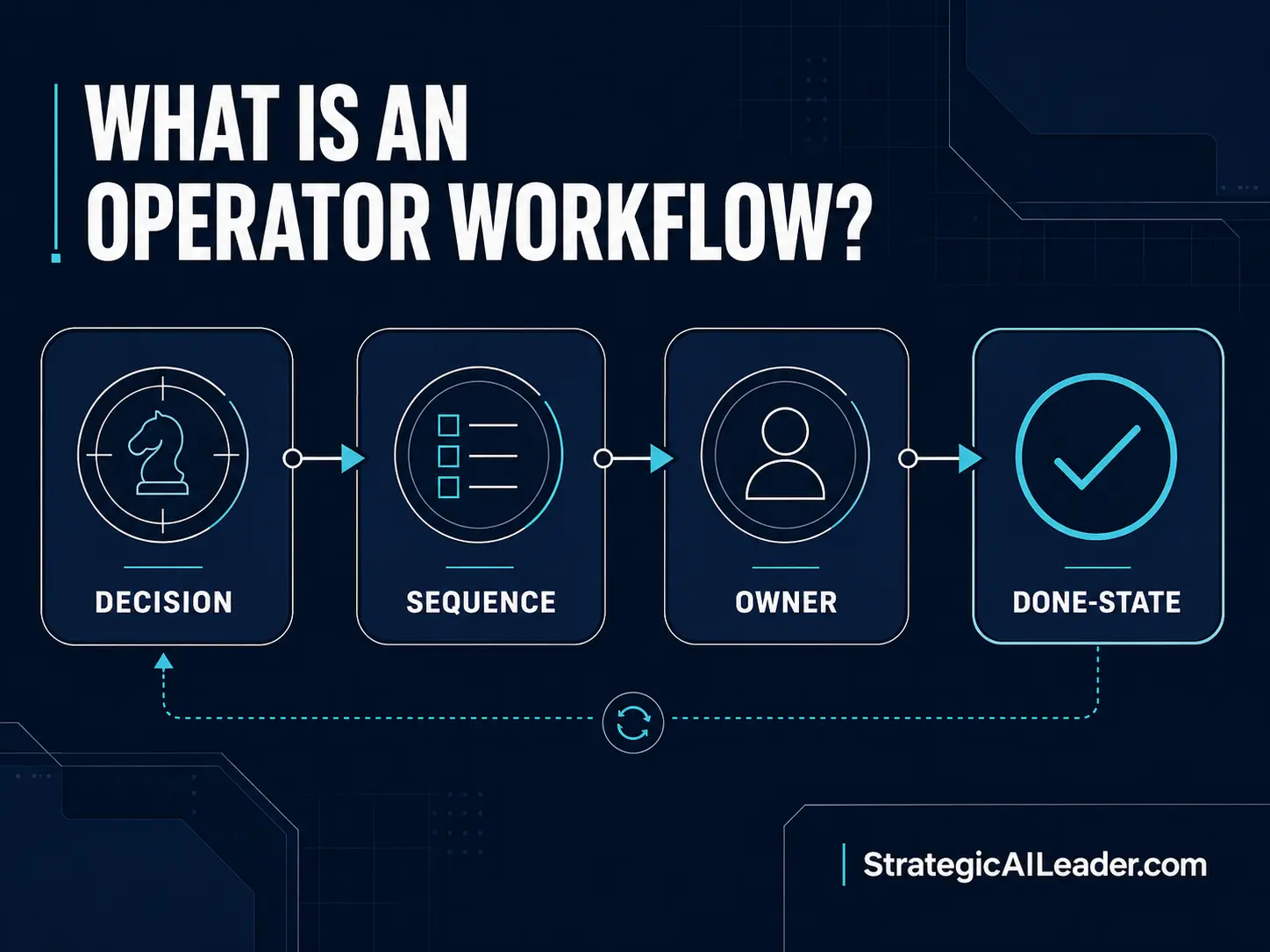
An operator workflow is the repeatable path that takes an approved decision or operational trigger to finished work, with an accountable owner, a visible sequence, and observable completion criteria.
The start is wider than a board vote. A customer request, a scheduled date, a threshold breach, a system event, an approval, an incident, or a new record starts the same kind of work. The operator workflow is the active route that work follows, not the folder that describes how work should look.
Teams confuse documentation with execution because documents are easy to finish. A file sits finished and unused. The operator workflow is the reusable route. The current work item travels that route: who is accountable, what happens next, where the work changes hands, and what proves completion.
If the team cannot show the route from its operating records, the workflow is not visible enough to manage, improve, or automate. Notes, habits, slides, and hope still fill the gap.
What Leaders Get Wrong About Workflows
Leaders stack artifacts on top of a missing route. The stack looks like progress. The week still has no owner.
A process is a repeatable set of related activities. A process document is the written description of those activities. Filing the document does not complete the process. An SOP is a controlled instruction for a consistent procedure. A playbook offers recommended responses for known situations. A framework is a model for organizing thought or decisions. None of those objects is the active route an approved decision or trigger follows to completion.
A playbook offers choices. A workflow identifies what happens next, who owns the result, and what proves completion.
A named framework is useful in the right setting. Some frameworks become slides that survive the offsite and change nothing about next week’s work. If a framework slide just shipped and next week’s work still has no owner, sequence, or completion evidence, the team added a name and skipped the route. You installed vocabulary.
The model landed. The path did not.
An operator workflow does not replace strategy, governance, SOPs, playbooks, or frameworks. Use those objects to set direction, control risk, and support judgment. Use the operator workflow to move an approved decision or trigger to finished work.
The Four Parts of an Operator Workflow
Use the four-part test as an executive diagnostic. Check whether each part is explicit, visible, and usable. A route with a missing or unclear part remains a workflow fragment. Name the fragment. Do not promote it.
Decision or Trigger
Name what starts the work. “Improve onboarding” is a theme. “Leadership approved ten customers for the new onboarding pilot” is a trigger. A customer request, a Friday cutoff, a threshold breach, or an incident starts the same class of work. If two people describe the start differently, the team still has a topic.
Visible Sequence
Show the actual order of work. “The team knows” is not a sequence. If a competent operator who was out last week cannot see the next step from the record, the sequence lives in people’s heads. Tribal memory is not an operational workflow.
Tribal memory creates operational risk. A 2023 NIST paper examining a 2021 reactor incident found that experienced personnel had compensated for unclear procedures through internal system knowledge. Their departure exposed those procedural gaps.
The stakes differ across industries, but the operating weakness is the same. Critical steps should not depend on knowledge held only by experienced employees.
Accountable Owner
One accountable role, with one person assigned to the current work item. Workflow design names the role. Each active instance displays the person currently assigned. The accountable person keeps work moving, resolves blockers, manages escalations, and verifies completion.
A department name is not accountability. Shared participation is fine. Shared accountability is not. “Ops,” “the pod,” or “whoever touched it last” leaves the work item without an owner.
Observable Done-State
Name the evidence that proves the work is finished. “We are on it” is not completion. “All ten customers received the checklist, completion status is recorded, feedback is logged, and the owner submitted a keep, revise, or retire recommendation” is completion. If the team cannot tell finished from in motion without a status meeting, the route has no end. Work without an end is a pile.
What Higher-Risk Workflows Also Need
The four-part test confirms the route exists. Cross-functional work needs clearer hand-offs and accountability. Higher-risk, regulated, or high-cost work also needs stronger controls.
Think about workflow design in two layers. The four-part test is the first layer. Additional controls make the route dependable across teams.
For that class of work, name required inputs, hand-offs, approvals, status evidence, exception rules, an escalation path, and timing expectations. Add risk controls, monitoring, and recovery where the work requires them. The list is a starting set, not a complete production specification.
Do not turn the extras into a software specification. Write them in the same language the team already uses to run the week. If a hand-off is invisible, the next person waits. If an exception has no rule, the owner improvises. If blocked work has no escalation path, the item sits until someone books another meeting.
Operator Workflow vs Process, Playbook, and Framework
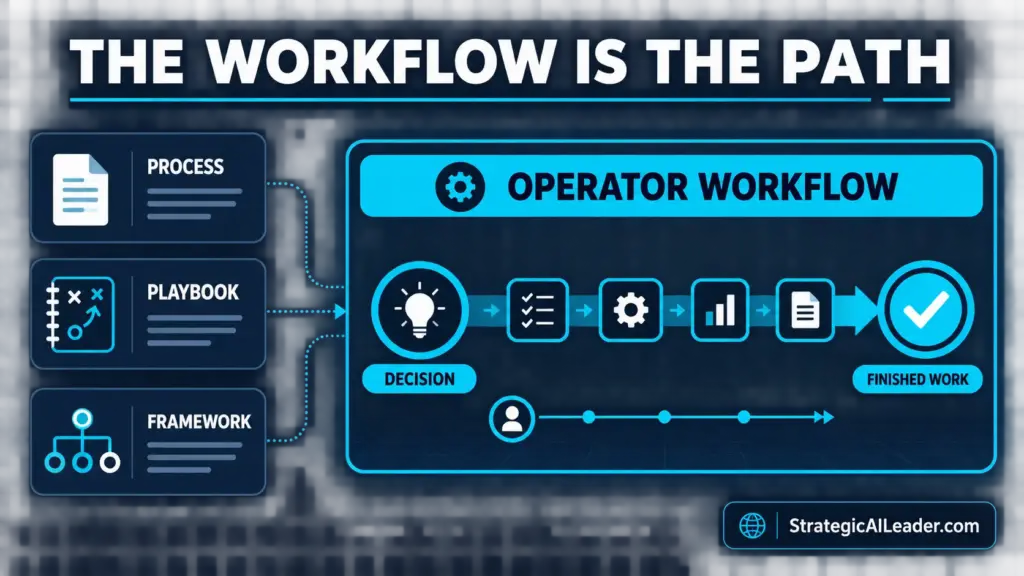
Process and process document are not the same thing. A process sometimes runs while its document is wrong. A document sometimes exists after the process has stopped. An SOP tells people how to perform a procedure the same way. A playbook helps people choose a response. A framework helps people think. An operator workflow is the active route from a decision or trigger to finished work.
Those objects work together. Strategy and governance set the constraints. A process keeps related activities consistent. An SOP standardizes a procedure inside a step. A playbook supports judgment when the situation varies. A framework gives the team a shared model. The operator workflow defines the execution route. The work record shows how a specific item moved through the trigger, sequence, ownership, and completion criteria.
An operator workflow does not replace the other objects. The other objects do not replace the operator workflow.
| Question | Operator Workflow | Process | Playbook | Framework |
|---|---|---|---|---|
| What is it? | The active route from a decision or trigger to finished work | A repeatable set of related activities | Recommended responses for known situations | A model for organizing thought or decisions |
| What does it require? | Trigger, sequence, owner, and completion evidence | Activities, rules, and expected outcomes | Situations and recommended actions | Concepts and relationships |
| What proves completion? | Observable completion criteria | The intended operational outcome occurs | The selected response is applied | Not usually completion-based. Evidence appears in the resulting decision or analysis |
| What does it support? | Execution and accountability | Consistency and repeatability | Judgment in recurring situations | Shared understanding |
| Common failure | Work moves through tribal knowledge | Documentation does not match practice | Teams have options but no execution route | Teams adopt vocabulary without changing execution |
An Operator Workflow Example
The customer onboarding pilot below is an illustrative example. No company name, result, or quote is attached to it. Use it to see the parts, not as a reported case.
Decision or trigger: Leadership approves ten customers for a new onboarding pilot.
Visible sequence:
- Operations confirms the customer list.
- Customer Success sends the new checklist.
- Product records questions and points of friction.
- The owner reviews completion data on Friday.
- The owner submits a keep, revise, or retire recommendation.
Accountable owner: Head of Customer Success. The role is accountable. The current work item shows the person assigned this week.
Observable done-state: All ten customers receive the checklist, completion status is recorded, feedback is logged, and the owner submits a keep, revise, or retire recommendation.
Approval of that recommendation starts a separate implementation workflow. Do not treat pilot completion and rollout approval as the same workflow.
Exception: Any blocked customer receives escalation within one business day.
Without the workflow, Sales assumes Customer Success owns launch. Customer Success waits for the final list. Product keeps the old checklist. Leadership books another status meeting. Nobody knows if the pilot finished.
The lesson is simple. A pilot with a decision, a deck, and a deadline still fails as execution when the route is missing. The missing object is the operator workflow: a visible sequence, one accountable role with an assigned person, completion evidence, and a rule for blocked work. Write those parts before anyone automates the checklist or adds an AI assistant to the thread.
When Do You Need an Operator Workflow?
Formal workflows deliver the greatest value for recurring, cross-functional, regulated, or high-cost work. One-time tasks often need less structure, but complex projects still need visible ownership and completion criteria.
Need is highest when the same class of trigger keeps leaving the room and dying the same way. A founder gets three answers to “what happens after approval.” A COO inherits playbooks and still cannot see trigger-to-completion. An automation project starts, and tools get bolted onto tribal steps.
A tool bolted onto unnamed tribal steps is still tribal steps, now with a login.
Solo operators also use operator workflows. The trigger, sequence, and done-state stay explicit. Shared visibility matters when the work must survive absence, delegation, audit, collaboration, or later automation. Not every personal habit needs team-wide documentation. The moment someone else has to finish the week, the habit has to become a visible operating path.
How to Test a Workflow This Week
Start with the work record, not the slide.
Ask: What started the work? Who owned the result? What happened first? Where did responsibility change hands? What evidence proved completion? What happened when the work stalled? How long before first visible action? How long before completion?
If the team cannot answer the first five questions from the work record, the workflow is not visible enough to manage, improve, or automate.
Then run one exercise on a repeating decision.
- Choose one repeating decision or trigger.
- Write the trigger in one sentence.
- Assign one accountable role.
- Name the person currently assigned to the live work item.
- List the steps the team actually runs, not the steps in the old document.
- Mark every hand-off.
- Define completion evidence someone observes without a meeting.
- Record the time from trigger to first visible action on the next run.
- Run the route once before anyone adds automation.
- Review blockers after the run and write the escalation rule those blockers needed.
The point is not a score. The point is a visible execution route the team runs again on Monday.
How Operator Workflows Fit Existing Operating Systems
An operator workflow sits inside the operating models already in use. The workflow is the trigger-to-completion route. The surrounding models set direction, process, and reinforcing behavior. Name the route first, then place it inside the model that fits the stage of the company.
Use Operator systems for the wider collection of operating models.
Use the 3-Layer Ops System for early-stage scale when you need execution, process, and accountability in one operating model.
Use the Strategy-Systems-Rituals Model for operational excellence when you need direction, repeatable systems, and reinforcing behavior.
Software records workflow activity and, when configured for the purpose, enforces required steps or controls. Define the trigger, accountability, sequence, and completion criteria first. Select software after the four-part test is explicit.
Operator Workflow FAQ
What is an operator workflow?
An operator workflow is the repeatable path that takes an approved decision or operational trigger to finished work, with an accountable owner, a visible sequence, and observable completion criteria. The workflow is the route current work actually follows, not the folder that describes how work should look.
How is an operator workflow different from a process, playbook, or framework?
A process groups related activities so work stays consistent. A playbook lists recommended responses when a situation repeats. A framework gives people a shared model for thinking. An operator workflow is different: it is the reusable route a work item follows to finished work, with ownership and completion evidence attached.
Is an operator workflow the same as an SOP?
No. An SOP standardizes how a procedure is performed. One step in an operator workflow sometimes includes an SOP. The SOP still does not name the trigger, the accountable owner, or the completion evidence. Treat the SOP as instruction inside the route, not as the route itself.
Can one person run an operator workflow?
Yes. One person still names the start, the order of work, and the evidence that proves the item is finished. Documentation for a team is not required for a solo habit. The habit becomes a visible operator workflow the moment coverage, handover, audit, or later automation depends on someone else seeing the route.
Does an operator workflow require software?
No. Software records workflow activity and, when configured for the purpose, enforces required steps or controls. Leaders still have to name the trigger, accountability, sequence, and completion criteria before a tool helps. Select software after the four-part test is explicit. A login does not create those parts.
Which metrics measure workflow performance?
Track the time from trigger to first action, total completion time, hand-off delays, rework, exceptions, overdue items, and the percentage of work with assigned ownership and observable completion evidence. Select metrics tied to the workflow’s purpose instead of measuring activity alone.
Who owns an operator workflow?
One role owns the operator workflow design. Each live work item then shows the person assigned to that run. The assigned person moves the item, clears blockers, escalates exceptions, and verifies completion evidence. Naming a department, a pod, or whoever touched the item last is not ownership.
An operator workflow turns an approved decision or operational trigger into visible, accountable execution.
Subscribe to the Strategic AI Leader newsletter for practical systems covering AI, operations, and growth. Each article gives you a framework, implementation guidance, and lessons from real operating work.
Next, read the 3-Layer Ops System for early-stage scale to connect your workflow with process design and accountability.
Operational Systems and Constraints: Next Steps
Use process standardization to make repeatable work consistent across teams.
Use operating rituals and cadence to establish recurring reviews and decision routines.
Use modern COO operating model to connect operational responsibility to growth.
Use manager operating system to structure recurring management work with AI.
I write about:
- AI + MarTech Automation
- AI Strategy
- COO Ops & Systems
- Growth Strategy (B2B & B2C)
- Infographic
- Leadership & Team Building
- My Case Studies
- Personal Journey
- Revenue Operations (RevOps)
- Sales Strategy
- SEO & Digital Marketing
- Strategic Thinking
Want 1:1 strategic support?
Connect with me on LinkedIn
Read my playbooks on Substack