How Operators Are Cited in AI Search: Essential Strategies
Historically, a user’s search experience often concluded with a familiar blue link, which directed attention to a single source. In contrast, buyers today frequently consult AI tools such as ChatGPT, Perplexity, or Gemini, and then decide based on the citation presented to them.
GEO exists because ranking a blog post is not enough when the live fact never appears in that citation set, a gap that affects usefulness and trust.
Generative engine optimization is not a replacement for SEO. However, it helps ensure a company fact is on a page a model can find, retrieve, and quote.
Moreover, GEO should be used to emphasize verifiable content, not to replace human expertise. It reinforces trust while guiding models to quote accurate facts.
What Is GEO?
| GEO (generative engine optimization) is the repeatable work of making an approved answer visible and citable in AI search and answer engines, with an accountable owner, a visible sequence, and observable citation evidence. |
For GEO, begin with the concrete fact rather than a keyword list. The guidance suggests that a pricing change, a product constraint, a safety rule, or a comparison, when properly framed, can serve as that fact to ground the narrative. This approach keeps the focus on what actually matters to readers and to the models that quote it.
Move it from the operating record into the places models actually quote, so the cited material aligns with how the system presents information. By citing the fact in the right location, you improve clarity, reduce redundancy, and ensure consistency across reports and analyses.
Treat GEO as a practical operating concept. Measurement practices are still developing. GEO itself now has broad industry and research usage. Do not wait for a standards body to finish the vocabulary.
A citation is an outcome, not proof the operating practice exists. Models choose sources probabilistically. A miss this week does not mean the team has no GEO. The management test is simpler: a defined source, an owner, a distribution path, a measurement system, and a correction loop. Without those five, the team has content volume.
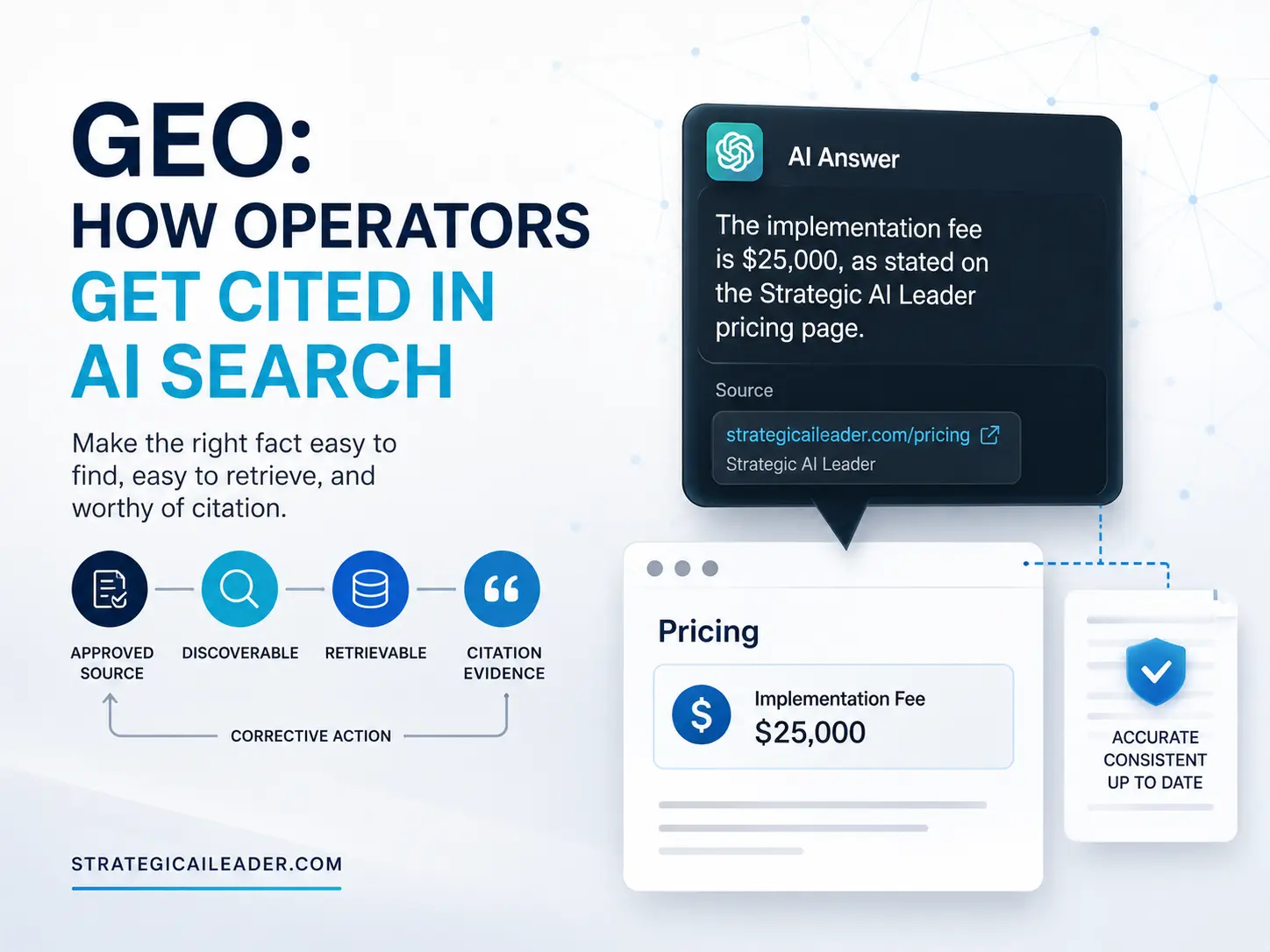
A pricing page can show the current implementation fee, while an AI assistant still cites an older number from a blog post, a partner page, or a cached source. The approved fact is already live, so another pricing page edit will not solve the problem. The team has to identify the source of the conflict, correct the citation path, and test the same buyer question again.
What Leaders Get Wrong About GEO
Teams publish more pages and call the problem solved. Answer engines still quote a two-year-old blog, a partner page, or a competitor.
A content calendar can look healthy while the live fact is wrong. Sales hears the old price from an assistant. Support pastes a stale constraint. Nobody owns the correction.
Buying a tracking dashboard does not create GEO. Leaders still have to name the live fact, the path that publishes and refreshes it, and the person who acts when a model quotes the wrong page.
The Four Parts of GEO Work
Use the four-part test as a presence check. Fewer than four is a fragment.
Approved answer or source
GEO is willing to stand behind its commitments.
Additionally, we should show up for AI search.
The current implementation fee is X, published on the pricing page, reviewed by Finance.
If two leaders would write different answers, nothing is safe to publish.
Visible sequence
The record has to show how the fact gets onto a page, into supporting FAQ or docs, and into a refresh when it changes. “Marketing will handle it” is not a sequence. Anyone covering last week should see the next step from the record.
Accountable owner
One accountable role, with one person assigned to the current fact. Marketing, product, or ops can hold it. That person keeps the page current, checks citations, and escalates a stale quote. A department name is not ownership.
Observable citation evidence
A published page is not enough. Citation evidence is a cited URL, a source attribution, factual use of the page, or a recorded miss. Referral visits, leads, pipeline, and conversions are downstream outcomes, not citation evidence. If cited versus invisible needs a slide, the work has no done-state.
How GEO Gets Cited
Between an approved page and a citation sits a path most teams skip.

Approved source → discoverable source → retrievable source → citation candidate → citation evidence → corrective action.
| Stage | What it means | Why it matters |
|---|---|---|
| Approved source | One current fact on one intended URL | Conflicting first-party pages poison later retrieval |
| Discoverable source | Crawlers and internal links can reach it; the fact is in text | Hidden or image-only facts never enter the set |
| Retrievable source | Indexed and eligible to appear with a snippet | Many AI features retrieve from a search index, not a CMS preview |
| Citation candidate | Relevant, fresh, consistent, and extractable | Query fan-out retrieves several pages; inconsistency splits the chance |
| Citation evidence | Cited URL, attribution, factual use, or a recorded miss | Referral traffic is not citation evidence |
| Corrective action | Investigate the miss, then retest | Another edit does not automatically restore a cite |
Crawlability, internal discoverability, and indexing decide whether a bot can see the page and whether retrieval can use it. Google Search Central’s AI Features and Your Website (reviewed 31 Aug 2026) requires a supporting link in AI Overviews or AI Mode to be indexed and snippet-eligible in Search, with no extra technical requirements. Full page accessed. Eligibility is not selection, and the page does not cover ChatGPT or Perplexity.
Google’s guide to optimizing for generative AI features (reviewed 31 Aug 2026) describes retrieval-augmented generation pulling relevant, up-to-date pages from the Search index, then citing them. Query fan-out can retrieve several of your URLs plus third-party pages for one question. Full page accessed. GEO and AEO are treated as common terms; many “hacks” are not supported, and no citation-share target is published.
A retrieved page still has to be worth quoting. A fee, a constraint, or a comparison in a clear sentence is easier to lift than a fact buried in a screenshot. Aggarwal et al., in GEO: Generative Engine Optimization (arXiv 2311.09735; KDD 2024), report visibility gains up to 40% on GEO-bench, with efficacy varying by domain. Abstract accessed 31 Aug 2026. That figure is their benchmark result, not a guarantee and not a SAL KPI.
Citation measurement is the last operating loop, not a one-off demo. Microsoft’s February 2026 AI Performance preview (reviewed 31 Aug 2026) shows citation counts and referenced URLs across Copilot, Bing AI summaries, and select partner integrations. Full post accessed. Total Citations, Average Cited Pages, grounding queries, and page-level activity are visibility measures, not ranking, authority, or a page’s role inside one answer. One query to two assistants is not strong evidence.
A miss, a stale quote, or a conflicting source is a diagnosis. Check accuracy, crawlability, index status, canonical or duplicate pages, conflicting first-party information, and important third-party information, then retest. Do not assume another source edit fixes a citation miss. Selection is probabilistic. A clean path raises the chance of a cite. It does not guarantee one.
GEO vs SEO, AEO, and Content Strategy

Nearby jobs share vocabulary. Confusing them is how a team can “win search” on a report and still lose the answer a buyer hears.
Frame each by its primary operating objective, not as a universal taxonomy. Category boundaries in this field are still argued.
GEO does not replace SEO. A page that ranks and never gets cited still leaves the assistant quoting someone else.
| Concept | What it means | Why it matters |
|---|---|---|
| GEO | Get a live fact cited inside generated answers | Buyers now decide from citations, not only blue links |
| SEO | Make pages findable and chosen on traditional results | Many AI features retrieve from the same index that powers Search |
| AEO | Become the selected answer on answer boxes, voice, and similar surfaces | A snippet win is not the same job as a generated citation |
| Content strategy | Decide what the company will say | GEO cannot cite a fact the company has not approved |
A GEO Example
The pricing-answer pilot below is an illustrative operating scenario. No company, result, or quote is attached. Use it to see the path, not as a reported case.

Trigger: Leadership approves a new implementation-fee explanation for the next ten enterprise deals.
Visible sequence:
- Finance confirms the fee language.
- Product updates the public pricing page.
- Customer success adds a matching FAQ line.
- The assigned person asks the same buyer question across several AI systems, more than once where practical.
- Each observation records the cited URL, whether the answer matches the approved fee, a class of cite / miss / stale / conflicting source, and any corrective action.
Accountable owner: Head of Marketing. The current work item shows the person assigned this week.
Observable done-state: The fee language is live on the intended URL, the FAQ matches, and the repeated check is written down.
Exception: If a system still quotes the old fee, do not assume another page edit will fix it. Check whether the live page is accurate, crawlable, and indexed, whether a canonical or duplicate is winning, whether another first-party page or an important third-party page still shows the old fee, then retest and record the result.
Without that route, SEO keeps optimizing the blog. Sales hears the old fee from an assistant. Product assumes the page update was enough. Nobody knows whether models use the new fee.
The same execution gap shows up in operator workflow: a decision can exist and still fail as work. GEO fails the same way when the fact, the person assigned, and the citation check are missing.
When Do You Need GEO?
Formal GEO work matters most when buyers ask AI systems about a recurring, high-stakes, or frequently changing fact. A stable story may need less structure. A live price, a safety constraint, or a deal comparison still needs an owner and a citation record.
Need is highest when the same question leaves the room and comes back as someone else’s answer. Referral traffic is a downstream outcome. It is not citation evidence.
A tracking login does not create those parts. Leaders name the live fact first.
A single operator can still run GEO. The fact, the path, and the repeated check stay explicit. Shared visibility matters when the fact must survive vacation, a product change, or an audit.
How to Test GEO This Week
Start with the buyer question, not the content calendar.
Ask: What question do buyers already put into AI tools? Which fact will the company stand behind, and on which URL? Who owns the live page? What URLs were cited on the last repeated check, and did the answer match? What happens when a system quotes the old fact?
If the team cannot answer the first five from the work record, GEO is not visible enough to manage, improve, or automate.
Run one exercise on a repeating question.
- Choose one question buyers already ask AI tools.
- Write the approved fact in one sentence and point to the URL that should be cited.
- Assign one accountable role and name the person currently assigned.
- Confirm the page is internally linked, crawlable, and showing as indexed.
- Ask the same question across several AI systems. Repeat the check where practical. Record cited URL, match to the approved fact, and a class of cite, miss, stale, or conflicting source.
- Write the corrective action for any miss, including the investigation list above. Do not treat a single pass as proof.
Score is not the goal. The team needs a visible fact it can defend on Monday.
How GEO Fits Existing Operating Systems
Use The GEO Operating System when you need the wider operating design for AI visibility. Stay here for the definition and the citation path.
Sit the GEO Operating Model next to that system view. A team can adopt the model and still lack a live URL, an assigned person, and a repeated check for one fact.
GEO FAQ
What is GEO?
GEO (generative engine optimization) is the repeatable work of making an approved answer visible and citable in AI search and answer engines, with an accountable owner, a visible sequence, and observable citation evidence.
How is GEO different from SEO?
SEO makes pages findable and chosen on traditional results. GEO makes a live fact citable inside generated responses. A URL can rank and still never be the source an assistant quotes.
Is GEO the same as AEO?
AEO targets answer boxes, voice, and similar answer surfaces. GEO targets generative engines that compose an answer and choose citations. The two can share a page. They are not the same job.
Can one person run GEO?
One person can run it for a small set of live facts. The fact, the path, and the citation check still have to be explicit. Shared visibility matters when the fact must survive absence, a product change, or an audit.
Does GEO require special software?
Leaders can start with the live URL, a repeated check across several AI systems, and a written miss rule. Software helps record citations at scale. A dashboard does not invent the fact or the owner.
When do you need GEO?
Buyers already asking AI tools about a recurring, high-stakes, or changing fact is the usual trigger. Complex one-off launches still need an owner and a citation record if an assistant will be asked about them.
Who owns GEO?
Workflow design identifies one accountable role. Each live fact displays the person currently assigned. That person keeps the page current, runs the citation check, and corrects a stale quote. A department label is not ownership.
GEO turns a live fact into a citation a buyer can see.
Subscribe to the Strategic AI Leader newsletter for practical systems covering AI, operations, and growth.
Next, read The GEO Operating System if you need the system design that sits beside the citation path you just used.
Help Support My Writing
Subscribe for weekly articles on leadership, growth, SEO, and AI-driven strategy. You’ll receive practical frameworks and clear takeaways that you can apply immediately. Connect with me on LinkedIn or Substack for conversations, resources, and real-world examples that help.
Related Articles
The Truth About AI-Driven SEO Most Pros Miss
Intent-Driven SEO: The Future of Scalable Growth
SEO Strategy for ROI: A Better Way to Win Big
Future of SEO: Unlocking AEO & GEO for Smarter Growth
Skyrocket Growth with Keyword Strategy for Founders
Unlock Massive Growth with This 4-Step SEO Funnel
AI Traffic in GA4: How to Separate Humans vs Bots
I write about:
- AI + MarTech Automation
- AI Strategy
- COO Ops & Systems
- Growth Strategy (B2B & B2C)
- Infographic
- Leadership & Team Building
- My Case Studies
- Personal Journey
- Revenue Operations (RevOps)
- Sales Strategy
- SEO & Digital Marketing
- Strategic Thinking
Want 1:1 strategic support?
Connect with me on LinkedIn
Read my playbooks on Substack