AI Pilot: How to Run a Proven Bounded Test
Finance approved an AI test for invoice coding. Soon, three other teams wanted access. More seats appeared, usage increased, and the software looked active. Yet nobody had written down when the test would end, who owned the final decision, or what evidence would justify continued funding.
The company called the work an AI pilot. In practice, the rollout had already started.
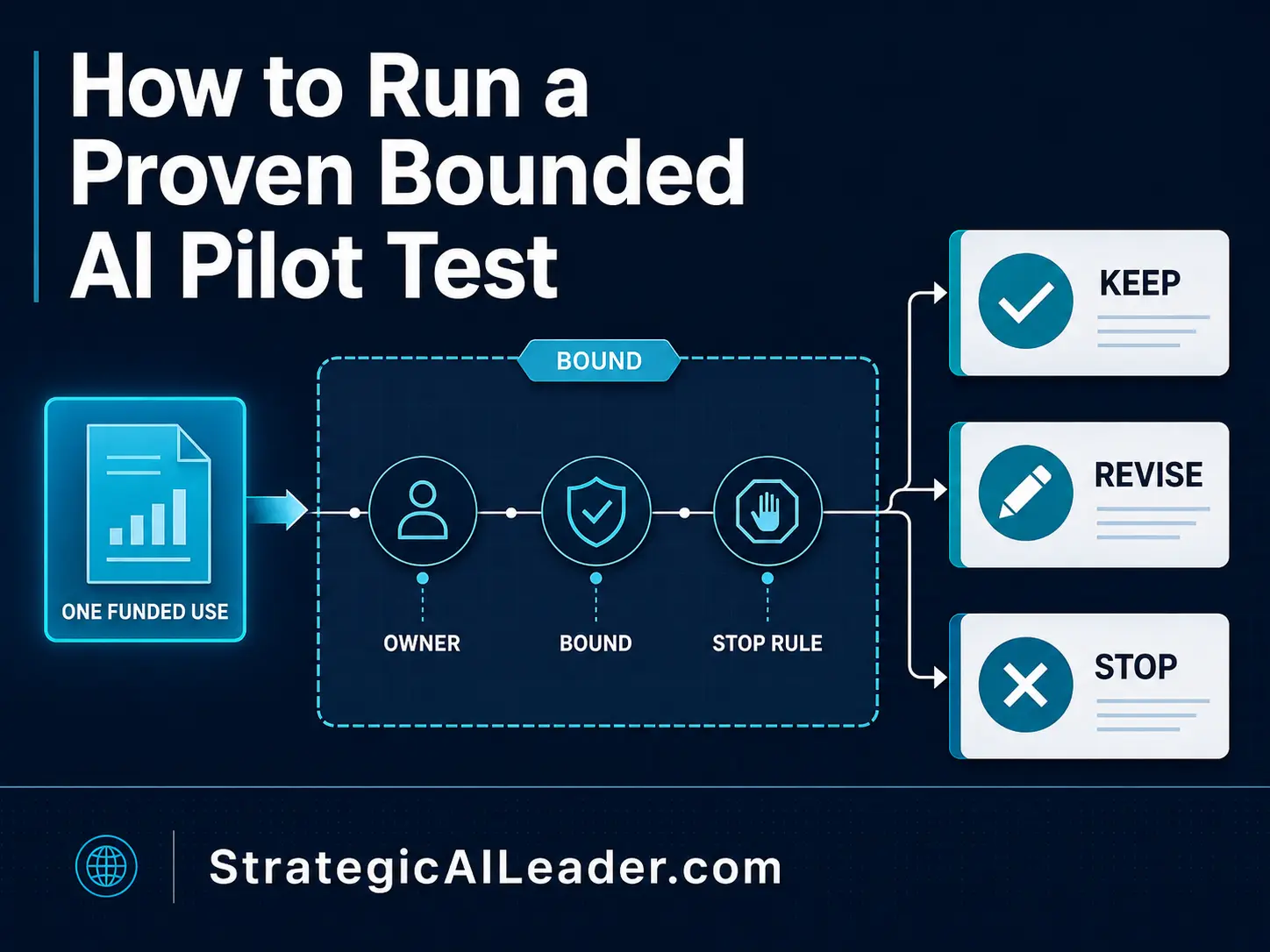
An AI pilot should answer one leadership question: Does this specific AI use deserve more investment?
A strong pilot gives leadership enough evidence to make a defensible Keep, Revise, or Stop decision. Software access, usage, output volume, and demos all contribute information, but none of them replaces the decision.
What Is an AI Pilot?
| An AI pilot is a bounded test of one funded AI use, with an accountable owner, a decision rule, operating evidence, and a recorded decision to Keep, Revise, or Stop. |
The goal is not to prove AI works in general. The goal is to determine whether one specific use deserves continued funding and operational support inside your business.
A complete AI pilot should answer five questions:
- What use are you funding?
- When does the test reach its evaluation point?
- Who owns the decision?
- What evidence determines the outcome?
- What decision did the owner record?
When those answers are missing, leadership is funding uncertainty without a clear decision system.
What Leaders Get Wrong About AI Pilots
Many AI pilots begin with technology instead of a business decision. A leader approves a platform, employees gain access, teams start experimenting, and a few workflows show promise. Usage grows before anyone defines what success means.
At that point, activity starts replacing evidence. Seat count looks like adoption. Prompt volume looks like progress. A polished demonstration looks like proof of value.
None of those measures answers whether the use deserves continued investment.
The executive mistake is treating an AI pilot as an adoption exercise. Adoption measures whether people use the technology. A pilot determines whether one funded use produces enough operating value to justify the next dollar, workflow, or phase of implementation.
The distinction matters because undefined pilots rarely end cleanly. A pilot without a boundary slowly becomes permanent work. A pilot without an owner becomes shared responsibility. A pilot without a decision rule stays alive because nobody has defined the conditions for ending or expanding it.
The Five Parts of a Strong AI Pilot
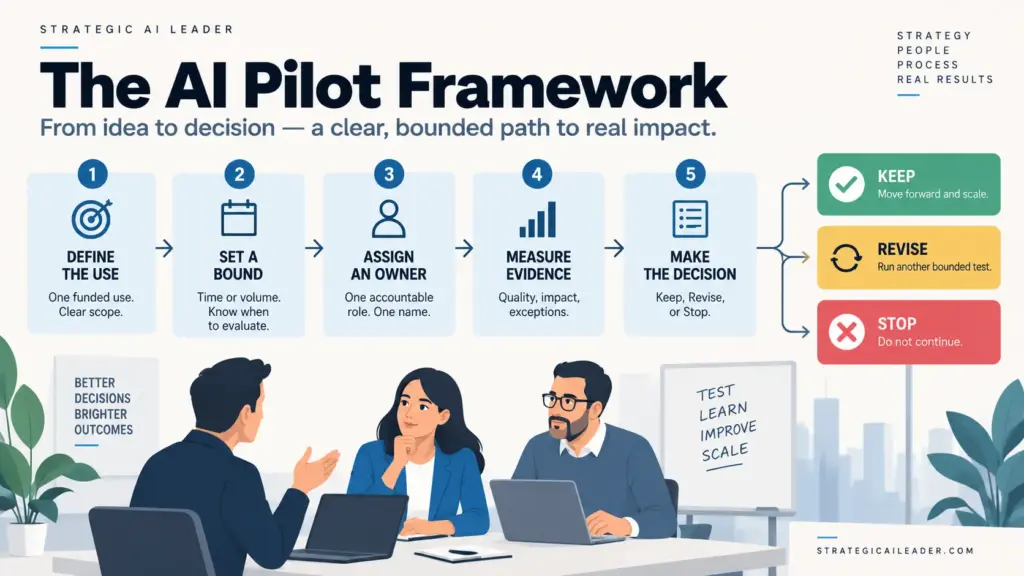
operating evidence and a final Keep Revise or Stop decision
A useful AI pilot needs five visible parts. Together, they turn experimentation into an operating test leadership can evaluate.
| Pilot Component | What It Defines | Leadership Question |
|---|---|---|
| One funded use | The specific AI use under evaluation | What are we testing? |
| Defined bound | The time or volume that triggers evaluation | When do we make the call? |
| Accountable owner | The role and person responsible for the pilot | Who owns the decision? |
| Decision rule | The evidence behind Keep, Revise, or Stop | How will we judge the result? |
| Recorded decision | The final outcome of the pilot | What did we decide? |
1. One Funded Use
Start with one specific use.
“We want Finance to experiment with AI” gives the team too much room to interpret the test differently. “We are testing AI-assisted invoice coding for a defined class of approved vendors” creates something leadership can evaluate.
The pilot record should also identify what sits outside the test. Payment approval, vendor onboarding, purchasing decisions, and general expense questions might all remain out of scope.
That boundary matters because the question is not whether employees find useful things to do with AI. The question is whether the funded use under review deserves continued investment.
If several unrelated uses share the same budget and evaluation, leadership is running a portfolio of experiments. That approach has a place, but each use still needs its own operating judgment.
2. A Defined Bound
Every AI pilot needs a point where evidence collection ends and evaluation begins.
The bound might use time, such as two weeks, 30 days, or one quarter. Another pilot might use volume, such as 400 invoices, 1,000 customer requests, or 200 support tickets.
For some work, combining both creates a stronger test. “Two weeks or 400 invoices, whichever comes first” gives the team a clear evaluation point without allowing the pilot to continue indefinitely.
The bound answers a basic management question: When do we stop collecting pilot evidence and make the decision?
Without a clear answer, temporary experiments slowly become permanent operating expenses.
3. An Accountable Owner
Every live AI pilot needs one accountable role, followed by one person assigned to the current test.
Saying “Finance owns the pilot” leaves too much ambiguity. Naming the Controller as the accountable role and identifying the person currently assigned to the pilot creates a different level of responsibility.
The owner keeps the work inside scope, watches exceptions, reviews the evidence, applies the decision rule, and records the final outcome. Other employees, technical teams, vendors, and leaders will participate, but participation should not blur accountability.
When nobody knows who has authority to make the final call, pilots survive through meetings rather than decisions.
4. A Decision Rule
The decision rule explains how the evidence leads to Keep, Revise, or Stop.
A vague objective such as “see whether AI improves invoice processing” gives the owner little to judge. A stronger rule defines the operating conditions behind each outcome.
| Decision | Meaning | Example |
|---|---|---|
| Keep | Evidence supports moving the use forward | Quality holds, exceptions stay controlled, and the workflow improves |
| Revise | The use shows value but a defined problem needs correction | The route works, but one rule or exception path repeatedly fails |
| Stop | Evidence does not support continued investment | Quality, risk, or operating impact fails the agreed threshold |
Teams use different language for these rules. You might hear exit criteria, acceptance criteria, decision thresholds, or go or no-go rules. The terminology matters less than the function.
The rule should tell leadership what evidence earns continued funding, what evidence requires another test, and what evidence ends the work.
5. A Recorded Decision
A pilot should end with a written outcome: Keep, Revise, or Stop.
Keep means the pilot produced enough evidence to justify moving the use forward. Revise means the use showed enough value to deserve another bounded test after a defined change. Stop means the evidence does not justify further investment.
“Give it more time” should not become an unofficial fourth outcome.
If leadership believes another test is warranted, the team should state what needs to change, establish a new bound, update the decision rule where needed, and run a new test.
Extending an undefined pilot hides indecision. Starting a revised pilot creates a fresh commitment leadership can judge.
What About an Early-Stop Condition?
Some failures should end a pilot before the normal bound arrives.
An early-stop condition serves a different purpose from the bound and decision rule.
| Control | Purpose |
|---|---|
| Bound | Defines when normal evaluation occurs |
| Decision rule | Defines how evidence produces Keep, Revise, or Stop |
| Early-stop condition | Defines a failure serious enough to halt the test immediately |
Possible early-stop conditions include:
- A privacy breach
- An incorrect high-risk payment
- A prohibited customer decision
- A material compliance failure
- Repeated failures beyond an agreed risk threshold
High-risk AI uses should define these conditions before testing begins. Waiting until a serious failure occurs forces the team to invent risk rules under pressure.
What Evidence Makes an AI Pilot Decision Defensible?
The five parts define the pilot. Evidence determines whether the final decision deserves funding.
Leaders need more than activity metrics. Seat counts show access. Prompt volume shows usage. Output volume shows production. None of those measures proves operating value.
A strong pilot should collect evidence across five areas.
| Evidence Category | What to Measure | Why It Matters |
|---|---|---|
| Baseline | Performance before AI | Shows whether the workflow improved |
| Quality threshold | Minimum acceptable result | Establishes the bar for continuation |
| Exception severity | Type and consequence of failures | Separates minor errors from material risk |
| Operating impact | Effect on the complete workflow | Detects work shifted to other people or queues |
| Decision evidence | Evidence tied to the final outcome | Makes Keep, Revise, or Stop defensible |
Baseline Performance
Start with the baseline. Measure how the work performed before the AI pilot using the same unit leadership plans to judge during the test.
For invoice coding, relevant measures might include:
- Coding accuracy
- Processing time
- Exception volume
- Review effort
- Cost per completed invoice
- Same-day resolution
Without a baseline, leadership knows what happened during the pilot but has little evidence showing whether performance improved.
Quality Threshold
Define the minimum result the workflow must maintain.
The acceptable result should reflect both the funded use and its operating risk. An internal summarization workflow should not carry the same tolerance as invoice coding, legal review, customer support, or payment decisions.
The threshold answers a practical question: How good does the work need to be before leadership keeps funding it?
Exception Severity
Count failures, then judge their consequences.
Ten formatting errors do not carry the same business consequence as one incorrect payment or one privacy exposure. Raw failure counts hide this difference.
The pilot record should identify which failures require:
- Normal review
- Revision
- Immediate intervention
- Early termination
Operating Impact
Operating impact tests whether AI improved the complete workflow rather than one isolated task.
A system might reduce creation time while increasing review work. Another might process requests faster while sending more problems into an escalation queue.
The right question is not simply, “Did AI perform the task faster?”
Leadership needs to know whether the full workflow improved.
Decision Evidence
Finally, connect the recorded decision to the evidence.
Keep should mean the work met the stated decision rule. Revise should mean the operating route demonstrated value while a defined part needs correction. Stop should mean the evidence does not support continued funding.
A pilot produces evidence for an investment decision. A presentation does not replace that evidence.
AI Pilot Example: Invoice Coding
Consider a Finance team testing AI-assisted invoice coding for a defined class of approved vendors. Payment approval, vendor onboarding, and general expense questions remain outside the pilot.
The team sets a bound of two weeks or 400 invoices, whichever comes first. Before work begins, Finance records the existing coding accuracy, processing time, exception volume, review effort, and same-day resolution rate for the same invoice class.
The Controller owns the pilot, with one person assigned to the live test. The team writes the decision rule before processing the first invoice.
| Pilot Element | Invoice-Coding Example |
|---|---|
| Funded use | AI-assisted coding for a defined class of approved vendor invoices |
| Out of scope | Payment approval, vendor onboarding, and general expense questions |
| Bound | Two weeks or 400 invoices, whichever comes first |
| Owner | Controller |
| Keep | Quality meets threshold, exceptions receive same-day review, workflow improves |
| Revise | The route creates value but a defined rule or exception path needs correction |
| Stop | Quality, operating impact, or risk fails the agreed threshold |
| Early stop | Serious high-risk coding failure |
During the pilot, most invoices route correctly, but one vendor category repeatedly misroutes. The exception process catches the issue before payment, and the team documents the pattern.
When the bound arrives, the owner reviews the evidence. The pilot does not earn Keep because the recurring vendor issue still needs correction. The overall route shows enough value to justify another test, so the owner records Revise.
Leadership now knows what worked, what failed, what needs to change, and why another bounded test deserves consideration.
Without the decision system, the same result might have produced a positive presentation, more licenses, and an unresolved workflow problem.
AI Pilot vs. Proof of Concept vs. Rollout
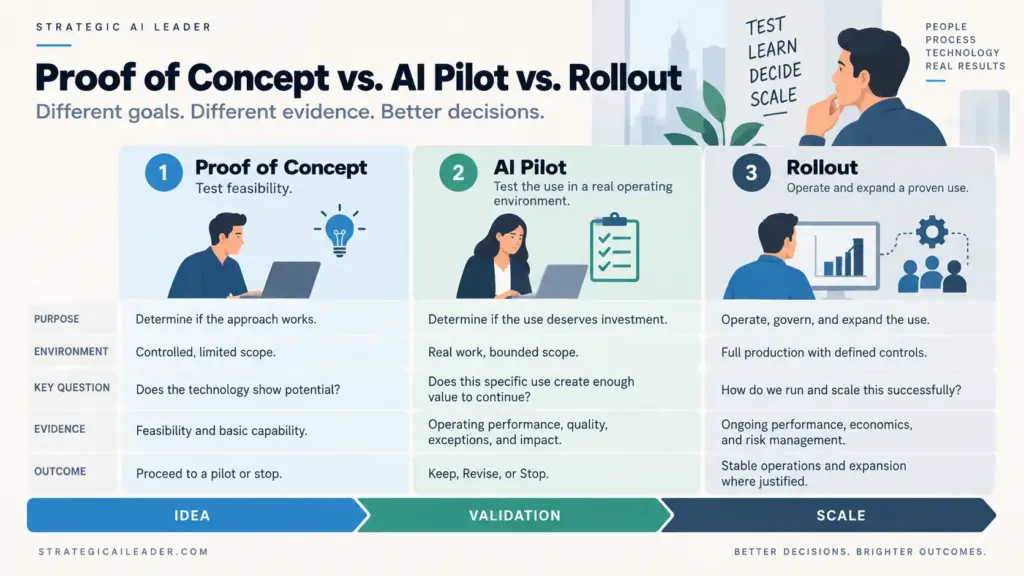
Leaders often mix several stages of AI implementation. Each stage answers a different question.
| Stage | Primary Question | Evidence of Completion |
|---|---|---|
| Proof of concept | Does the approach work? | Feasibility demonstrated |
| AI pilot | Does this use deserve investment? | Keep, Revise, or Stop recorded |
| Production | How will the approved use operate? | Workflow, ownership, controls, and support defined |
| Scale | Where should the proven capability expand? | Expansion supported by operating and economic evidence |
A proof of concept tests feasibility. The question is whether the approach works well enough to warrant an operating test.
An AI pilot tests the use inside a bounded operating environment. The question is whether the use deserves continued investment.
Production turns a kept use into repeatable work. Scale expands the capability when the economics and operating evidence support expansion.
Treating a proof of concept as a pilot skips operating evidence. Treating a pilot as a rollout skips the funding decision. Treating a Keep decision as unlimited permission to expand skips production discipline.
What Happens After an AI Pilot Gets a Keep Decision?
Keep does not mean the work is ready for unrestricted production.
A kept use still needs a clear operating model.
| Production Requirement | Question to Answer |
|---|---|
| Exception handling | What happens when the AI gets something wrong? |
| Coverage | Who owns the work when the assigned person is unavailable? |
| Governance | What is the system allowed to do? |
| Funding review | When will leadership evaluate continued spending? |
| Performance check | When will the owner reapply the operating criteria? |
Governance answers a different question from the pilot. AI governance strategy defines what the system is allowed to do and what controls surround the work. The pilot determines whether one funded use deserves continued investment.
AI workflow then defines how the approved work moves from trigger to completion.
If the kept use later becomes an AI agent, ownership, evidence, exceptions, and return still matter. Increasing autonomy raises the importance of those controls rather than removing them.
Diagnostic Questions for Any AI Pilot
Before reviewing the vendor presentation, open the pilot record.
Ask:
- What one AI use are we funding?
- What remains outside the test?
- What time or volume bound triggers evaluation?
- Who owns the live decision?
- What evidence produces Keep, Revise, or Stop?
- What failure triggers an early stop?
- What baseline are we comparing against?
- What final decision came from the last completed test?
If leadership needs a meeting to reconstruct those answers, the pilot is not visible enough to manage well.
How to Test Your AI Pilot This Week
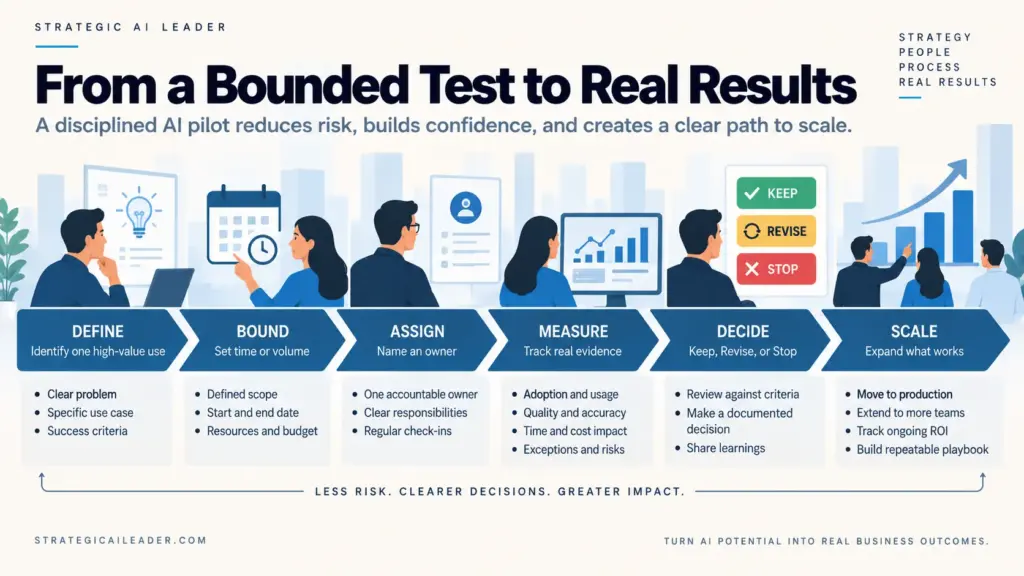
Start with one live pilot rather than the entire AI portfolio.
- Write the funded use in one sentence.
- State what sits outside the test.
- Set a time or volume bound.
- Assign one accountable owner.
- Record the current baseline.
- Define the evidence required for Keep, Revise, and Stop.
- Write any required early-stop conditions.
- Run the work inside the defined boundaries.
- Track quality, exceptions, and operating impact.
- Record the final decision when the bound arrives.
Another leader should be able to read the pilot record and understand why the work earned Keep, Revise, or Stop without asking the team to recreate the story.
AI Pilot FAQ
What is an AI pilot?
An AI pilot is a bounded test of one funded AI use with an accountable owner, a decision rule, operating evidence, and a recorded Keep, Revise, or Stop decision.
What is the purpose of an AI pilot?
The pilot gives leadership evidence for deciding whether one AI use deserves continued investment.
How is an AI pilot different from a tool rollout?
A tool rollout gives people access to technology. An AI pilot tests one funded use inside a defined operating boundary and ends with a recorded decision.
Who should own an AI pilot?
One accountable role should own the pilot, with one person assigned to the current live test. The owner reviews the evidence and records the final decision.
What proves an AI pilot is complete?
The pilot reaches its bound, the owner applies the decision rule, and the record shows Keep, Revise, or Stop.
Is a proof of concept the same as an AI pilot?
No. A proof of concept tests whether an approach is feasible. An AI pilot tests whether a specific use works inside an operating environment and deserves continued investment.
What should happen after a Keep decision?
Move the use into production design. Define exception handling, coverage, governance, funding review, and the next performance check before expanding the work.
Continue Learning
An AI pilot should resolve uncertainty before your organization expands spending, access, and dependency. The technology does not decide whether the pilot worked. The evidence supports the decision, and leadership still has to make the call.
Subscribe to Strategic AI Leader for practical systems covering AI strategy, operations, growth, and leadership.
Next, read The Ultimate AI Agent Strategy for Leaders Who Want ROI if your Keep decision now needs to become an operating AI system with measurable return.
Help Support My Writing
Subscribe for weekly articles on leadership, growth, SEO, and AI-driven strategy. You’ll receive practical frameworks and clear takeaways that you can apply immediately. Connect with me on LinkedIn for conversations, resources, and real-world examples that help.
I write about:
- AI + MarTech Automation
- AI Product Development
- AI Strategy
- AI Workflow Automation
- Context Engineering
- COO Ops & Systems
- Growth Strategy (B2B & B2C)
- Infographic
- Leadership & Team Building
- Marketplace Growth Strategy
- My Case Studies
- Personal Journey
- Revenue Operations (RevOps)
- Sales Strategy
- SEO & Digital Marketing
- Strategic Thinking
Want 1:1 strategic support?
Connect with me on LinkedIn
Read my playbooks on Substack