Some organizations generate strong AI investment returns while others produce a succession of pilots that stall before production. Most leaders treat this as a tooling problem. It is an operating model problem – and that distinction determines everything that follows.
AI ROI strategy equals operating model maturity multiplied by decision velocity stability. When that equation is unsolved, AI tools create activity without creating economic value. McKinsey’s 2025 State of AI report found that while more than 78% of companies now use AI in at least one business function, more than 80% still report no material contribution to earnings – what McKinsey calls the “gen AI paradox.” Organizations scaling agents into unstable decision structures are not accelerating returns. They are accelerating the cost of fixing them later.
Return on AI investment follows decision architecture quality. Organizations that redesign how decisions get made – who owns them, what data binds them, where authority stops – generate compounding returns. Organizations that add AI on top of existing approval chains generate cost without leverage.
The AI ROI Strategy Stack is a five-layer operating model that connects specification, decision ownership, execution, monitoring, and learning into a repeatable system for generating stable AI investment returns.
What Leaders Get Wrong About AI Investment Returns
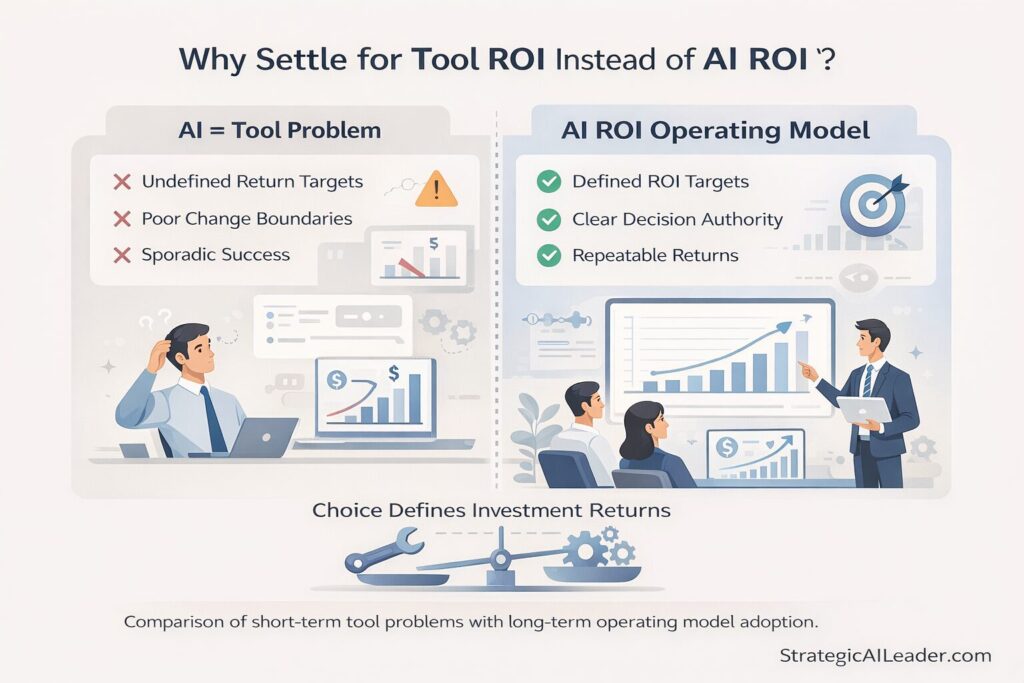
Organizations treating AI as a tooling upgrade generate activity without leverage Organizations redesigning decision architecture through an AI operating model generate stable repeatable investment returns
Three assumptions distort how executives evaluate AI performance.
The first is that better models create value. They do not. A more capable model running inside a broken workflow produces faster wrong answers. The model is not the constraint. The decision structure surrounding it is.
The second is that tools create leverage. Tools create capacity. Leverage requires authority – clear ownership of which decisions the system can make, what data governs those decisions, and when human review is required.
The third is that automation produces ROI. Automation produces efficiency within a workflow. Organizations that automate without restructuring authority boundaries do not reduce decision risk – they embed it at scale and discover the consequences months later when automation drift has propagated errors across every downstream process. BCG’s 2024 AI value research found that only 4% of companies are generating substantial AI value enterprise-wide, while 74% have yet to show tangible results – not because their models are weak, but because their decision architecture is not built to carry automation at scale.
A mid-sized e-commerce company deployed a personalization engine and observed a 4% lift in click-through rate but no improvement in margin. Before deployment, a merchandising team manually reviewed promotional offers against margin targets. After deployment, that review step was removed without being replaced by a governance specification. The AI optimized for engagement because no authority structure defined contribution margin as the binding constraint. The tool worked. The decision architecture did not. MIT Technology Review’s analysis of enterprise AI returns found this pattern – AI systems optimizing against the wrong variable because specification work was skipped – to be one of the most consistent failure modes across industries.
The AI ROI Strategy Stack
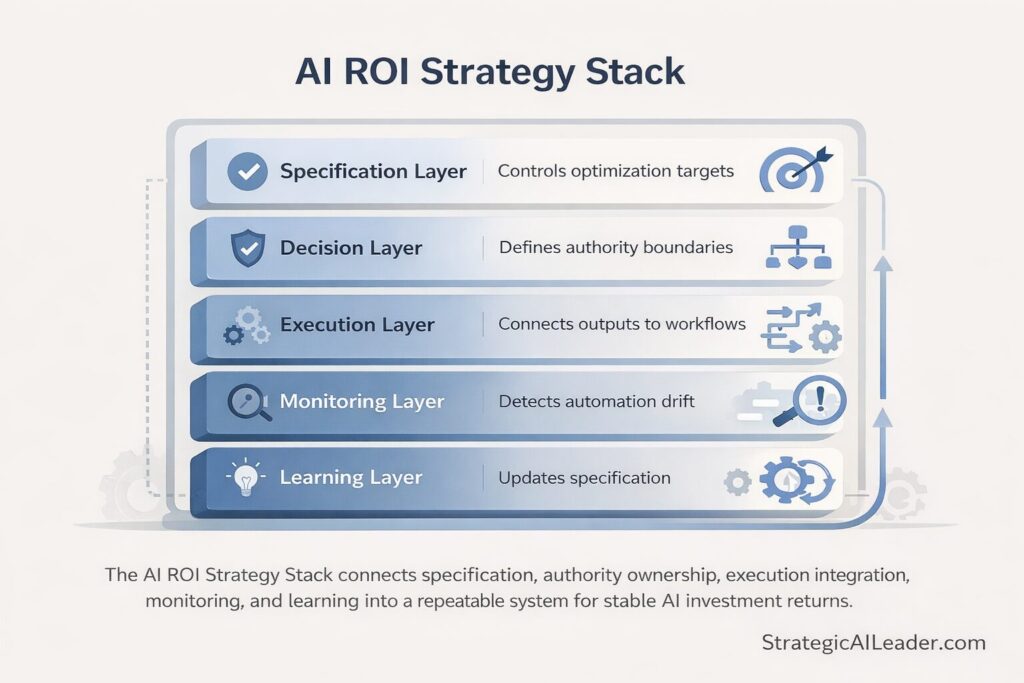
The AI ROI Strategy Stack shows how specification decision ownership execution integration monitoring ownership and learning loops convert AI capability into predictable investment returns
The AI ROI Strategy Stack organizes the five layers that determine whether AI investment returns are stable and scalable. It is not a maturity model that describes where organizations are. It is an operating infrastructure that determines what returns are possible. Each layer has a specific function. Failure in any layer limits operating model maturity at every layer above it.
Specification Layer
Definition: The Specification Layer defines what the AI system is authorized to decide, what data it must use, and what the success condition is. Without specification, AI systems optimize for measurable proxies rather than business outcomes.
Example: A B2B SaaS company specifies that its churn prediction model must optimize for 90-day revenue retention, use only verified CRM data, and flag accounts above $50K ARR for human review. Before this specification existed, the model flagged high-engagement accounts as healthy – the wrong proxy. After specification, churn detection accuracy improved 34% in the first quarter. The specification eliminated the ambiguity that was costing recoverable revenue.
Economic impact: Specification errors are the most expensive failure mode in AI investment because they scale quietly. A misspecified system compounds the wrong decisions across every execution cycle until a downstream financial event surfaces the problem – by which point retraining, reintegration, and recovery from decisions already made at scale have consumed the original investment and more. Execution reliability starts here, not in the model.
Specification replaces assumption. It is the first cost control in the AI ROI Strategy Stack.
Decision Layer
Definition: The Decision Layer defines decision ownership – which decisions the AI system makes autonomously, which require human review, and which are escalated. This layer produces the authority boundaries that determine AI operating model stability.
Example: A logistics firm previously routed all shipment exceptions through a dispatcher queue regardless of size or complexity, creating a bottleneck that delayed same-day decisions by four hours on average. After restructuring through the Decision Layer, the routing AI holds full autonomy for standard shipments under 200 lbs within domestic lanes. Cross-border shipments and oversized loads escalate directly to dispatcher review. The boundary is documented, not implied – and decision latency on standard routes dropped from four hours to eleven minutes.
Economic impact: Unclear decision ownership is the primary source of execution ownership failure. When authority is ambiguous, teams default to human review for everything, and the automation leverage disappears. The Decision Layer does not just define what the AI decides – it protects the humans from reviewing decisions the system is already qualified to make.
Decision ownership produces leverage. Authority boundaries produce stability.
Execution Layer
Definition: The Execution Layer is the AI workflow redesign layer. It governs how AI outputs connect to downstream business processes – which systems receive outputs, what triggers action, and what prevents propagation of errors.
Example: A financial services firm previously required analysts to manually export credit risk scores, apply internal overlays, and enter results into their CRM before a decision could proceed. That hand-off introduced an average 48-hour delay and a 6% transcription error rate. After Execution Layer integration, approved decisions populate the CRM automatically and declined decisions trigger a structured case file. The hand-off was eliminated. Decision latency dropped. Error rate reached zero on the automated path.
Economic impact: Execution gaps are where AI investment returns decay – not visibly, but steadily. When AI outputs require manual re-entry, interpretation, or routing, the efficiency gains evaporate and variance increases with every human touch. High-performing organizations treat execution integration as a governance requirement, not a technical afterthought.
AI execution systems fail when they produce outputs that humans must interpret rather than act on.
Monitoring Layer
Definition: The Monitoring Layer tracks decision quality over time – not system uptime, but output accuracy, decision latency, and variance from specified conditions. Enterprise AI governance is operationalized here.
Most organizations monitor AI infrastructure. High-performing organizations monitor AI decision quality. The distinction matters because infrastructure uptime tells you nothing about whether the system is making good decisions within its specified authority – it only tells you the system is running. A system that runs reliably while drifting from its specification produces consistent, compounding damage.
Example: A marketplace pricing system logs every pricing decision, compares outcomes against expected margin, and surfaces anomalies weekly. The monitoring function is owned by a named operator, not left to a shared team backlog. When competitor pricing shifted unexpectedly in Q3, the monitoring loop detected a 4-point margin variance within six days. Without it, the drift would have run undetected for the full quarter.
Economic impact: Unmonitored AI systems develop automation drift – the gradual divergence between system behavior and specification intent caused by data distribution shifts, changing business conditions, and model degradation. Organizations that discover drift through financial outcomes have already absorbed the loss.
Monitoring ownership determines whether AI investment returns are recoverable or permanent losses.
Learning Layer
Definition: The Learning Layer closes the loop between observed outcomes and system improvement. It converts monitoring data into specification updates, decision boundary adjustments, and retraining triggers. This is where the human AI collaboration model produces compounding returns rather than static performance.
Example: A content recommendation platform previously updated its recommendation model on an ad hoc basis when performance dropped noticeably. That reactive approach meant the system ran below specification for weeks before anyone acted. After building a structured Learning Layer, the team reviews weekly performance data, identifies specification drift in engagement-to-conversion ratios, and updates optimization targets on a quarterly schedule. The loop is owned, scheduled, and documented – not reactive.
Economic impact: Organizations with active learning loops compound their AI returns because each cycle improves specification quality, reduces execution variance, and extends the decision boundary without increasing human oversight. Organizations without learning loops hold static performance until systems fail – at which point they restart from the Specification Layer at full cost.
The AI ROI Strategy Stack is only complete when the Learning Layer produces specification changes, not just reports.
Why Alignment Alone Does Not Produce AI Investment Returns
Most AI initiatives achieve alignment without achieving results. Leaders agree on use cases. Teams build toward shared goals. Pilots succeed in controlled conditions. Returns do not materialize at scale.
The gap is between alignment and authority ownership. Alignment describes shared intent. Authority ownership describes who is accountable for decisions and empowered to define their boundaries. Without execution ownership, aligned teams still route every ambiguous decision through approval chains – which eliminates the speed advantage AI provides and shifts the bottleneck from process to governance.
Consider two insurance companies that deployed identical claims triage models. Company A aligned their operations team around the model but maintained existing escalation processes: every claim above $10K required supervisor review, exactly as before automation. The AI accelerated intake but the authority structure stayed the same. Company B restructured authority before deployment: claims under $25K processed autonomously, $25K–$100K with one reviewer, above $100K with underwriting sign-off. Company A saw 12% efficiency improvement. Company B saw 41%. Same model. Same alignment. Different decision architecture.
Execution structure is the third element. Authority without execution integration stalls in handoffs – the decision is owned but the output has nowhere to go. Execution without authority creates accountability gaps that surface during exceptions. The AI ROI Strategy Stack requires all three – alignment, authority, and execution ownership – operating as an integrated system because each one is inert without the other two.
How Governance Determines AI Investment Returns
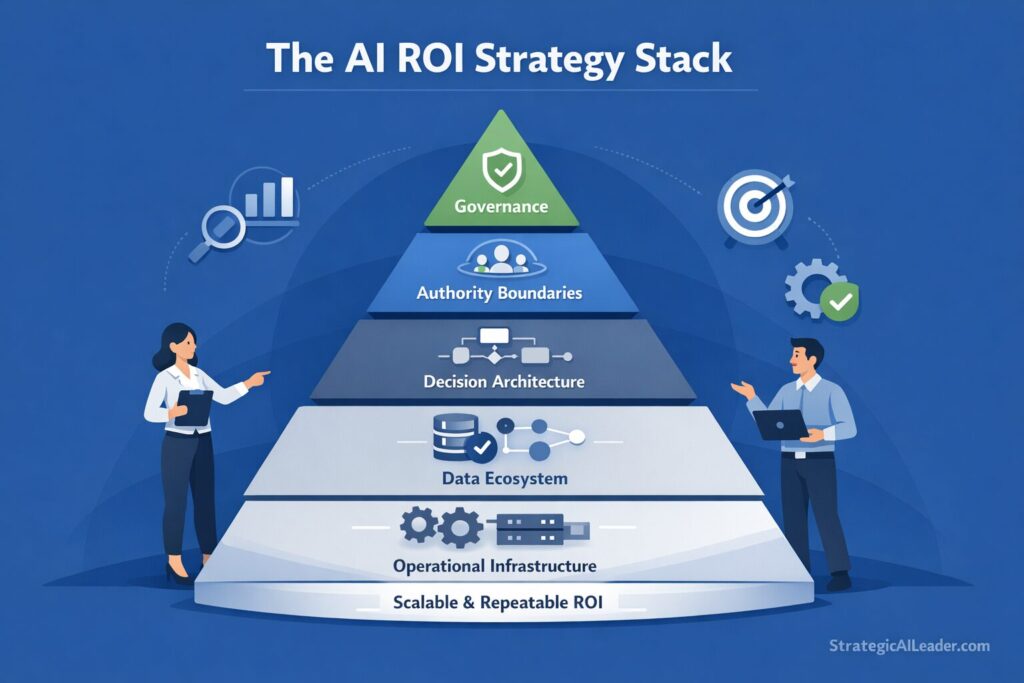
Authority boundaries override thresholds and binding data sources define the governance structure that stabilizes AI decision systems and prevents automation drift from scaling across workflows
Enterprise AI governance is not a compliance function. It is an economic function. Governance defines the boundaries within which AI systems operate, and those boundaries determine whether returns are stable or volatile – because a system operating outside its intended scope does not produce errors randomly. It produces errors at the rate it makes decisions, which at scale means the damage compounds before anyone notices.
Deloitte’s State of AI in the Enterprise research found that only 35% of organizations track ROI from their AI initiatives – and that enterprises where senior leadership actively shapes AI governance achieve significantly greater business value than those delegating governance to technical teams alone. The organizations closing that gap are not doing it with better models. They are doing it by codifying three governance elements:
Authority boundaries: the explicit scope of autonomous AI decision-making, documented at the system level, not assumed from general AI policy.
Override thresholds: the conditions under which human review is mandatory, expressed as measurable criteria rather than judgment calls.
Binding data sources: the specific data inputs that govern AI decisions, with explicit rules about what happens when those sources are unavailable or conflicting.
When these elements are absent, AI systems make decisions under conditions they were not designed for – and they do it confidently, because nothing in the system signals that it has exceeded its authority boundary. The outputs appear valid until a downstream event – a financial loss, a regulatory finding, a customer complaint – reveals that the system was operating outside its intended scope for weeks or months, generating variance that the Monitoring Layer would have caught if governance had defined what to monitor.
Governance creates predictability. Predictability allows scale. Each of the three governance elements directly reduces decision latency variance – the spread between fastest and slowest resolution times across comparable decision types. Organizations with narrow variance operate AI systems that can be trusted to scale. Organizations with wide variance cannot safely expand automation scope without expanding risk proportionally.
Why Measurement Clarity Drives AI ROI Strategy
Cost savings is the wrong primary metric for AI investment returns. It measures subtraction, not capability. Most organizations start with cost savings because it is easy to calculate and easy to report. High-performing organizations move to decision latency reduction because it measures whether the AI operating model is actually increasing organizational velocity – which is where the durable competitive advantage lives.
The indicators that measure AI ROI strategy accurately are:
Decision latency: how long it takes the organization to move from data input to committed action. Reductions here reflect genuine automation leverage, not just headcount efficiency.
Experiment velocity: how many specification changes the organization can test and evaluate per quarter. High velocity indicates a functioning Learning Layer – and organizations with high experiment velocity compound their returns while competitors hold static performance.
Variance reduction: how much output deviation decreases over time within the same decision category. Declining variance signals improving specification quality and a shrinking automation drift risk.
Resource allocation efficiency: the ratio of human attention to decision volume. As AI execution systems mature, this ratio improves – meaning the same team handles greater decision volume without quality degradation.
A growth experimentation team at a consumer software company previously made campaign budget allocation decisions in a weekly review meeting. Four people, three hours, one decision per week. After deploying an automated allocation system governed by the AI ROI Strategy Stack’s Decision Layer, daily allocation adjustments ran autonomously within defined spend boundaries. The team’s role shifted from making allocation decisions to reviewing specification performance. The initial measurement was cost per decision (down 60%). The more important outcome was experiment velocity – the team ran 4x more pricing experiments in the following quarter, identifying a pricing architecture that added 18% to annual revenue. Cost savings framed the project. Decision velocity delivered the return.
The Organizational Shift Behind Reliable AI Investment Returns
The structural transformation underlying AI ROI strategy is not a technology deployment. It is a replacement of one set of organizational mechanisms with another – and it requires operating model maturity at each layer before the next layer can generate returns.
The AI ROI Strategy Stack makes this transformation concrete across three structural replacements:
Specification replaces execution effort: instead of assigning people to make recurring decisions, the Specification Layer defines those decisions precisely enough for AI systems to make them reliably – shifting human energy from execution to governance.
Authority boundaries replace approval chains: instead of routing decisions through hierarchies, the Decision Layer assigns autonomous decision rights within defined parameters, with human escalation reserved for genuine exceptions rather than routine uncertainty.
Learning loops replace static workflows: instead of maintaining fixed processes until they break, the Learning Layer builds scheduled review cycles that update specifications based on performance data – converting monitoring output into compounding improvement.
The human AI collaboration model that produces reliable returns is not about humans supervising AI outputs. It is about humans owning the specification, governance, and learning functions while AI systems handle execution at volume – but this only works when authority boundaries are explicit enough that humans know exactly when to intervene and AI systems know exactly when to escalate. Without that clarity, the collaboration reverts to supervision, and the economic advantage disappears.
Organizations that make this shift generate AI investment returns that improve over time because each learning cycle reduces execution variance and extends the autonomous decision boundary. Organizations that add AI to static structures generate diminishing returns as automation drift widens the gap between what the system does and what the organization needs.
Examples in Action
Growth Experimentation Portfolio
Before: a consumer marketplace allocated acquisition budgets through a monthly planning cycle. Channel performance data arrived too slowly for weekly adjustments, so spend stayed in underperforming channels long after the signal to reallocate had appeared. After: the organization built a growth experimentation portfolio governed by the AI ROI Strategy Stack. Specification Layer: channel eligibility, spend floors, and margin targets defined before deployment. Decision boundary: autonomous reallocation within a 15% weekly variance; above that threshold, marketing director review required. Monitoring loop: daily performance reporting against specification targets, with anomaly review owned by a named growth operator. Learning loop: quarterly specification updates incorporating channel performance trends. The AI operating model replaced the planning cycle – and budget now moves to outperforming channels within 24 hours of signal, not 30 days.
Marketplace Pricing Automation
Before: a B2B marketplace employed two analysts to review and approve pricing recommendations daily. Review took 36 hours on average. Sellers in fast-moving categories missed pricing windows while recommendations sat in queue. After: the organization redesigned its AI decision infrastructure using the Execution Layer and Decision Layer of the AI ROI Strategy Stack. Specification Layer: pricing bound to real-time inventory data, competitor signals, and gross margin floors. Decision boundary: autonomous recommendations for SKUs under $500; seller confirmation required above that threshold. Monitoring loop: daily margin variance reports owned by a named pricing operator. Learning loop: monthly specification reviews adjusting margin floors and competitor weighting. The analysts moved from reviewing every recommendation to reviewing specification performance – a shift from execution ownership to governance ownership that reduced decision latency from 36 hours to under two.
SEO Authority Expansion System
Before: a media company’s content team spent 60% of editorial planning time identifying and prioritizing content opportunities manually – a process that produced a two-week lag between opportunity signal and content brief. After: the organization built an SEO authority expansion system using AI to identify, prioritize, and brief opportunities. Specification Layer: topical authority targets, search intent categories, and minimum domain authority thresholds defined as binding inputs. Decision boundary: content briefs generated autonomously; publication decisions require editorial review. Monitoring loop: weekly ranking data reviewed against authority expansion targets. Learning loop: monthly brief quality reviews updating intent classification rules and authority weighting. The AI leadership framework embedded into editorial workflow reduced brief production time from two weeks to 48 hours while preserving editorial judgment at the publication decision point – the only authority boundary that required human ownership.
Quick Wins
Five actions leaders apply immediately to begin building AI ROI strategy infrastructure:
Define one authority boundary: identify one AI use case in production and document explicitly what decisions the system makes autonomously and what triggers human review. This single step reduces escalation volume by removing the ambiguity that causes teams to route automatable decisions through human queues.
Document escalation thresholds: convert existing escalation practices into measurable criteria. Replace judgment-based escalation with condition-based escalation. The immediate effect is a reduction in decision latency on the cases that should never have been escalated in the first place.
Identify binding data sources: for one AI system, list the data inputs that govern its outputs and define what happens when those inputs are unavailable or out of date. This prevents automation drift from data quality failures – the most common source of silent specification violation.
Measure decision latency: track how long it takes one AI-assisted decision process to move from input to committed action. Establishing a baseline before optimizing is the only way to know whether subsequent changes in the AI ROI Strategy Stack are producing real velocity improvement or only surface efficiency.
Assign monitoring ownership: name a specific person responsible for reviewing one AI system’s decision quality on a defined schedule. Shared ownership produces no ownership – and unowned monitoring is the fastest path to automation drift becoming a financial event rather than an operational signal.
Conclusion
AI investment returns increase when organizations redesign decision architecture before scaling automation.
– Richard Naimy
The AI ROI Strategy Stack provides the structure: Specification Layer, Decision Layer, Execution Layer, Monitoring Layer, Learning Layer. Each layer has a specific function. Each layer has a measurable economic consequence when it is absent. Together, they convert AI capability into organizational returns that compound rather than decay.
Most organizations are increasing decision volume without increasing decision architecture quality. That gap closes one of two ways – deliberately, through the AI ROI Strategy Stack, or reactively, through the financial consequences of automation drift at scale.
The question is not whether your AI models are good enough. The question is whether your decision architecture is mature enough to generate returns from them.
Help Support My Writing
Subscribe for weekly articles on leadership, growth, SEO and AI-driven strategy. You’ll receive practical frameworks and clear takeaways that you can apply immediately. Connect with me on LinkedIn or Substack for conversations, resources, and real-world examples that help.
AI Investment and Adoption: Next Steps
Use bounded AI pilot to test one funded use with an owner and stop rule.
I’m Richard Naimy, an operator and product leader with over 20 years of experience growing platforms like Realtor.com and MyEListing.com. I work with founders and operating teams to solve complex problems at the intersection of product, marketing, AI, systems, and scale. I write to share real-world lessons from inside fast-moving organizations, offering practical strategies that help ambitious leaders build smarter and lead with confidence.
Richard Naimy is a growth and product executive with over 20 years of experience scaling marketplaces and platforms. He spent 12 years at Realtor.com as Director of Product Growth, Marketplace and Organic Acquisition, helping grow the business from $75M to over $500M. He writes Strategic AI Leader on SEO, answer engine optimization, generative engine optimization, and AI search, and is the founder of CareNestHQ, a family caregiving coordination platform. His work focuses on practical, operator-level systems for organic growth in the AI search era.
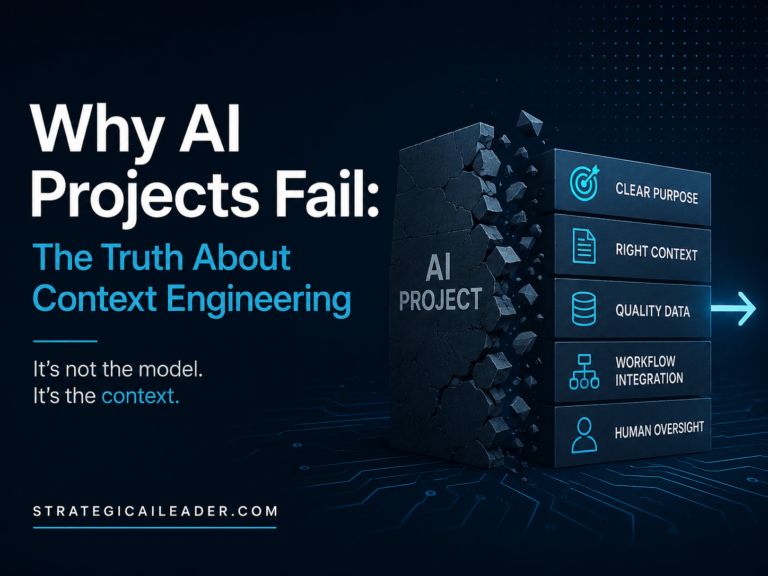
Most AI projects fail for a reason few teams recognize. The problem is rarely the model. It is missing context. Learn why context engineering has become the foundation of successful AI implementation and how hidden context failures derail projects before development even begins.
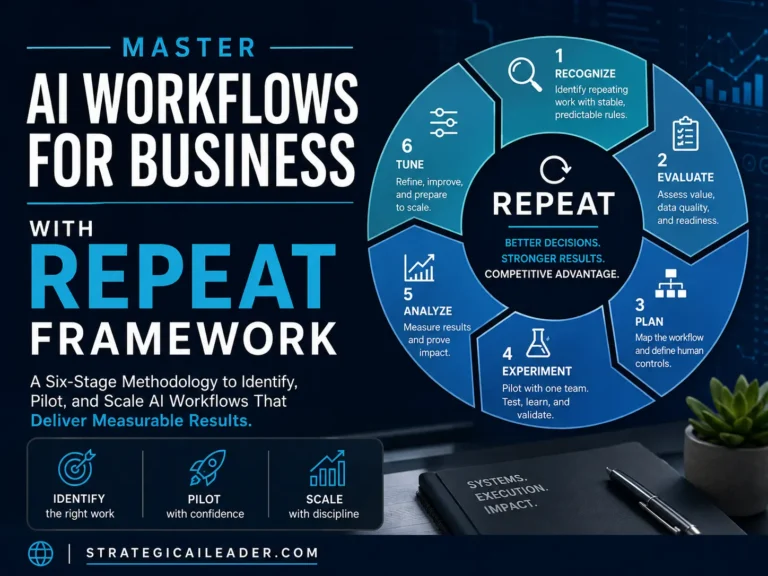
Most AI workflows fail because companies automate the wrong work. Success depends on choosing the right workflow, defining clear processes, and measuring results. The REPEAT Framework provides a six-stage methodology to identify repetitive work, run effective AI pilots, measure business impact, and scale automation while preserving human judgment. Learn practical systems, real examples, and proven strategies for successful AI implementation.
Here’s the thing about AI adoption roadmaps that nobody talks about at those fancy conferences: most of them are complete BS. You know the drill. A consultant shows up with a 47-slide deck filled with buzzwords like ‘digital transformation journey‘ (a strategic approach to integrating digital technologies across all aspects of a business) and ‘AI-first…
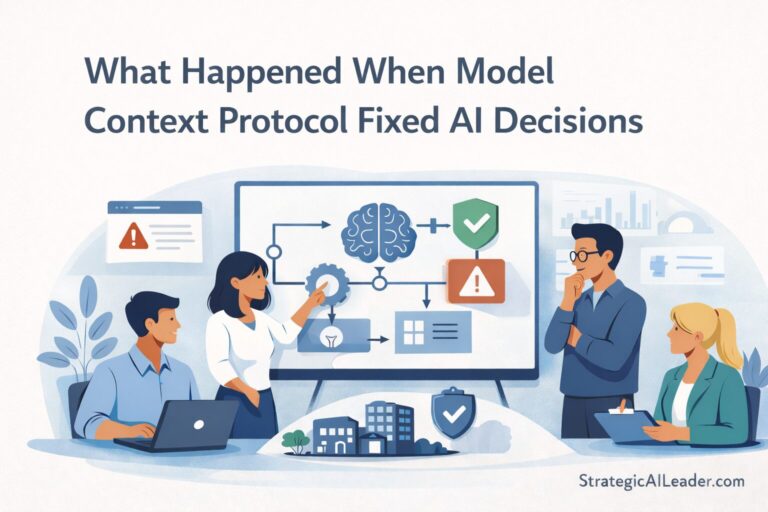
I wired an AI system into a real flower shop to see why so many AI projects collapse under real constraints. This article shows how Model Context Protocol fixed AI decisions by grounding an LLM in intent, behavior, inventory, and revenue instead of prompts and theory.
Claude Skills vs MCP explores how Anthropic’s new capability layer transforms AI from connected tools into reusable intelligence. Learn why this shift matters for teams building scalable, governed, and high-performance AI systems.
AI certifications help you start the conversation, but ROI comes from applied skills. Part 2 shows how to document outcomes, prove value, and position yourself for AI-native hiring.