Proven Demand Generation: How Operators Capture Qualified Demand
I have sat through enough growth reviews to recognize the pattern. Marketing presents a full campaign calendar. Registrations are up. Lead volume looks healthy. Then sales opens its pipeline report and asks a harder question: Where are the buyers?
Most teams answer by debating lead quality, attribution, or follow-up speed. Those issues matter, but the argument often hides a deeper failure. The company has built activities around demand without designing the system that moves buyer interest toward a commercial decision.
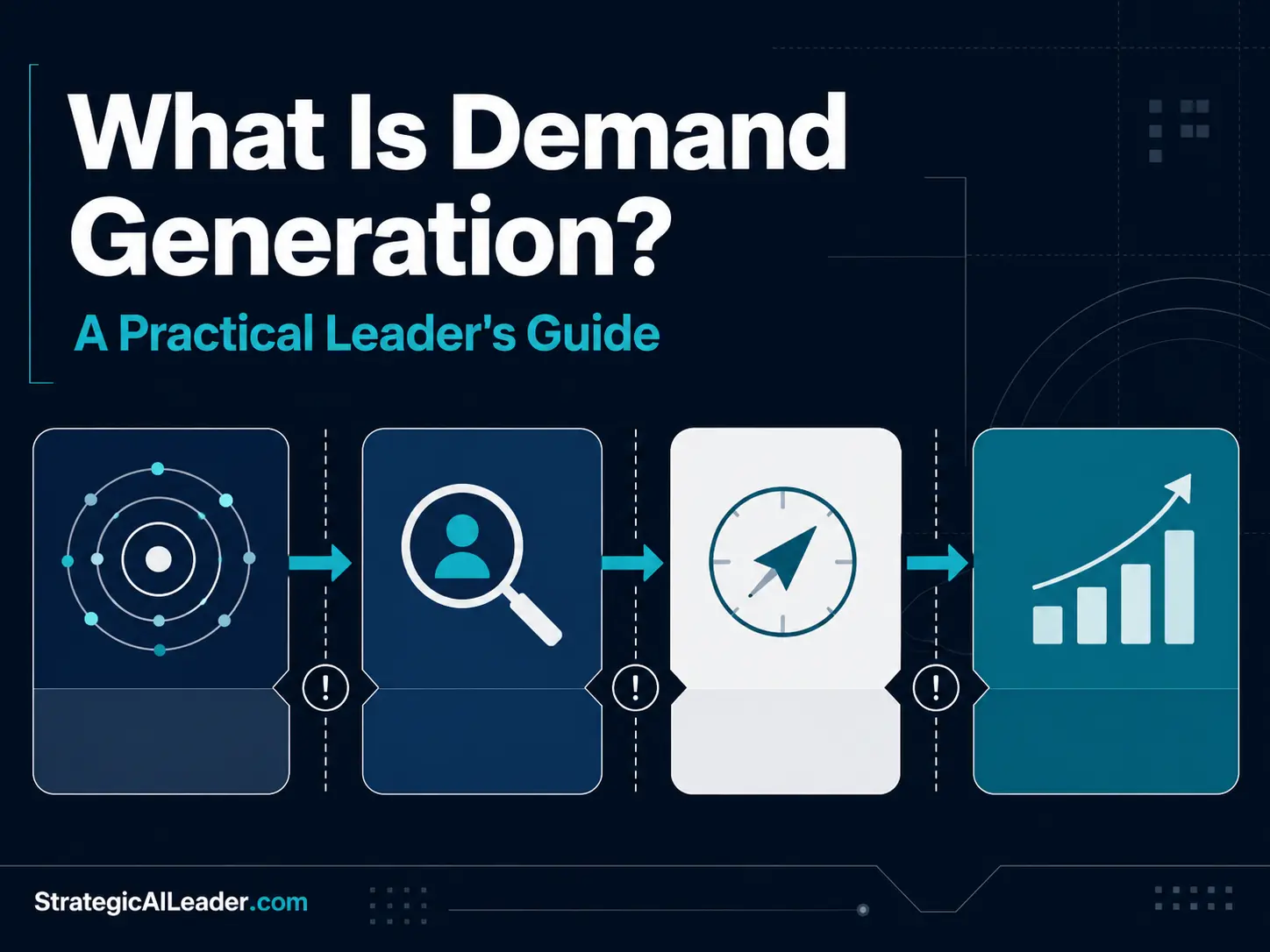
That distinction matters when asking, what is demand generation? Demand generation is the coordinated work of creating awareness, building buyer interest, and helping a market understand why a problem deserves attention. Strong programs also make it easy for interested buyers to take the next step. They do not pretend every impression should become a meeting, but they do show leadership how attention, intent, and pipeline connect.
Salesforce describes B2B demand generation as a long-term effort to build awareness, authority, and trust across the customer lifecycle. HubSpot draws a useful line: demand generation creates attention and interest, while lead generation captures that interest at specific points.
The definitions are straightforward. Operating the system is not.
Demand Generation Is a Market System, Not a Campaign Type
Companies often use “demand generation” as a label for paid campaigns, webinars, content syndication, or an internal marketing team. That framing reduces a business system to a collection of tactics.
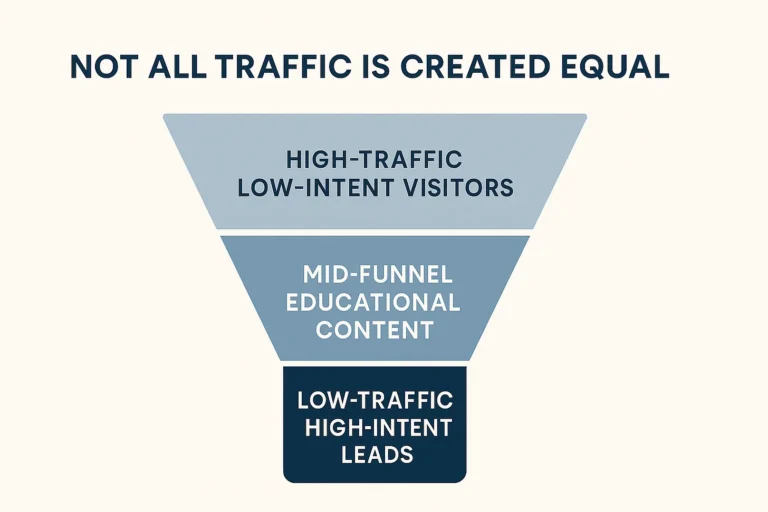
Demand begins before a buyer fills out a form. A future customer must first recognize a problem, understand its cost, connect it to a class of solutions, and remember a credible provider when the timing is right. My attraction-based funnel playbook explains how authority, trust signals, and behavioral triggers support that movement without forcing every buyer into an immediate sales conversation. In a complex B2B purchase, several people may move through those stages at different speeds. An operations leader might feel the pain first. Finance may enter when the price becomes relevant. IT and legal may not care until a specific vendor reaches consideration.
One campaign rarely moves the entire buying group. One lead record rarely represents the full decision.
A narrow focus on immediate conversions creates bad strategy. A team sees low form volume and concludes the content failed, even though target accounts are reading, returning, and discussing the problem internally. Another team celebrates thousands of downloads without noticing that the offer attracted students, competitors, and junior practitioners who will never enter a buying process.
Demand generation has to serve two time horizons at once. It must help future buyers form a preference before a purchase window opens, then help active buyers move when intent becomes visible. Salesforce describes this as a full-lifecycle strategy, not a top-of-funnel event that ends when a name enters the CRM.
That creates an uncomfortable measurement problem. Future demand does not always identify itself. Active demand often appears late. HubSpot reported in its 2026 marketing statistics that nearly 70% of marketers see leads arriving later in the buying process after completing more AI-assisted research. Buyers are learning, comparing, and narrowing options before a company sees a traditional conversion event.
Leaders should not respond by abandoning measurement. They should stop asking one metric to explain the whole system.
Why Healthy Marketing Reports Still Produce Weak Pipeline
A campaign dashboard and a pipeline report describe different parts of the buyer journey. Problems begin when leadership treats them as competing versions of the truth. The B2B revenue metrics leaders choose determine whether teams see commercial movement or another collection of disconnected channel numbers.
Marketing often owns reach, engagement, and lead creation. Sales owns accepted opportunities and revenue. Revenue operations manages the systems between them. Each team optimizes the portion it sees, which means a broken handoff can survive even while every department hits its local target. The failure resembles the one in my sales operations case study, where shared definitions and repeatable operating rules matter more than another isolated dashboard.
Consider a webinar program. Marketing selects a broad topic because broad topics drive registrations. The registration form stays short because fewer fields improve conversion. The nurture sequence sends the same follow-up to everyone because segmentation would take more work. Sales receives a list with names, titles, and email addresses, but no clear problem signal or timing. Reps scan the list, recognize weak intent, and return to outbound prospecting.
Nothing in that sequence looks irrational from inside one department. Together, the choices produce an expensive list with little commercial meaning.
The failure started before sales received the leads. The topic attracted interest but did not reveal a buying problem. The form captured identity but not intent. The follow-up delivered content but did not create a meaningful next step. The handoff transferred records without transferring context.
Leadership often reacts by asking marketing for more leads or sales for faster follow-up. Both responses increase activity inside the same broken design.
The better question is: At which point did buyer interest stop becoming more specific?
That question changes the review. If target accounts never engage, the audience or message is wrong. If they engage but do not take a next step, the offer may lack relevance or urgency. If they request contact and sales rejects them, marketing and sales may disagree about qualification. If sales accepts opportunities but deals stall, the demand program may have created curiosity without building enough internal consensus.
Each failure needs a different correction. More traffic solves only one of them.
Demand Generation vs Lead Generation vs Demand Capture
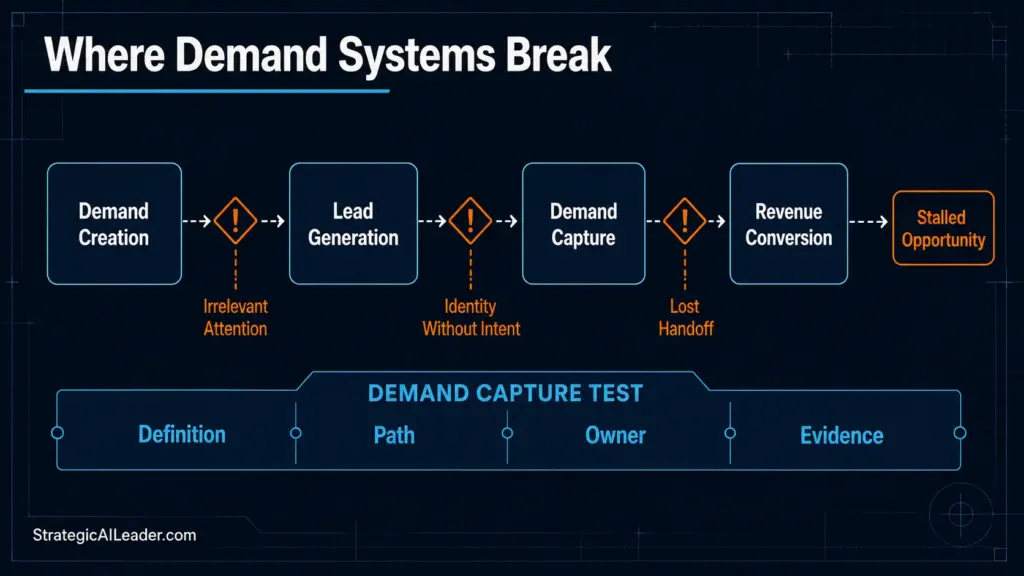
The language gets messy because companies assign these terms according to their org charts. A useful operating model separates them by the job each one performs.
Demand creation helps the market recognize a problem, understand the stakes, and associate your company with a credible point of view. Thought leadership, original research, useful search content, events, communities, and category education often do this work. The audience may remain anonymous for months.
Lead generation gives interested people a reason to identify themselves. A newsletter, assessment, webinar registration, template, trial, or consultation produces a contact record and permission for follow-up. The record proves identity. It does not automatically prove buying intent.
Demand capture meets buyers when intent becomes stronger. A buyer searches for a solution, visits a pricing page, compares vendors, requests a demonstration, starts a trial, replies to outreach, or asks a specific implementation question. Capture design reduces friction at the moment a buyer wants progress.
The three jobs overlap, but collapsing them creates predictable mistakes. When leaders judge demand creation only by form fills, teams gate useful content and shrink its reach. When they judge lead generation by raw volume, teams lower the qualification bar and send sales weak records. When they treat demand capture as another campaign, they overlook practical barriers such as confusing offers, slow routing, generic follow-up, or missing proof.
The operating relationship looks like this:
| Job | Question it answers | Evidence worth reviewing | Common failure |
|---|---|---|---|
| Demand creation | Are the right buyers learning and forming a preference? | Target-account reach, branded search, engaged visits, repeat consumption, direct traffic | Broad attention with little relevance |
| Lead generation | Which interested people have identified themselves? | Relevant contacts, role and account fit, stated problem, permission to continue | Contact volume mistaken for intent |
| Demand capture | Are active buyers finding and completing a meaningful next step? | High-intent visits, replies, trials, consultations, demos, accepted opportunities | Intent arrives but the route loses it |
| Revenue conversion | Does qualified demand become pipeline and revenue? | Sales acceptance, opportunity progression, pipeline value, win rate, revenue | Marketing creates interest that the sales process cannot advance |
The table should not become another dashboard with 30 metrics. Its purpose is diagnostic. Leadership needs enough evidence to identify the stage where movement stopped.
Qualification Is a Strategic Choice
Teams often discuss lead qualification as a scoring problem. They debate thresholds, point values, or which actions deserve more weight. The spreadsheet matters less than the definition underneath it.
A qualification rule expresses what the company believes about its market. If the rule requires a senior title, a target account, an active problem, and a near-term project, the company has chosen a narrow view of present demand. If the rule counts any content download from an approved industry, it has chosen a broad view of possible future demand. Neither approach is automatically correct. The problem appears when leadership expects narrow-pipeline quality from a broad-volume definition. A precise B2B ideal customer profile gives the team a defensible starting point for fit, but fit still does not prove intent or timing.
Good qualification separates fit, problem, intent, and timing.
Fit asks whether the buyer or account resembles the customers the company serves well. Problem asks whether a relevant business need exists. Intent asks whether behavior suggests active evaluation rather than general education. Timing asks whether the organization has a reason to act within a useful window.
Those dimensions should not collapse into one score too early. A perfect-fit account with weak present intent belongs in a different path from a poor-fit contact who requested a demo. The first may deserve patient education and account monitoring. The second needs a fast, respectful qualification step rather than automatic placement in the sales pipeline.
Leaders also need to inspect who the system excludes. A senior-title requirement may miss practitioners who research and champion the solution. A short purchase window may ignore enterprise buyers who need months to build consensus. A high behavioral score may reward one enthusiastic user while overlooking the rest of the buying committee.
Qualification should improve resource allocation, not create false certainty.
The Demand Capture Test
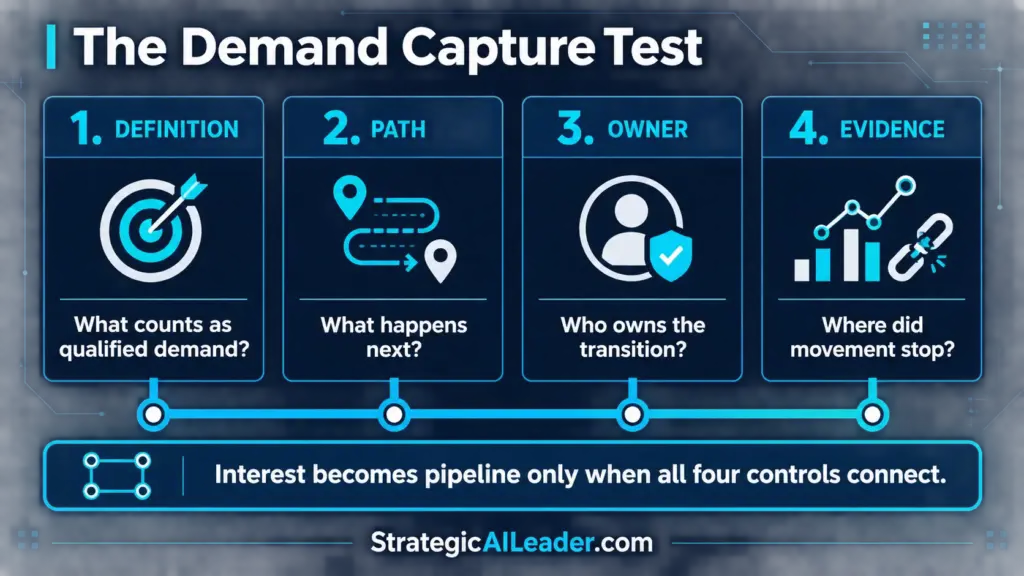
I use a four-part test to determine whether buyer interest has a real operating path. The test does not replace positioning, creative strategy, channel selection, or sales execution. It exposes whether those efforts connect once interest appears. This operating layer belongs inside a broader growth operating system that turns market signals into decisions, execution, and learning.
Start with a qualified-demand definition
Write one sentence describing the account or buyer, the problem signal, and the meaningful next action.
“We need more pipeline” gives the team no decision rule. “An operations leader at a target account who has an active implementation problem and wants a working session” gives marketing, sales, and revenue operations something they can challenge together.
The sentence will not cover every edge case. Its value comes from forcing tradeoffs into the open. If sales expects active projects while marketing reports engaged accounts, leadership needs two stages with different names. Renaming every engaged account an MQL does not resolve the difference.
Map the path with context, not boxes
A funnel diagram shows stages. An operating path explains what changes between them.
For each handoff, document what the buyer did, what the company learned, who acts next, how quickly they act, and which context follows the record. A webinar registrant who reports an implementation problem should not receive the same sequence as someone who attended for general education. A pricing-page visitor from a target account should not wait three days for a generic email.
The route needs an exception path as well. What happens when a prospect fits the account profile but lacks timing? What happens when a buyer requests help but falls outside the ideal customer profile? Without those rules, teams either discard useful future demand or force weak opportunities into pipeline.
Assign ownership across the gaps
Demand systems fail at boundaries because departments own stages while nobody owns movement.
Marketing may own the campaign. Sales development may own first contact. Account executives may own qualified opportunities. Revenue operations may own routing logic. When performance drops between two stages, every team can point to a metric proving its own work succeeded.
One accountable leader must review the full path. That person does not perform every task. The role exists to resolve definition conflicts, inspect failed handoffs, and stop local optimization from damaging the overall result.
Review evidence as a chain
Do not begin the review with a blended return-on-investment number. Start with buyer movement.
Did the intended accounts see the message? Did the right people engage? Did their behavior reveal a relevant problem? Did they take a meaningful next step? Did sales accept the opportunity? Did the opportunity progress?
A break in the chain identifies the work. Weak reach points toward distribution or audience selection. Strong reach with weak engagement points toward the problem framing. Strong engagement with weak capture suggests an offer or route problem. High capture with low sales acceptance exposes qualification disagreement. Accepted opportunities that stall may signal weak urgency, missing stakeholders, or a gap between the marketing promise and sales conversation.
The distinction goes deeper than attribution. Attribution distributes credit. Diagnosis identifies the constraint.
A One-Week Demand System Review
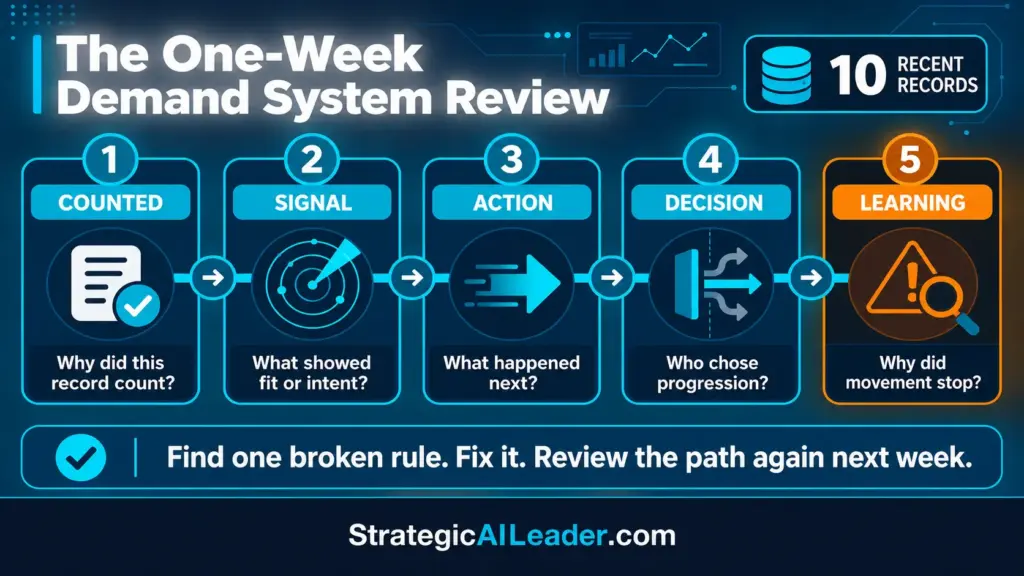
Do not start by rebuilding the entire funnel. Choose one live source of attention already consuming budget or team time.
Bring marketing, sales, and revenue operations into the same review. Put ten recent records on the screen, not a summary slide. Follow each one from its first known interaction to its current state. Look for missing context, unexplained delays, inconsistent qualification decisions, and buyers who disappeared between systems.
Then answer five questions:
- What did the buyer do that made the company count this record?
- What evidence suggested fit, problem, intent, or timing?
- What next action did the buyer receive, and how long did it take?
- Who decided whether the record progressed?
- What did the company learn when the record stopped?
Ten records will not establish a market benchmark. They will reveal whether the operating logic exists at all.
Finish the review with one correction rule. The rule might require a problem question on the registration form, a two-hour response standard for high-intent actions, a separate nurture path for target accounts without active timing, or a required rejection reason from sales. Run the same path for another week and inspect whether the correction changed buyer movement.
That is more useful than adding another campaign to a calendar the organization cannot explain.
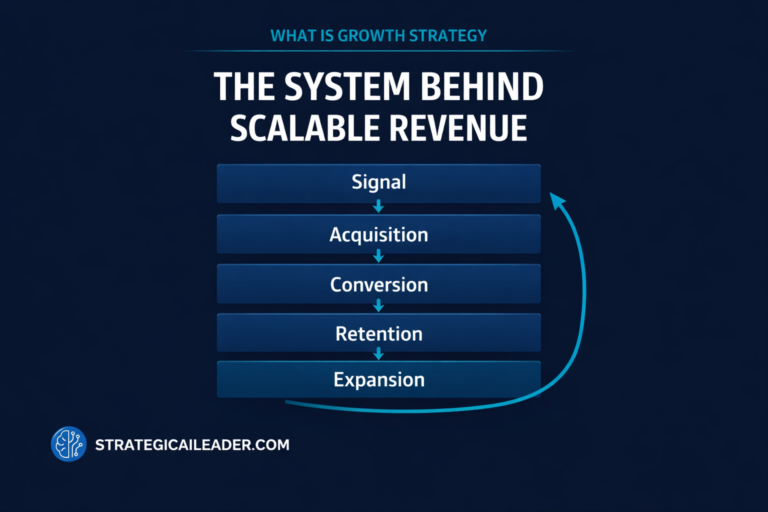
The same principle appears in my article on operator workflow. A decision becomes operational only when the route, owner, and evidence are visible. Demand follows the same discipline. For the broader choices around markets, positioning, and growth bets, read What Is Growth Strategy?. If your foundation already works and you want to apply AI inside it, use the AI-Powered Demand Generation Playbook.
Demand Generation FAQ
What is demand generation in simple terms?
Demand generation helps the right buyers understand a problem, develop interest in solving it, and build trust in a company before and during a purchase decision. The work includes market education, thought leadership, content, events, paid distribution, nurturing, and high-intent conversion paths. A complete program connects those activities to qualified pipeline without treating every interaction as immediate buying intent.
What is the difference between demand generation and lead generation?
Demand generation creates awareness, interest, and preference across a market. Lead generation gives interested people a reason to identify themselves through an action such as registering for an event, subscribing, downloading a resource, requesting an assessment, or starting a trial. A lead record confirms identity and engagement. Qualification still has to determine fit, problem, intent, and timing.
How do you measure demand generation?
Measure demand generation as a chain rather than one blended number. Review whether the program reached target accounts, earned meaningful engagement, captured stronger intent, produced sales-accepted opportunities, and contributed to qualified pipeline. The most useful metric depends on the stage being evaluated. Branded search may help assess demand creation, while sales acceptance and opportunity progression help assess commercial movement.
Who should own demand generation?
Marketing or growth often owns the overall program, but ownership should extend across the handoffs connecting marketing, revenue operations, sales development, and account executives. One accountable leader should review the full path, resolve conflicting definitions, and correct failures between departments. Assigning each stage to a team without assigning ownership for movement leaves the largest gaps unmanaged.
Does demand generation work for small businesses?
Yes. A small business does not need a large advertising budget or complex technology stack to build demand. It needs a clear customer definition, a relevant problem, useful education, a credible offer, and a visible next step. A local consultant might use search content, workshops, referrals, and a consultation path. A B2B software company might use research, webinars, account engagement, and demonstrations. The system changes with the buying process, but the operating logic stays consistent.
Does demand generation require marketing automation?
No. Teams should define the buyer, qualification rules, path, ownership, and evidence before automating anything. Marketing automation becomes valuable when volume, segmentation, or response timing exceeds what the team can manage reliably. Automating an unclear route increases speed without improving judgment.
What Leaders Should Take From This
Demand generation is not a campaign label and it is not a softer name for lead generation. It is the market-facing system that creates buyer understanding, builds preference, captures interest, and connects active demand to a commercial path.
Leaders should expect different evidence at different stages. They should also expect the evidence to connect. Reach without relevance wastes attention. Leads without context waste sales time. Pipeline without genuine urgency creates false forecasts.
Before approving another campaign, ask the team to show where buyer interest becomes more specific, who owns each transition, and what the organization learns when movement stops. If those answers live in three departments and do not agree, the company does not need more demand activity yet. It needs a demand system.
Get More Strategic Insights
If your campaign calendar looks healthy but qualified pipeline tells a different story, subscribe to Strategic AI Leader. I share practical frameworks for finding the missing decision, owner, handoff, or measurement rule before your team adds more tools.
Sources
- Salesforce: What Is B2B Demand Generation?
- HubSpot: Demand Generation vs Lead Generation
- HubSpot: 2026 Marketing Statistics, Trends, and Data
Explore the Strategy Library
This article is part of a broader operator framework library covering AI execution, growth systems, and revenue infrastructure.
- Case Studies
Applied AI product launches, evaluation frameworks, and deployment decisions. - AI Strategy
Model selection, guardrails, automation architecture, and enterprise AI readiness. - AI + MarTech Automation
Workflow automation across acquisition, attribution, and lifecycle systems. - Growth Strategy
Compounding revenue systems across positioning, channels, retention, and expansion. - Revenue Operations
Pipeline architecture, forecasting reliability, and GTM infrastructure. - Sales Strategy
Deal velocity, qualification frameworks, and enterprise conversion mechanics. - SEO & Digital Marketing
Search-driven growth, authority building, and technical visibility systems. - COO Ops & Systems
Execution infrastructure, process scaling, and operating cadence design. - Leadership & Team Building
Organizational alignment, hiring systems, and operator capability development. - Strategic Thinking
Decision frameworks for complex product, platform, and market environments. - Framework Visuals
Operator diagrams, system stacks, and execution maps. - Personal Journey
Lessons from building platforms, shipping AI products, and leading execution teams.
Want 1:1 strategic support?
Connect with me on LinkedIn
Read my playbooks on Substack