SoFi Outperforms Bank of America in AI Answers
Your brand has strong Google rankings.
Your team publishes regularly.
Buyers know your name.
However, you ask an AI assistant a purchase question, and AI search visibility for fintech brands makes competitor appear ahead.
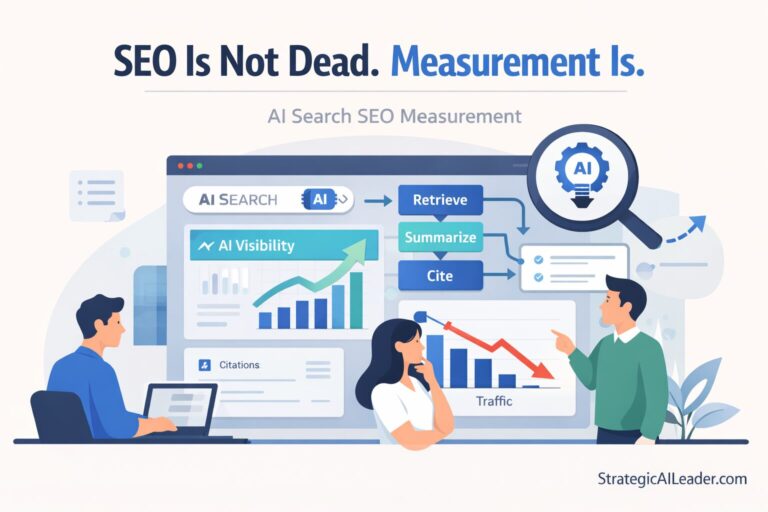
AI search visibility deserves a separate place in your growth reporting. Moreover, a search ranking tells you where a page appears.
Additionally, an AI answer adds another question: how does the response present your business when a buyer asks for help choosing?
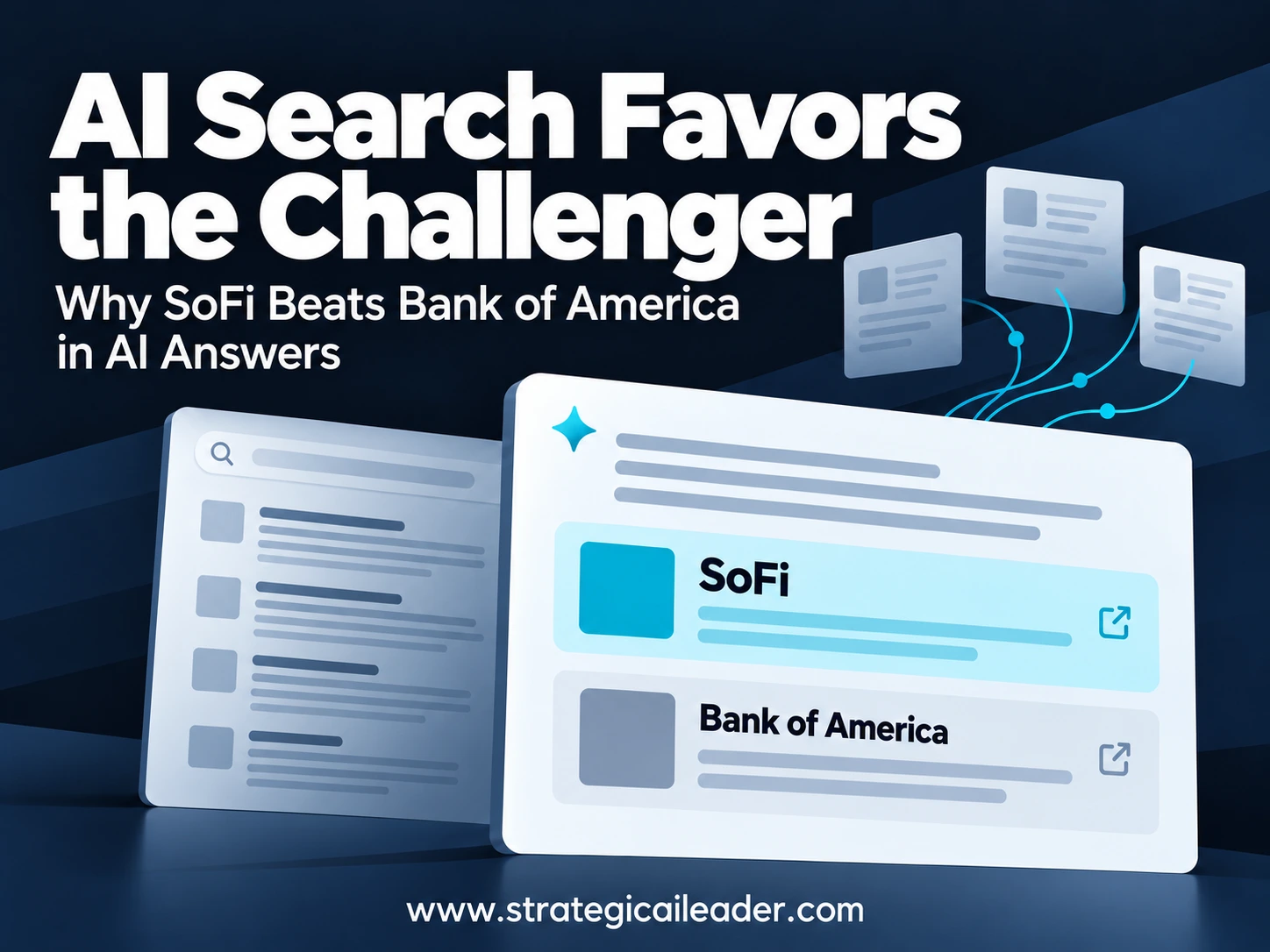
NP Digital’s fintech AI visibility study announcement offers a useful example. Its September 14, 2026 press release reports SoFi appearing earlier than Bank of America in AI answers, with an average first-mention position of 3.75 versus 6.07. Positive framing reached 61.8% of SoFi mentions versus 46.8% for Bank of America.
Those figures deserve attention. Additionally, they also deserve restraint. However, the comparison shows a visibility gap. As a result, the results do not establish why the gap exists or prove every challenger enjoys an advantage.
My takeaway is operational.
Additionally, your team needs to know which buyer decisions generate accurate recommendations for your business.
Where competitors appear, you should know which changes deserve investment.
AI search visibility for fintech brands overview
Key visibility measures
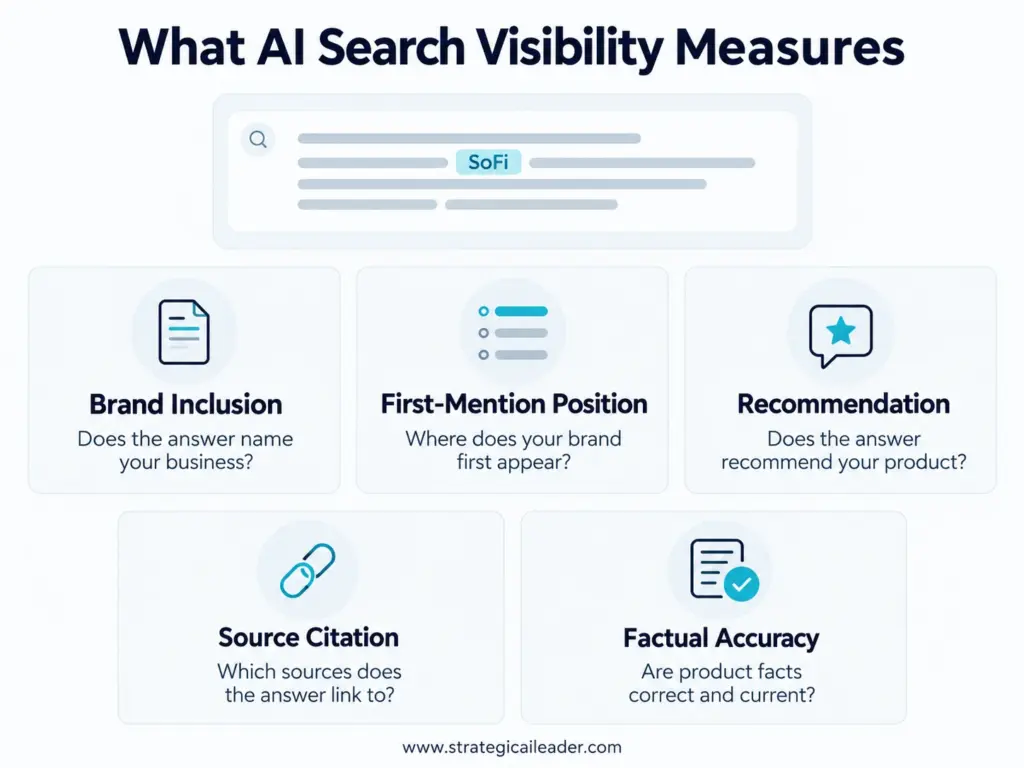
to understand your presence in AI answers
| AI search visibility describes how often and how prominently your brand appears in AI-generated responses to relevant questions. Useful measurement also checks recommendation language, cited sources, and factual accuracy. |
Keep those measures separate. An assistant might cite your article without recommending your product. Another response might recommend your business without linking to your website. A third might name your company while describing an outdated service.
Each response creates a different problem for your team. A single visibility score hides those differences. Your answer engine optimization process should check whether the surface selects your approved answer, alongside the broader brand visibility measures.
What leaders get wrong about AI search
The first mistake is assuming existing search performance guarantees inclusion in AI answers. Your SEO dashboard tracks pages and queries. Your AI monitoring should also track how responses describe your products and match them to buyer needs.
The second mistake is treating GEO as a replacement for SEO. Understanding the differences between SEO, AEO, and GEO helps your team assign separate goals for discoverability, answer selection, and source citation.
Google’s guidance on AI features and website eligibility states SEO fundamentals still apply to AI Overviews and AI Mode. Supporting pages need indexing and eligibility for search snippets. Google requires no special AI markup for inclusion.
Keep your technical foundations. Add measurement for the answer experience. A crawlable page with clear product information serves both efforts.
The third mistake is confusing positive language with buyer preference. “A respected provider” tells you little about whether the answer recommends your product for a specific need. Read the surrounding explanation before declaring a win.
What the SoFi comparison supports
NP Digital’s fintech AI visibility analysis and methodology covers 68,334 answers to 250 prompts across five platforms and ten fintech categories. Its composite score combines mention frequency, first-mention position, and category coverage.
The analysis places Apple first overall and SoFi first among pure fintech brands. SoFi appeared across all ten categories. Breadth contributed to its result. The authors also identify position and sentiment as text-based proxies rather than human-coded labels.
My interpretation: a broad portfolio creates more opportunities when buyers receive useful information about each product. Breadth alone tells us little about the quality of those answers.
A bank serving several customer groups needs specific evidence for each group. A specialist needs enough evidence to support its narrower promise. Neither business earns a recommendation through positioning language alone.
The leadership question becomes more concrete: where does your public information support a buyer’s decision, and where does your team leave gaps?
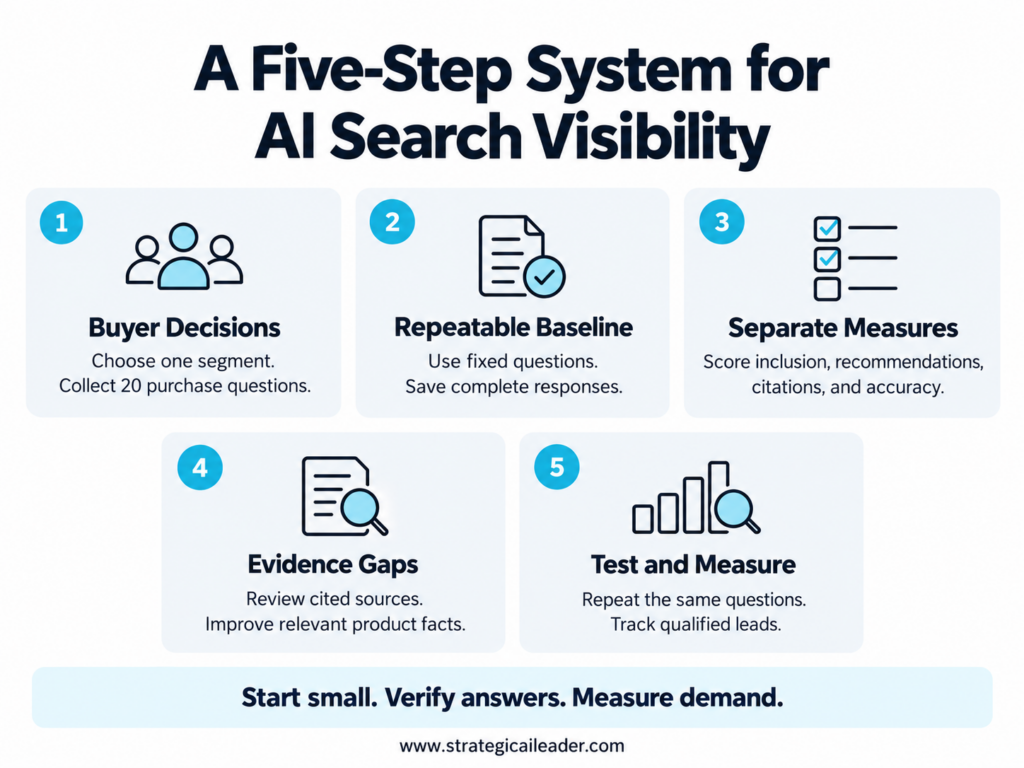
A five-step system for AI search visibility
evaluate changes against qualified demand
1. Start with decisions your buyers make
Choose one valuable customer segment before building a large prompt list. Ask sales, support, and product teams which questions influence selection.
For a commercial real estate marketplace, useful test questions might include:
“Where should I advertise a small retail property for lease in Dallas?”
“Which commercial listing services explain listing costs before sign-up?”
“How should I compare a marketplace with a local broker for leasing warehouse space?”
These illustrative prompts cover location, pricing, and service fit. They give your team more useful context than “best commercial real estate website.”
Build an initial set of 20 questions across discovery, comparison, and selection. Keep branded questions separate from questions buyers ask before choosing a provider.
The broader principle follows intent-driven SEO: organize content around decisions, then select the queries needed to evaluate coverage.
2. Establish a repeatable baseline
Run the same questions across your selected platforms. Record the date, platform, available model information, location, and whether the session used web search or personalization.
Save the complete response and every visible source link. Repeat each question in fresh sessions. A single response establishes an observation, not a stable pattern.
For Google AI Overviews, record queries without an overview separately. An absent overview and an overview excluding your brand represent different outcomes.
Start with three runs per question on three platforms. Twenty questions produce 180 responses per measurement round. Treat the sample as a directional baseline for your chosen questions, rather than an estimate of every buyer’s experience.
Fix the test questions during each comparison period. Changing the prompt set while changing your content makes the results harder to interpret.
3. Score inclusion, recommendation, and accuracy separately
Record five fields for each response:
Brand inclusion. Does the response name your business?
First-mention position: Where does your brand first appear among named providers? Calculate position only for responses containing your brand.
Recommendation: Does the assistant recommend your product for the stated need, list your business as an option, or advise against choosing your product?
Source citation: Does the response link to your website, an independent source, or both?
Accuracy: Does the description match current pricing, availability, features, and eligibility?
Suppose an assistant names your marketplace in eight of 30 valid responses. Your inclusion rate is 26.7%. If three responses contain incorrect pricing, your dashboard should show those errors alongside inclusion.
Review accuracy by checking each answer against current approved product information. Assign neutral, mixed, and uncertain labels where appropriate. Automation helps organize responses, but human review should resolve consequential errors and ambiguous recommendations.
4. Diagnose the evidence gap before commissioning content
Read the answers where competitors appear and your business does not. Inspect the visible cited pages. Look for missing product facts, unanswered comparisons, weak geographic coverage, and outdated third-party descriptions.
Treat the sources as clues. A visible citation does not reveal every input behind the answer.
For the marketplace example, your homepage might describe a national service while leaving listing costs, supported property types, and local coverage unclear. Publishing another general article about commercial real estate would leave those buyer questions unresolved.
Improve the page closest to the decision. State relevant facts, explain limitations, and add comparisons where evidence supports them. Keep related questions together when one page answers them well.
For independent coverage, prioritize accurate product reviews, documented customer results, and relevant editorial comparisons. Correct outdated descriptions through the publisher’s established process. Give reviewers evidence they are free to evaluate.
Keep brand and product facts consistent across channels. Wording should suit each audience. Pricing, service availability, and product relationships should agree.
5. Test a change and connect results to demand
Choose a narrow intervention. Improve a pricing page, clarify one product’s eligibility, or publish a documented comparison. Record the change and its date.
Repeat your fixed prompt set on a regular schedule. Keep a separate set of unchanged questions as a reference. If both groups move similarly, investigate broader platform changes before crediting your edit.
An improved inclusion rate supports further investigation. Revenue requires additional evidence. Apply the same discipline as an SEO strategy focused on ROI: connect search activity to qualified leads and commercial outcomes.
Track identifiable AI referral visits, qualified leads, and conversions. Ask new prospects how they first heard about your business. Report referral data and self-reported discovery separately to avoid counting the same lead twice.
Who should own the work?
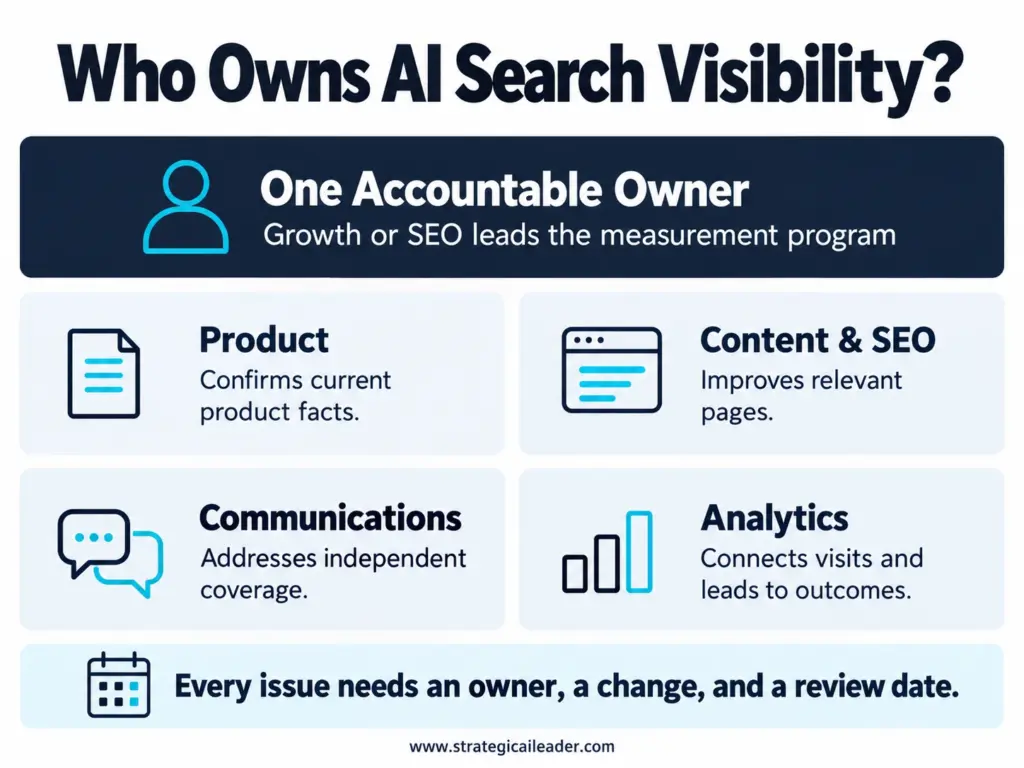
Assign one accountable owner for the measurement program. A growth or SEO leader is a practical starting point, with explicit support from product, communications, and analytics.
Product confirms facts. Content and SEO improve relevant pages. Communications addresses independent coverage. Analytics connects visits and leads to business outcomes.
Give each issue a named owner, a proposed change, and a review date. A GEO operating model connects monitoring with responsibility for source updates and follow-up checks. A visibility report without decisions becomes another reporting task.
Established companies should begin with one product and one customer segment. Smaller companies should begin with a use case where their offer has a documented advantage. Both approaches keep the first test focused enough to evaluate.
What to prioritize this week
Choose one customer segment with clear commercial value.
Collect 20 purchase questions from sales conversations, support records, and customer research.
Run a repeatable baseline across three platforms and save the responses.
Identify one recurring factual error and one recurring omission.
Assign the relevant page or external description to an owner.
Set the next measurement date before making changes.
Keep the first cycle small. Expand the program after your team understands which observations lead to useful decisions.
AI search visibility FAQ
Does AI search favor smaller brands?
Brand size alone does not explain inclusion. Evaluate performance for your customer segment and questions. A challenger’s strong result in one study does not establish a universal platform preference.
Why did SoFi perform well?
The comparison establishes SoFi’s observed advantage over Bank of America. Explaining the result requires further evidence. Test positioning, product relevance, content coverage, and independent descriptions as possible contributors rather than established causes.
Does higher Google ranking guarantee an AI recommendation?
No. Track rankings and AI recommendations separately. Maintain technical SEO and helpful content while evaluating how responses present your business for specific buyer needs.
How often should teams measure AI answers?
Start weekly with a fixed prompt set and repeated runs. Adjust the schedule around product changes, customer importance, and available review capacity. Compare patterns across several rounds before increasing investment.
Should your team prioritize platforms listing fewer brands?
Choose platforms based on customer usage and observed business value. Fewer competing names in an answer do not establish greater reach, stronger buyer intent, or better conversion.
Build evidence your team is prepared to evaluate
My recommendation is to treat AI visibility as a managed growth experiment. Identify valuable buyer decisions, verify the answers, improve the evidence, and evaluate demand before scaling investment.
Help Support My Writing
Subscribe for weekly articles on leadership, growth, SEO, and AI-driven strategy. You’ll receive practical frameworks and clear takeaways that you can apply immediately. Connect with me on LinkedIn for conversations, resources, and real-world examples that help.
Related Articles
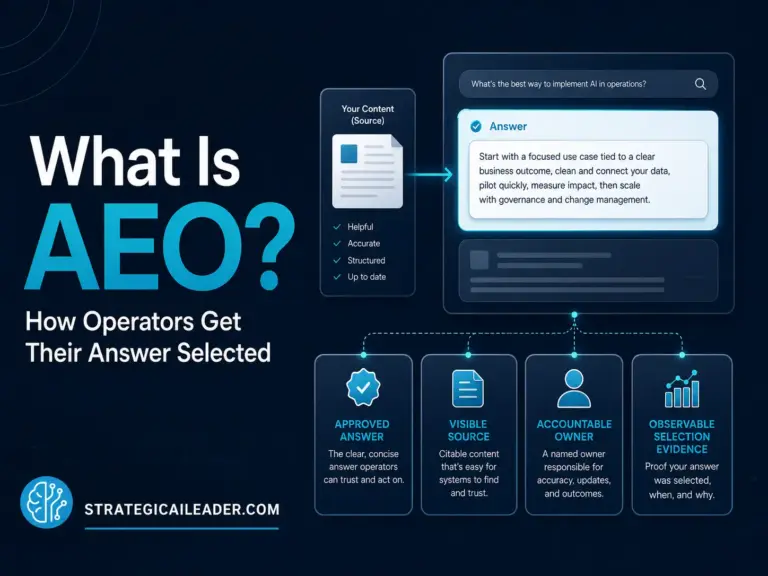
What Is AEO? A Proven Guide to Answer Selection
GEO Operating Model: The Truth About AI Visibility
The Truth About AI-Driven SEO Most Pros Miss
Intent-Driven SEO: The Future of Scalable Growth
SEO Strategy for ROI: A Better Way to Win Big
Future of SEO: Unlocking AEO & GEO for Smarter Growth
Skyrocket Growth with Keyword Strategy for Founders
I write about:
- AI + MarTech Automation
- AI Strategy
- COO Ops & Systems
- Growth Strategy (B2B & B2C)
- Infographic
- Leadership & Team Building
- My Case Studies
- Personal Journey
- Revenue Operations (RevOps)
- Sales Strategy
- SEO & Digital Marketing
- Strategic Thinking
Want 1:1 strategic support?
Connect with me on LinkedIn
Read my playbooks on Substack