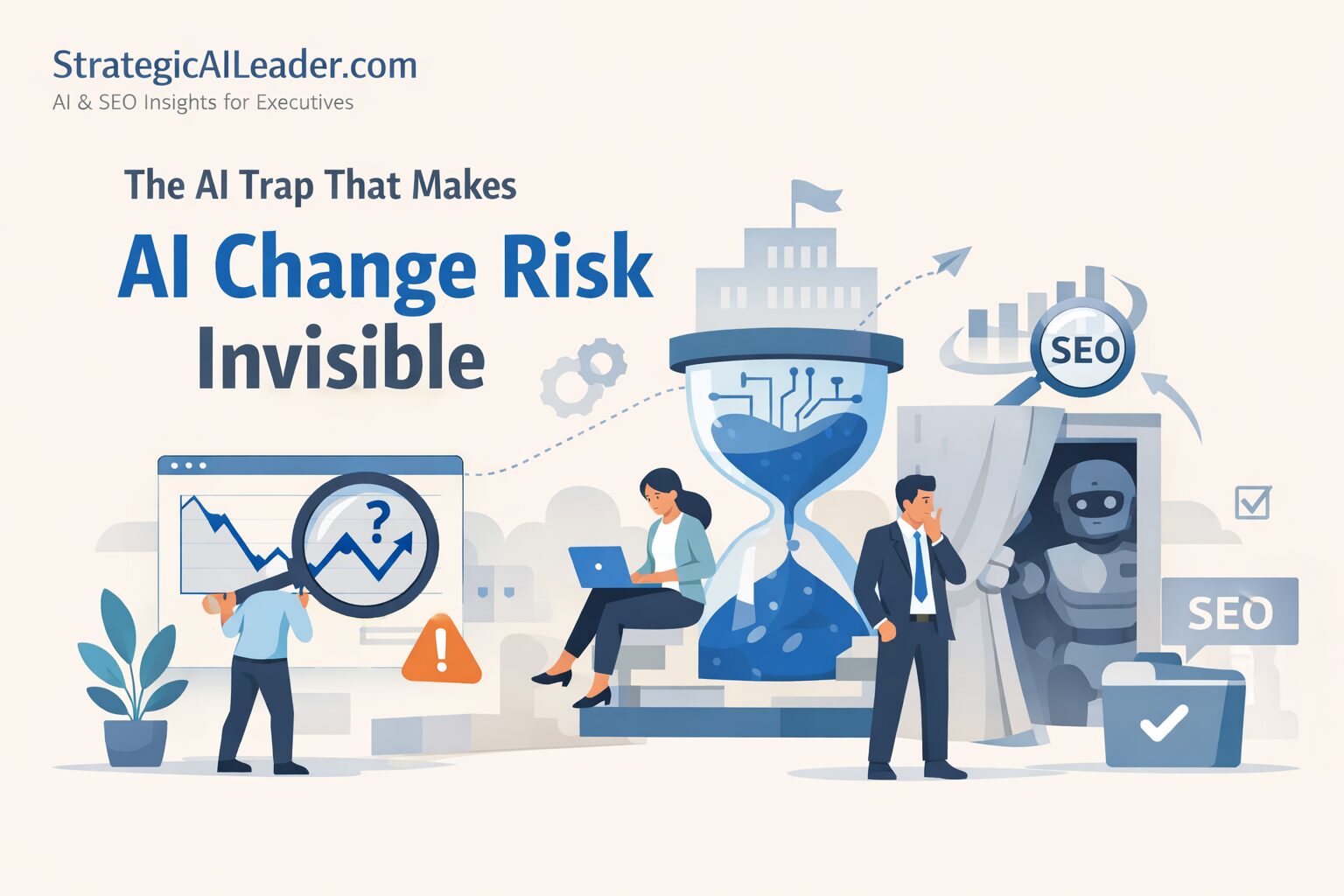
The Comfort Trap in AI Transitions: Why “Nothing Has Changed” Signals Risk

Nobody rings a bell at the top of a market. And nobody sends a memo when the rules of the game fundamentally shift. AI change risk emerges the same way.
Across boardrooms and Slack channels, a familiar refrain echoes: “AI discovery is just another evolution of SEO.” “We’ve seen similar shifts before with mobile.” “Let’s wait until the dust settles before we make any big moves.”
Sound reasonable? It should. Exactly that reasonableness creates the problem.
Major technology transitions don’t announce themselves with dramatic fanfare or obvious disruption signals. They arrive disguised as business as usual. The language stays familiar. The metrics look stable. Your quarterly planning deck uses the same templates as last year.
Meanwhile, the actual system, the one that determines who gets found, who gets trusted, and who gets left behind, has already started moving. Answer engines, systems that generate responses directly inside results, are reducing click volume on high-intent queries. At the same time, traffic dashboards still show green, a pattern already documented in independent zero-click search research. The shift isn’t coming later. It’s already underway.
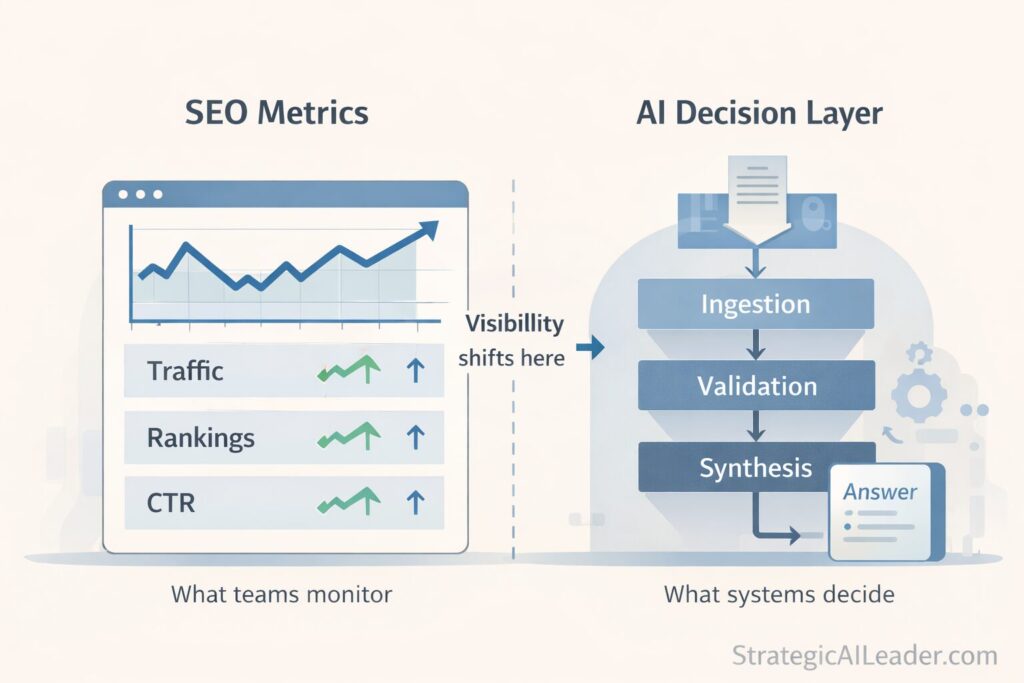
AI discovery and large language models have changed how information gets retrieved, evaluated, and presented. Since the surface still looks like search, many leadership teams assume they have time to figure out an AI strategy later.
In most cases, they don’t.
Why Reassurance Appears Before Real Change
Let me tell you what I’ve watched happen three times in my career across print media, mobile, and now AI.
When systems shift, the first instinct isn’t panic. Pattern matching takes over. Smart people look at the new thing and search for the closest analog to something they already understand. Print folks called websites “digital magazines.” Desktop teams called mobile apps “pocket websites.” Today, growth leaders call AI discovery “the next phase of SEO.”
The framing isn’t wrong because it’s inaccurate. Comfort makes the framing dangerous.
Uncertainty triggers familiar language because familiar language protects existing incentives. SEO teams rely on tools, workflows, and performance metrics built around keywords, rankings, and click-through rates. Content operations revolve around publishing cadences and CMS platforms. Executive dashboards track sessions, bounce rates, and conversion funnels.
Nobody wants to throw that infrastructure away. So organizations translate the new reality into old vocabulary. AI becomes “another channel.” LLMs become “just another algorithm update.”
But here’s what happens during these transitions. Job titles stay the same while the actual job changes completely. The metrics look stable, while what they measure becomes less relevant. Workflows run smoothly while outcomes quietly decay.
The behavior isn’t dishonest. Capable people default to continuity narratives because those narratives allow organizations to keep operating while everyone figures out what’s actually happening.
Waiting feels rational for three reasons.
First, best practices haven’t stabilized yet. There’s no definitive playbook for AI discovery optimization. Tools change monthly. Platforms are still evolving. Waiting for clarity feels prudent.
Second, the current approach still works. Traffic hasn’t collapsed. Rankings haven’t vanished. Revenue looks healthy. If it isn’t broken, why fix it?
Third, change is expensive. Restructuring content, retraining teams, rebuilding measurement systems. All of it costs money and political capital. Nobody gets promoted for dismantling what appears to be working.
These aren’t naive reasons. They’re the same reasons innovative teams cited during the last three major transitions. They’re also the reasons those teams spent the next 18 months playing catch-up while early movers built an asymmetric advantage.
The problem isn’t the logic. The problem is that figuring it out usually takes longer than the system waits. Research consistently shows organizations underestimate the time and structural change required to adapt to major technology transitions.
What Actually Changes First During AI Change
Most strategic writing about AI jumps straight to tactics. Update schema. Create FAQ content. Optimize for featured snippets. Tacticians aren’t wrong, but they’re skipping the fundamental shift.
Change doesn’t start with what you do. It begins with what happens before anyone sees what you did.
Visibility used to follow a predictable loop. You published a page. Google crawled it. Algorithms evaluated relevance signals like keywords, links, and engagement. When you ranked well, people clicked. If they clicked and stayed, you ranked better. Create, index, rank, traffic, authority.
AI discovery breaks that loop in four ways.
Ingestion happens differently. LLMs don’t simply index pages. They ingest content as training data, reference material, or retrieval candidates. Information becomes input to a synthesis process, not a destination. Existence matters less than extractability.
Evaluation shifts upstream. Before anyone sees a result, the system has already decided what matters. Algorithms evaluate structure, corroboration, and retrievability. Traditional SEO focused on signals humans observed. AI discovery prioritizes signals machines use before presentation.
Distribution bypasses clicks. When ChatGPT or Perplexity synthesizes an answer, the content may include a URL without a visible link. Citations often go unexpanded. Traffic becomes an unreliable proxy for influence.
Feedback loops disappear. The old model produced data. Traffic revealed interest. Bounce rates signaled a mismatch. Click paths showed intent. In AI discovery, systems rarely reveal when content influenced an answer or how heavily it was weighted. The signal that once guided optimization goes dark.
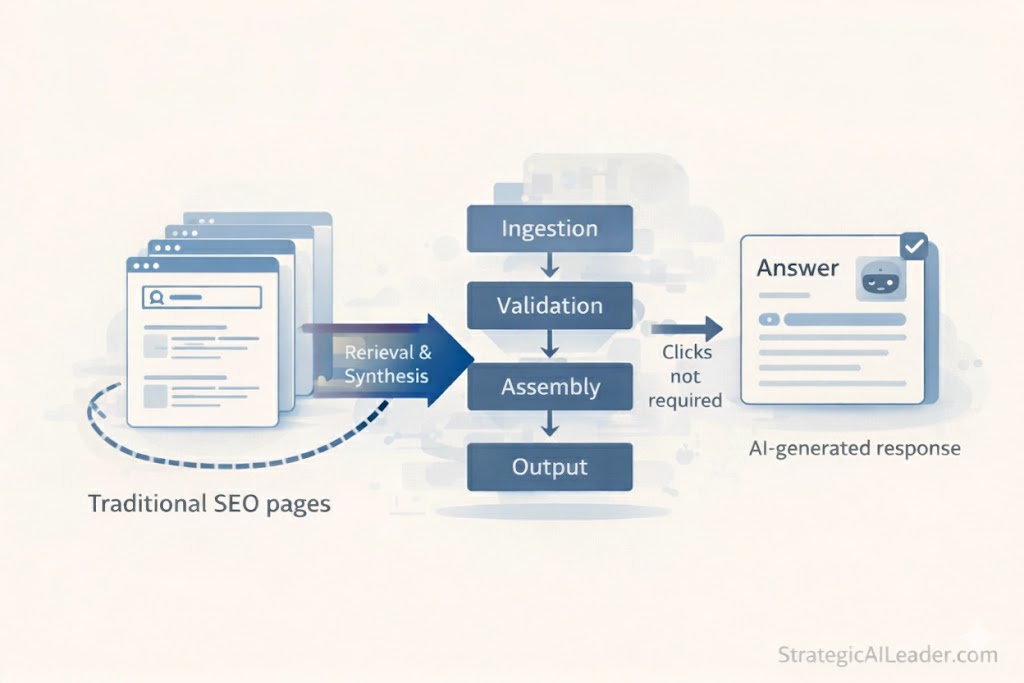
often without a click.
In short, the system now decides visibility before human preference enters the equation.
None of this requires new tools. It requires a different mental model of how visibility compounds.
Three Historical Signals Leaders Miss
Let me show you the pattern.
When the printing press emerged, information control didn’t belong to monks debating craftsmanship. Publishers understood that distribution scale mattered more than manuscript quality. The artifact, the book, stayed familiar. Power shifted anyway.
A monk in 1480 could create a flawless illuminated manuscript and reach a few dozen readers. A publisher could distribute a mediocre pamphlet to thousands in a matter of weeks. Quality still mattered, but distribution determined which quality ever reached an audience.
Mobile followed the same arc. The debate wasn’t apps versus mobile web. It was intent. Mobile usage fragmented research into moments. “I’m sitting down to browse” became “I need an answer right now.” The artifact, the screen, stayed familiar. Behavior changed completely.
I watched a retail company spend years optimizing desktop product pages. Beautiful photography. Detailed specs. Long-form buying guides. Mobile traffic grew steadily. By 2013, mobile accounted for 40% of visits but only 12% of revenue. Leadership repeated the same explanation. Mobile users browse. They buy a desktop.
They were half right. Mobile users were browsing. They also bought in-store minutes later, using information from a competitor whose site loaded faster and showed inventory instantly. One team optimized for sessions. The competing team designed its experience around moments. By the time restructuring began, 23% of market share had disappeared.
Pattern recognition matters. Artifacts stay familiar while power moves to whoever controls the new decision layer.
AI follows the same trajectory. The search box still looks the same. You type a query. You get an answer. Behind the interface, AI systems reshaped authority formation, trust accumulation, and visibility distribution.
Print shifted authority from craftsmanship to distribution. Mobile shifted intent from sessions to moments. AI shifts visibility from pages to synthesized answers.
Early adopters didn’t have better information. They asked better questions. They focused on how systems decide what matters, not what to call the transition.
What Retrieval-Optimized Content Actually Looks Like
Here’s the difference between content built for traditional SEO and content built for AI retrieval.
Traditional SEO content often looks like this. A long guide opens with a broad context. Features and considerations follow. Keywords appear at planned intervals. Internal links connect related pages. Everything checks the boxes.
Google ranks the page. Traffic flows. But when someone asks an answer engine a specific question, nothing in the structure makes extraction easy. The structure buries key facts, blends claims, and obscures validation points.
Retrieval-optimized content works differently.
It opens with a direct, verifiable statement. Design teams with fewer than 20 people typically choose between tool categories based on visual workflow needs, budget constraints, and creative file integration requirements.
Then it presents discrete claims.
Premium platforms offer native integration with primary design tools and tend to start at around $10–$12 per user per month.
Mid-tier platforms emphasize workflow customization and often rely on third-party integrations. Pricing generally falls between $8 and $12 per user.
Budget-focused options trade ease of use for flexibility, with lower price points and steeper setup costs.
Every claim stays atomic. Every comparison stays structured. Every statement remains corroborable. Every recommendation stays contextual.
When an LLM retrieves this content, it can extract facts, validate them against other sources, and synthesize answers. Visibility compounds through citation rather than clicks.
One B2B SaaS company applied this approach by restructuring its help center from long-form guides into atomic answers. Traffic dropped about 18% initially. Leadership panicked. Then they started tracking citation frequency across answer engines.
Within months, their content appeared roughly three times more often in AI-generated answers. About a third of new customers reported first encountering the brand through an AI-synthesized response rather than organic search. Those users converted at materially higher rates because they arrived informed. Industry research shows generative AI now plays a growing role in buyer discovery, evaluation, and early shortlisting.
Teams focused only on traditional traffic never saw the shift. I have heard several teams say, “well AI traffic only repersents 1 to 4% of our traffic, so why bother” They celebrated stable dashboards while competitors rebuilt visibility where it mattered.
Why “AI Discovery Is Just SEO” Creates Risk
The argument here isn’t anti-SEO. SEO built durable growth for two decades. It remains valuable.
The risk comes from labeling AI discovery as simply SEO with a new name.
Labels shape decisions. Calling this SEO implies teams can wait. It suggests existing metrics remain predictive. It frames advantage as incremental improvement inside a stable system.
That assumption breaks down quickly.
LLMs retrieve fragments, not pages. They don’t reward completeness. They reward extractable facts.
Trust forms through consistency and corroboration, not backlinks. Contradictory claims don’t rank lower. They get excluded.
Visibility no longer requires clicks to compound advantage. Content can shape answers without ever appearing in analytics.
Organizations treating AI discovery as SEO 2.0 optimize for human judgment after machines already decided relevance.
Teams getting this right aren’t waiting for definitions. They’re testing quietly while others debate terminology.
The Real Cost of Ignoring AI Change Risk
Decision delay shows up clearly in P&L terms.
The following example is a composite drawn from multiple client engagements. The pattern is consistent across industries.
Two marketing automation companies entered 2024 with similar products, scale, and positioning.
Company A chose to wait. SEO performance looked strong. Traffic was up year over year. Leadership postponed the AI strategy by assigning it to a future roadmap.
Company B ran experiments. The content team rebuilt fifty articles in atomic format. Citation frequency became a tracked metric.
By mid-year, Company B appeared in answer engine citations about four times more often. Roughly 20% of trial signups referenced AI-generated answers as their entry point.
They restructured content operations, retrained teams, and changed success metrics.
Company A stayed the course. Board decks stayed green.
Then the AI Overviews expanded, following Google’s announced rollout of generative answers directly inside search results. High-intent queries stopped driving clicks. Traffic dropped roughly 30% over the past few weeks. Audits found nothing broken.
The system wasn’t failing. The system had changed.
Company A rebuilt under pressure. Company B compounded its advantage.
The question for leadership is simple. Which company are you building?
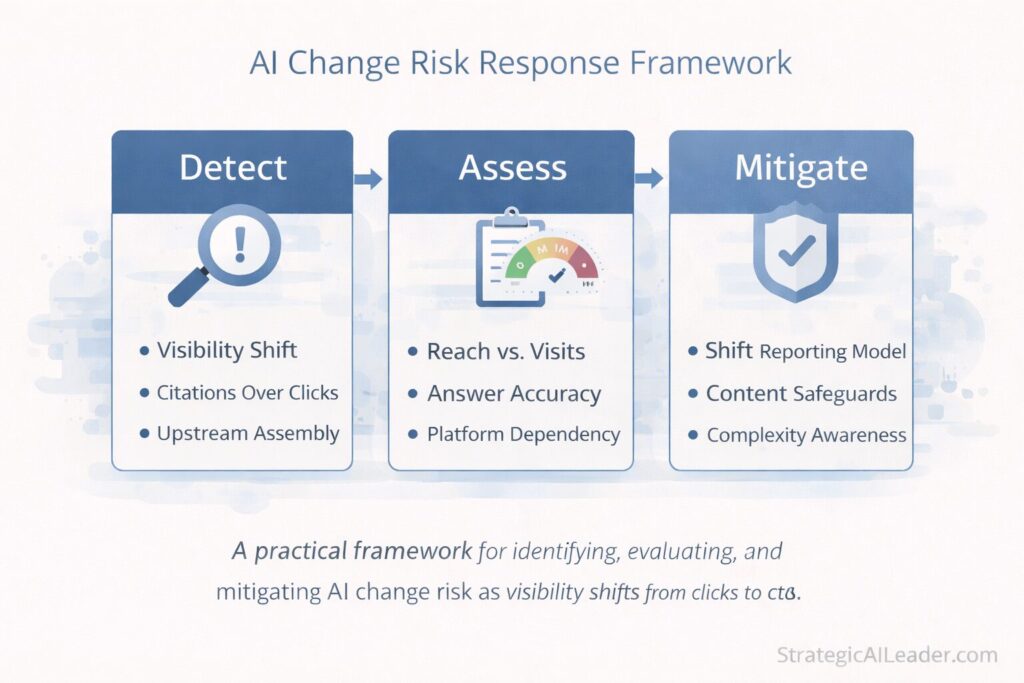
shifts from clicks to citations.
What Leaders Should Watch Instead
What follows isn’t a checklist. It’s a diagnostic.
- Are you optimizing for human judgment or machine ingestion first?
- Do your metrics explain inclusion, not just traffic?
- Are you testing quietly or waiting publicly?
- Have you structured information around fragments or pages?
- Are you hiring for the system you’re in or the one you were in?
- If those questions feel uncomfortable, that’s the point.
Final Thought: The Riskiest Assumption
System shifts rarely arrive with disruption. They come disguised as continuity.
Language stays familiar. Dashboards look stable. Organizations agree that nothing has changed.
That agreement is the risk.
The riskiest assumption in any transition is believing you’ll recognize the moment when it’s too late.
Leaders who adapt early don’t have better information. They ask better questions. They change how decisions get made while others debate labels.
So here’s the real question. What decisions feel safe to delay right now because the language sounds familiar?
Whatever came to mind is the one that matters most.
Related Articles
About the Author
I write about:
- AI + MarTech Automation
- AI Strategy
- COO Ops & Systems
- Growth Strategy (B2B & B2C)
- Infographic
- Leadership & Team Building
- My Case Studies
- Personal Journey
- Revenue Operations (RevOps)
- Sales Strategy
- SEO & Digital Marketing
- Strategic Thinking
Want 1:1 strategic support?
Connect with me on LinkedIn
Read my playbooks on Substack
Leave a Reply