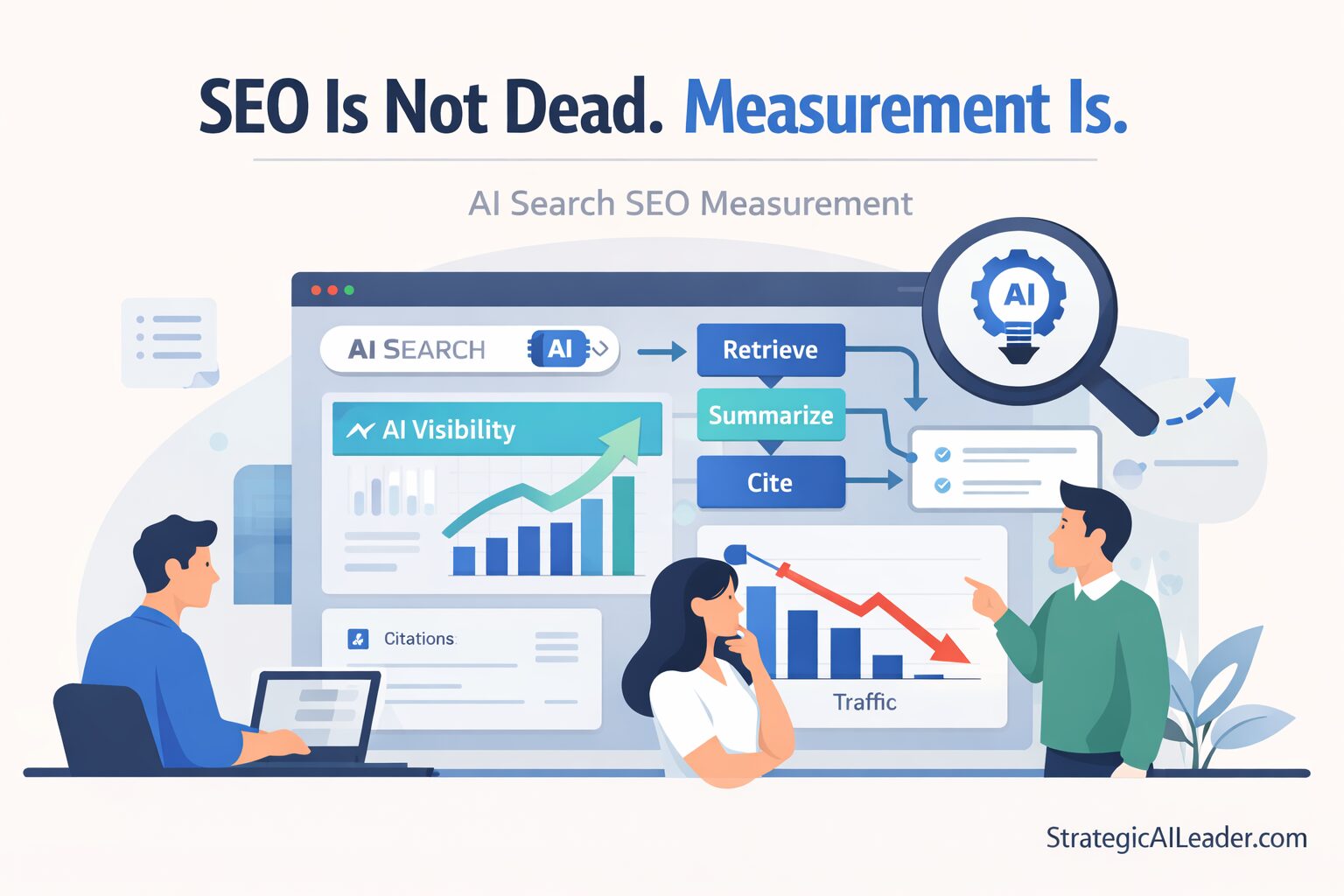
SEO Is Not Dead. Measurement Is.

AI search operates as a retrieval system, not a ranked list. Visibility now happens before a click exists, which is why AI search SEO measurement must look beyond traffic and rankings. Most teams diagnose the problem as traffic loss, when the real issue lies upstream, where AI systems decide what to retrieve, summarize, and cite.
You’re staring at your analytics dashboard, watching organic traffic slide month after month. Your rankings haven’t collapsed. Your content still ranks on page one. But the clicks? Gone. The conversions? Vanishing.
Here’s what nobody wants to admit: AI search didn’t break SEO. Your measurement system just can’t explain what’s happening anymore.
Rankings and clicks no longer tell you whether you’re winning in AI search. Research shows that AI Overviews significantly reduce click-through rates, even when pages still rank highly. What you see in analytics is what’s left after the AI already made its choice. That’s not the death of SEO. That’s the evolution of how search works.
Executive Summary
The Problem: Traditional SEO metrics like rankings and clicks no longer explain performance in AI search environments. Teams watch traffic decline while missing the real story happening upstream.
Why It Matters: AI systems retrieve, synthesize, and cite content before users ever click. Visibility shifted from ranked positions to retrieval probability, synthesis inclusion, and brand citations.
What Changed: Search evolved from delivering ranked lists to generating synthesized answers. The same SEO fundamentals matter, but measurement models failed to adapt.
What Leaders Should Do: Measure citation frequency, content extractability, and synthesis share instead of relying solely on traffic metrics. Redesign dashboards to focus on visibility signals that explain AI search performance.
What AI Search Actually Changed (And What It Didn’t)
SEO fundamentals still matter. Crawlability, clean structure, internal linking, entity clarity, and trust signals remain prerequisites for visibility. AI systems don’t bypass these requirements. They depend on them harder than traditional search ever did.
If your page fails basic SEO hygiene, retrieval fails upstream. No summary. No citation. No visibility. SEO still sets the floor. Measurement defines the ceiling.
Traditional search rewarded ranking position. AI search rewards retrieval reliability.
Traditional search is optimized for a ranked list. You aimed for position one, maybe the featured snippet. AI search expands queries, infers intent, and synthesizes answers from multiple sources simultaneously. A single user question now produces multiple inferred intents, multiple retrieval paths, and a synthesized response that may never send traffic your way.
AI search visibility refers to how often a brand is retrieved, summarized, or cited by AI systems, regardless of whether those interactions result in clicks. This matters because multiple industry studies show that AI summaries lead to fewer result clicks, even when traditional rankings remain unchanged. In other words, visibility increasingly happens upstream, inside generated answers, long before analytics tools register a visit. Measuring only traffic obscures where influence now begins.
Most dashboards still measure visits and conversions. AI search increases the value of what happens before those metrics even fire.
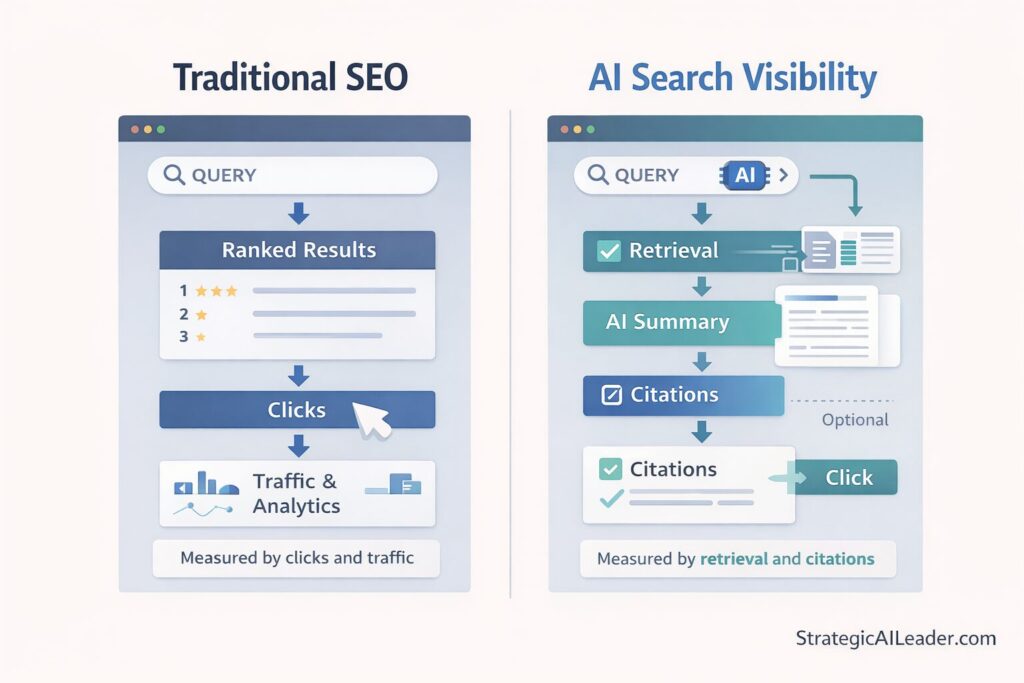
while AI search measures visibility through retrieval, summaries, and citations before clicks occur.
Why Traditional SEO Metrics Fall Short in AI Search
Rankings describe position, not presence.
Clicks describe visits, not influence.
Conversions describe outcomes, not exposure.
AI search breaks these assumptions.
Traditional SEO metrics struggle in AI search environments because rankings no longer predict attention or influence. Multiple analyses show that AI Overviews correlate with lower organic click-through rates, even for pages that continue to rank in top positions. Rankings still describe position in a list, but AI systems increasingly answer questions directly, bypassing the need to click altogether. When measurement focuses only on rankings and traffic, it misses the upstream shift in which visibility is determined.
We dug into the data. ChatGPT and Perplexity were citing their competitor 3-to-1 in AI-generated answers. Users got their answers without clicking. The client still ranked first in Google. They just lost the upstream battle for retrieval and synthesis.
The lesson: rankings stopped predicting influence the moment AI systems started synthesizing answers upstream.
From Rankings to Retrieval: The Three Layers of AI Search SEO
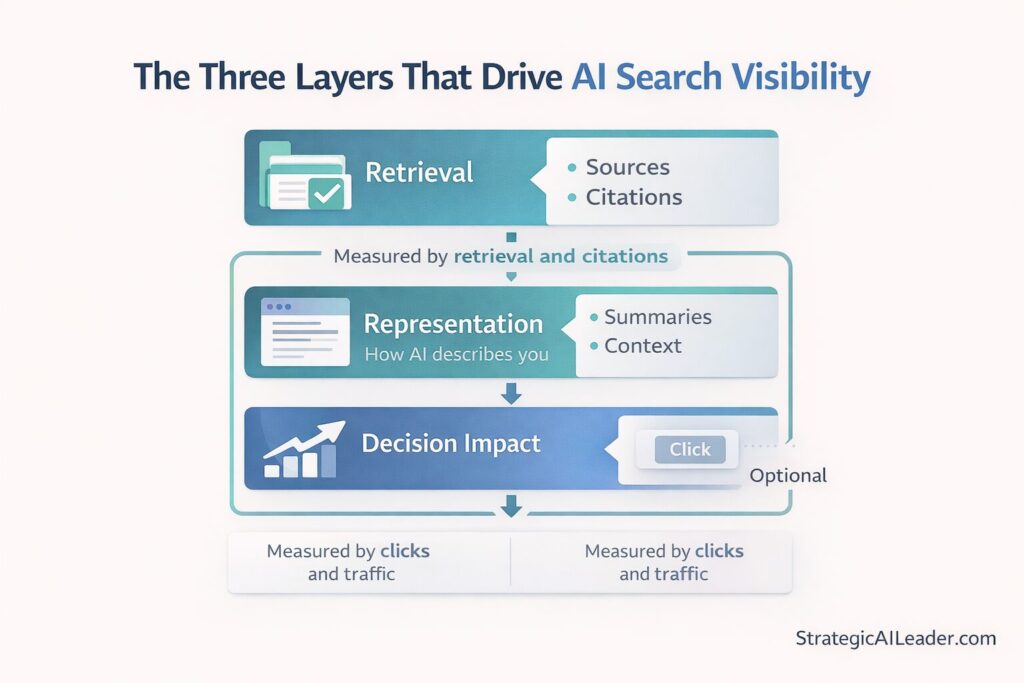
with measurement shifting upstream from clicks to citations and summaries.
SEO now operates across three layers:
1. Retrieval
Can AI systems find and extract your content? Structured data, clean HTML, and entity resolution matter more than ever. If your content lives in JavaScript-heavy frameworks or behind authentication walls, retrieval fails before synthesis begins.
2. Representation
How do AI systems summarize and cite your brand? Coherent messaging, authoritative signals, and extractable content determine whether you get mentioned accurately or misrepresented. Fragmented brands lose authority quickly in generative search because AI models prioritize coherence over volume.
3. Decision Impact
Did your content influence the user’s next action, even without a click? Brand recall, trust signals, and first-party relationships drive decisions downstream.
Traditional SEO optimizes layer three. AI search shifts the advantage to layers one and two.
Most dashboards only measure the last layer. AI search shifted value creation to the first two.
Who Gains and Who Loses Visibility in AI Search
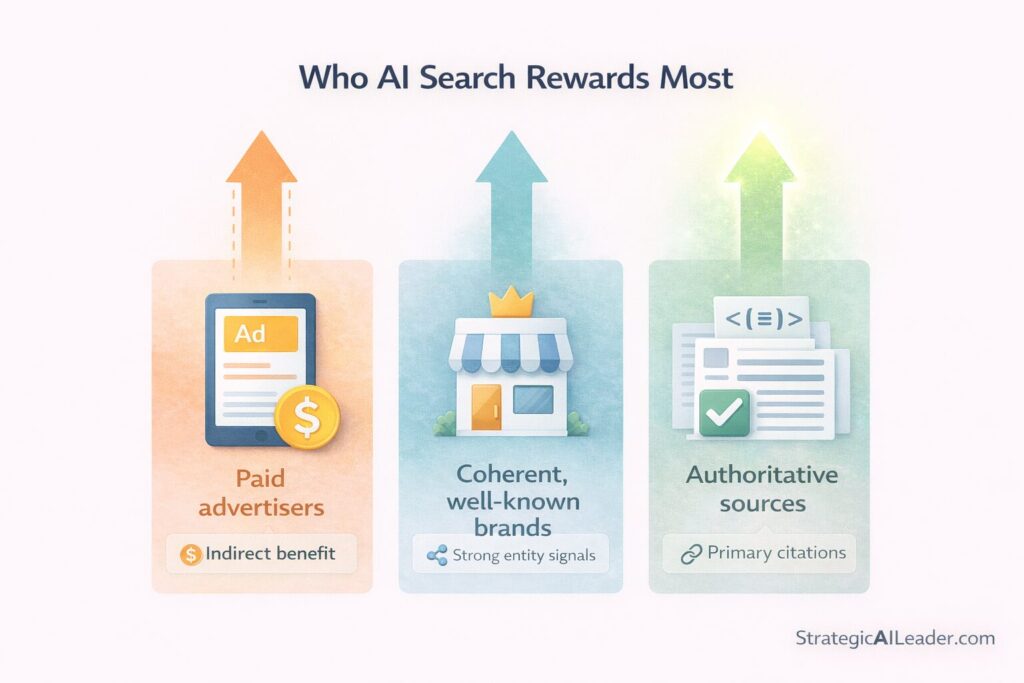
coherent brands next, and paid advertisers only indirectly.
AI search does not treat all content equally. Visibility concentrates around a small number of sources that AI systems trust, understand, and can summarize reliably. Brands either gain visibility through retrieval and citation, or they quietly lose influence even while rankings remain intact.
Who Gains Visibility
The brands that gain visibility in AI search share five traits:
- Primary sources with original research, data, or firsthand expertise
- Clear entity definitions that AI systems can easily attribute and reference
- Coherent messaging across content, schema, and public mentions
- Structured, extractable content that AI systems can parse without ambiguity
- Consistent topical authority rather than scattered keyword coverage
These brands appear repeatedly in AI summaries, recommendations, and citations. Visibility compounds because AI systems reuse sources they already trust.
Who Loses Visibility
The brands that lose visibility tend to look strong in traditional SEO metrics but weak in AI retrieval:
- High-volume content publishers optimized for keyword breadth
- Aggregators and commentary sites without original data
- Fragmented brands with inconsistent messaging across pages
- JavaScript-heavy or poorly structured content that limits extraction
- Sites relying on rankings and clicks as proof of authority
These brands still rank. They simply stop getting retrieved and cited. Visibility disappears upstream, long before analytics record a loss.
The Uncomfortable Reality
AI search creates a winner-take-most dynamic. A small number of authoritative sources dominate synthesis, while long-tail SEO strategies lose relevance. Visibility shifts from breadth to credibility, from volume to coherence, and from traffic capture to influence.
This is why many teams feel blindsided. The loss does not show up as a penalty or ranking collapse. It shows up as silence.
What to Measure Instead
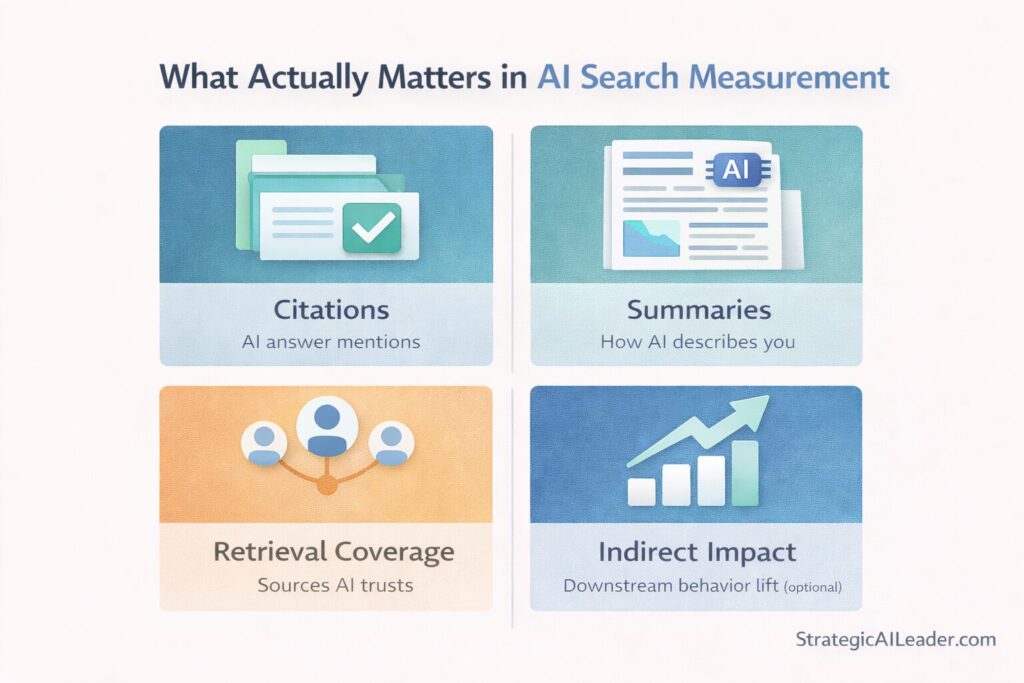
with business impact occurring downstream rather than through direct clicks.
Teams struggle with AI search because instrumentation lags behind reality.
Without visibility signals, traffic declines feel unexplained. Leaders see the symptom (fewer clicks) but miss the cause (lost retrieval or weak synthesis representation). Influence shifted upstream while measurement stayed downstream.
Influence shifted upstream while measurement stayed downstream. This shift did not begin with AI search. Independent research shows that zero-click searches already made up the majority of search behavior before generative answers became widespread. AI systems accelerated an existing pattern by satisfying intent directly inside results and summaries. When teams measure visibility only through traffic, they ignore how users increasingly consume information without ever clicking through.
You need to start tracking these signals:
Brand Citation Frequency
How often do answer engines mention your brand when users ask relevant questions? Track mentions across ChatGPT, Perplexity, Google AI Overviews, and Bing Copilot. Manual spot checks work early. Automated citation monitoring scales better.
Answer Engine Inclusion Rate
What percentage of target queries surface your content in AI summaries? Compare inclusion rates to your traditional ranking coverage. The gap reveals where you’re losing synthesis battles.
Content Extractability Score
Can AI systems cleanly parse your key claims, data points, and entity relationships? Audit content for structured markup, clear attribution, and unambiguous language. Jargon-heavy or overly complex content gets skipped.
First-Party Context Signals
How much proprietary data, original research, or unique perspective do you publish? AI systems reward primary sources. Secondary aggregation gets deprioritized fast.
Coherence Across Touchpoints
Do your messaging, schema markup, and public datasets align? Inconsistencies confuse retrieval systems. A brand that says different things in different places loses authority in synthesis.
I learned the cost of incoherence from a friend running SEO for a fintech startup. He published 200+ blog posts on “personal finance tips.” Broad, generic, totally forgettable. When AI search took off, he got cited exactly zero times. The competitor published 30 in-depth research reports with original survey data. They owned every AI summary in the category.
The takeaway: volume lost to coherence because AI systems synthesize from authoritative sources, not keyword-stuffed pages.
What SEO Metrics Replace Rankings in AI Search
Every CMO asks the same question: “If rankings don’t matter anymore, what do I put in the board deck?”
Fair question. These metrics explain AI search performance even when traffic declines:
Retrieval Coverage
Percentage of target queries where your content gets retrieved by AI systems, even if not cited in the final answer.
Synthesis Share
Your brand’s share of citations within AI-generated answers for priority topics.
Influence Without Clicks
Brand search lift, direct traffic increases, and first-party engagement growth correlated with AI search exposure.
Extractability Index
Content audit score measuring how AI-friendly your pages are (structured data, entity clarity, source attribution).
Authority Decay Rate
How quickly does your citation frequency drop when you stop publishing? Measures content freshness dependency.
Notice what’s missing? CTR. Bounce rate. Time on page. Those metrics still matter for traditional search. They just don’t explain what’s happening in AI search environments.
How AI Search Changes SEO Measurement Strategy
You’re a VP of Growth or an SEO leader trying to adapt. What actually changes in how you run the function?
Treat rankings as hygiene checks, not success metrics.
Rank tracking still signals technical health and competitive positioning. Rankings no longer predict traffic or influence. Use them to catch indexing issues and algorithm penalties. Stop using them to prove ROI.
Redesign dashboards around visibility signals.
Add citation tracking, answer engine inclusion rates, and brand mention frequency. Build these into weekly reporting. Make them as visible as organic traffic once was.
Audit content for extractability.
Run your top 50 pages through AI systems manually. Ask: “Does the AI accurately summarize our core claims? Do we get cited? Do we get misrepresented?” Fix the gaps before scaling production.
Align SEO, content, and data teams.
AI search rewards original research, proprietary data, and first-party signals. SEO can’t deliver results alone. You need content teams publishing unique insights and data teams instrumenting what matters.
Invest in a first-party context.
Build owned datasets. Publish original research. Create tools that generate proprietary signals. AI systems prioritize primary sources. Aggregation and commentary get demoted fast.
Leaders who adapt will build competitive advantage while others chase vanishing traffic metrics.
The Risk Few Teams Anticipate
AI search rewards coherence over volume.
Most brands built SEO programs optimized for keyword coverage. Publish 500 blog posts. Target 5,000 keywords. Capture every long-tail variation.
AI search doesn’t care. AI systems synthesize answers from a few authoritative sources with clear, consistent messaging. Fragmented brands with scattered content lose authority quickly. You can’t keyword-stuff your way into an AI summary.
Volume strategies actively hurt performance in AI search environments. More content creates more noise. Noise confuses retrieval systems. Confusion kills citations.
One e-commerce brand had 10,000+ product pages optimized for “best [product] for [use case].” They dominated traditional search. AI search launched, and its citation rate dropped to near zero. Why? No coherent brand narrative. No original data. Just keyword-optimized product descriptions regurgitated across thousands of pages.
Their competitor published a comprehensive buying guide with original testing data. That guide got cited in 80% of relevant AI summaries.
Coherence beats volume.
How Do You Measure SEO in AI Search?
Start with citation tracking and extractability audits, then layer in synthesis share metrics.
Citation Tracking
Monitor how often AI systems mention your brand across target queries. Run manual checks weekly for priority topics. Document which competitors get cited more frequently and why.
Extractability Audits
Test whether AI systems can parse your content cleanly. Check for:
- Structured data implementation (Schema.org markup)
- Entity clarity (clear attribution, unambiguous language)
- Source signals (author credentials, publication dates, data provenance)
Synthesis Share Analysis
Calculate your brand’s percentage of total citations within AI-generated answers for your category. Compare against competitors to identify authority gaps.
Build a simple tracking spreadsheet. Column one: target query. Column two: AI systems checked (ChatGPT, Perplexity, Google AI Overviews). Column three: citation status (mentioned, cited with link, summarized, ignored). Column four: competitor comparison.
Run weekly for your top 20 queries. Monthly for your top 100. The pattern reveals retrieval gaps faster than traffic analytics ever will.
What Metrics Replace Rankings in AI Search?
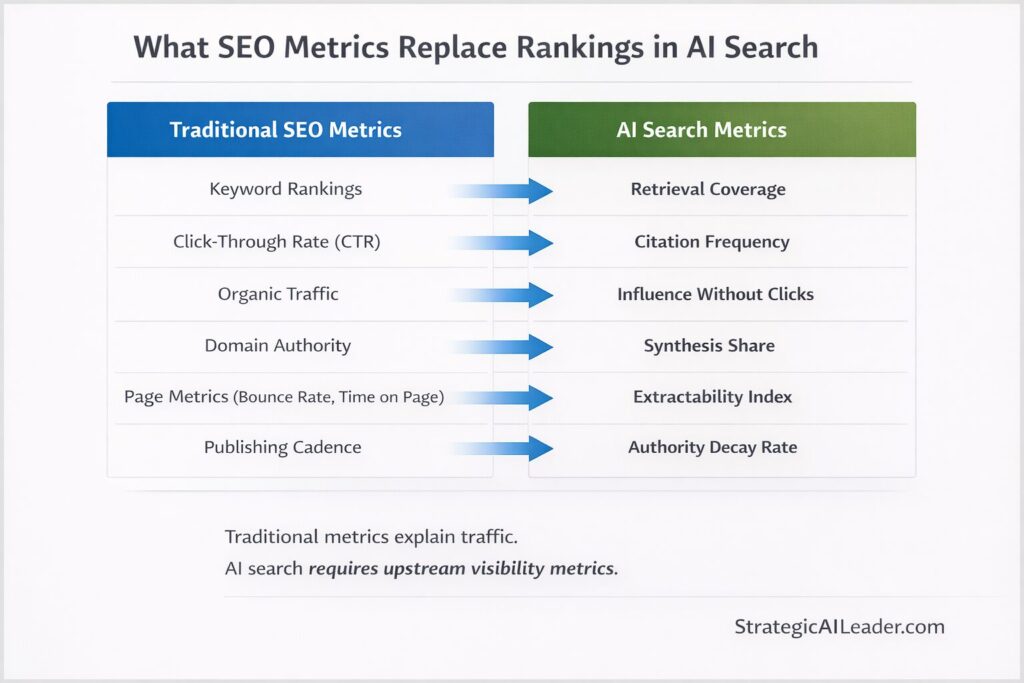
like retrieval coverage, citation frequency, and synthesis share.
Rankings described position in a list. AI search demands metrics that explain retrieval probability and the inclusion of synthesis.
Replace: Keyword rankings.
With: Retrieval coverage (percentage of queries where your content gets pulled into AI processing)
Replace: Click-through rate.
With: Citation frequency (how often AI systems mention or quote your brand)
Replace: Organic traffic.
With: Influence signals (brand search lift, direct traffic growth, first-party engagement correlated with AI exposure)
Replace: Domain authority.
With: Synthesis share (your percentage of citations within AI answers for priority topics)
Replace: Page-level metrics.
With: Extractability scores (technical audit of how AI-friendly your content structure is)
Keep rankings and traffic in your dashboard. Just stop treating them as the primary success metrics. They measure what’s left after AI systems already made their retrieval and synthesis decisions.
Does SEO Still Matter with AI Search?
Yes. But you need to rethink what SEO means.
SEO isn’t dead. The assumption that SEO equals traffic generation is dead. SEO now means building a brand that AI systems can retrieve, trust, and cite accurately.
Success requires:
- Technical excellence (so AI systems can crawl and extract your content)
- Entity clarity (so AI models understand who you are and what you do)
- Authoritative signals (so retrieval systems prioritize your content over competitors)
- Original research and data (so you become a primary source worth citing)
- Coherent messaging (so AI summaries represent your brand accurately)
Notice the shift? SEO transformed from a traffic channel into a visibility system. The output metrics changed. The inputs evolved. The fundamentals still matter.
If you’re still measuring SEO success purely through clicks and conversions, you’re flying blind. Traffic will keep declining while you miss the real story: AI systems choose who gets visibility before users ever click.
What Leaders Should Change Now
You don’t need a complete rebuild. You need strategic shifts in measurement, content, and instrumentation.
Start here:
- Add citation tracking to monthly reporting. Manual audits work early. Tools will catch up.
- Audit your top 20 pages for AI extractability. Can answer engines cleanly parse your claims? Fix ambiguity and jargon.
- Publish at least one piece of original research per quarter. Primary sources win in AI search. Aggregation loses.
- Align your schema markup, messaging, and public datasets. Inconsistency kills authority in synthesis.
- Build a cross-functional working group with SEO, content, and data stakeholders. AI search rewards collaboration.
Stop treating traffic loss as the only problem to solve. Traffic might never fully recover. Influence can grow anyway. Measure what actually matters now.
Key Takeaways
- SEO fundamentals (crawlability, structure, trust) still determine retrieval. AI systems depend on these signals more than traditional search ever did.
- AI search measures visibility before clicks. Citation frequency, synthesis share, and extractability matter more than rankings.
- Rankings describe position but no longer predict influence. The metric explains technical health, not business impact.
- Coherent brands win over high-volume content fragmentation. AI systems synthesize from a few authoritative sources, not thousands of keyword-stuffed pages.
- Leaders must redesign dashboards around retrieval and representation, not just traffic. Measurement determines whether you understand what’s actually happening.
The Uncomfortable Truth About AI Search and SEO
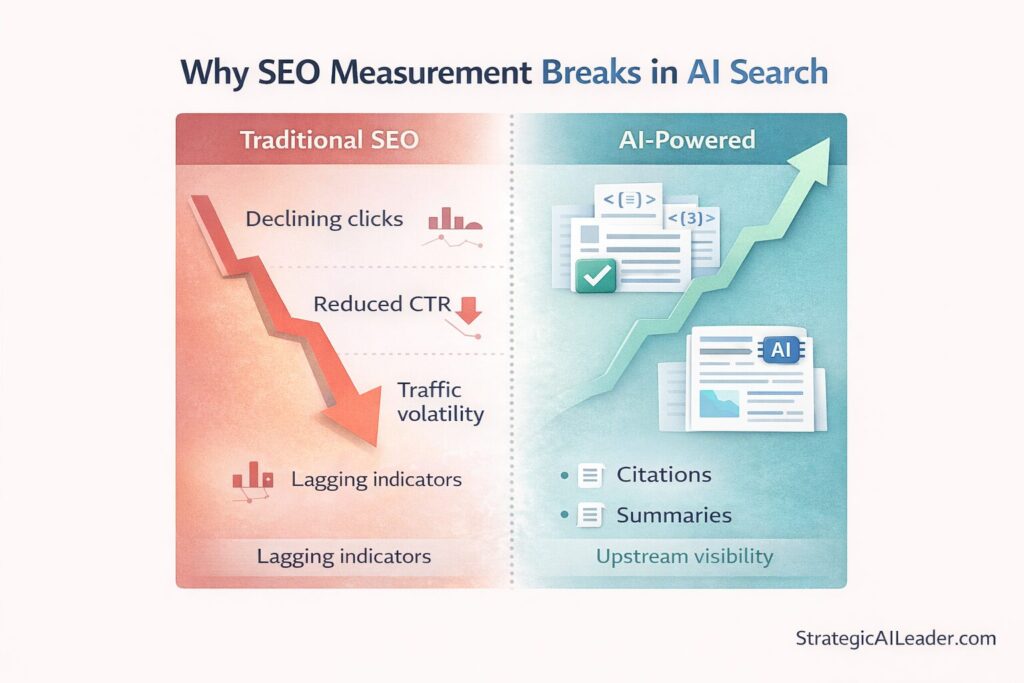
SEO still works. Measurement models stopped working.
AI search didn’t kill the discipline. AI search exposed how fragile most measurement systems were all along. Rankings and clicks felt like complete metrics because they correlated with revenue. Correlation broke. The metrics stayed.
Leaders who adapt fastest will rethink SEO as a visibility system, not a traffic channel. They’ll measure retrieval, synthesis, and influence. They’ll invest in coherence over volume. They’ll build instrumentation that actually explains performance.
The rest will keep watching traffic decline, wondering what went wrong, while their competitors get cited in every AI-generated answer that matters.
Your move.
FAQ: AI search SEO measurement
How Do You Measure SEO in AI Search?
You measure SEO in AI search by tracking citation frequency, retrieval coverage, and content extractability, rather than relying solely on rankings and clicks. AI search visibility depends on whether systems can find, parse, and cite your content before users ever click.
Core Metrics to Track:
Citation Frequency – How often AI systems mention or quote your brand across target queries. Monitor ChatGPT, Perplexity, Google AI Overviews, and Bing Copilot weekly for priority topics.
Retrieval Coverage – Percentage of target queries where your content gets pulled into AI processing, even if not cited in the final answer.
Extractability Score – Technical audit measuring whether AI systems can cleanly parse your structured data, entity relationships, and source signals.
Synthesis Share – Your brand’s percentage of total citations within AI-generated answers for your category compared to competitors.
Implementation Approach
Build a simple tracking system. Document target queries, AI systems checked, citation status (mentioned, cited with link, summarized, ignored), and competitor comparison. Run weekly checks on your top 20 queries, and monthly on your top 100. The pattern reveals retrieval gaps faster than traffic analytics.
What Metrics Replace Rankings in AI Search?
In AI search, retrieval coverage, citation frequency, and synthesis replace traditional rankings because they measure visibility before clicks happen. Rankings described position in a list. AI search demands metrics that explain whether your content gets retrieved and cited.
Replacement Framework:
Rankings → Retrieval Coverage
Percentage of queries where your content gets pulled into AI processing
Click-Through Rate → Citation Frequency
How often AI systems mention or quote your brand in generated answers
Organic Traffic → Influence Signals
Brand search lift, direct traffic growth, and first-party engagement correlated with AI exposure.
Domain Authority → Synthesis Share
Your percentage of citations within AI answers for priority topics
Page-Level Metrics → Extractability Scores
Technical audit of content structure, schema markup, and entity clarity
Keep rankings and traffic in your dashboard. Just stop treating them as primary success metrics. They measure what remains after AI systems already made their retrieval and synthesis decisions.
Does SEO Still Matter with AI Search?
Yes, SEO still matters with AI search, but success now depends on building content that AI systems can retrieve, trust, and cite accurately rather than optimizing solely for ranked positions. The fundamentals evolved, not disappeared.
What Still Matters:
- Technical excellence – Crawlability, clean HTML, and structured data enable AI retrieval
- Entity clarity – Clear attribution and unambiguous language help AI models understand your brand
- Authoritative signals – Trust metrics determine whether AI systems prioritize your content over competitors
- Original research – Primary sources get cited; secondary aggregation gets demoted
- Coherent messaging – Consistent positioning across touchpoints builds synthesis authority
SEO transformed from a traffic channel into a visibility system. Rankings and clicks still matter for traditional search. AI search added new layers where influence happens before users ever click. Measure both, but weight visibility signals higher as AI search adoption grows.
How AI Search Changes SEO Visibility
AI search changed how visibility works by moving influence upstream from clicks to retrieval and synthesis. Traditional search visibility meant appearing in ranked results. AI search visibility means getting retrieved, accurately represented, and cited in synthesized answers.
The Visibility Shift:
Traditional Search: Content ranks → User sees listing → User clicks → Visibility achieved
AI Search: Query triggers retrieval → AI extracts content → AI synthesizes answer → User sees citation → Visibility achieved (click optional)
Clicks and rankings measure the traditional path. Citation frequency and synthesis share measure the AI search path. Both matter, but AI search grows faster and captures a larger share of query volume across search, chat, and voice interfaces.
Measurement Implications:
Leaders must track both paths to understand total visibility. A brand with strong rankings but weak citations loses influence as AI search adoption grows. A brand with strong citations but weak rankings captures AI search visibility while missing traditional search traffic.
The strategic response involves optimizing for both visibility systems simultaneously. Maintain technical SEO fundamentals (rankings and clicks depend on these). Layer in AI search optimization (extractability, coherence, original research). Measure performance across both systems to identify which visibility path delivers the greatest business impact.
What Is Generative Search SEO?
Generative search SEO means optimizing content so AI systems can retrieve, understand, and accurately cite your brand when generating answers to user queries. The discipline combines traditional SEO fundamentals with new requirements around content extractability, entity clarity, and synthesis authority.
Core Components:
Retrieval Optimization – Ensuring AI systems can crawl, parse, and extract your content using clean HTML, structured data, and unambiguous entity markup.
Synthesis Optimization – Making your content easy for AI models to summarize accurately through clear attribution, consistent messaging, and extractable claims.
Authority Signals – Building trust markers that AI systems use to prioritize your content over competitors, including original research, credible sources, and coherent brand positioning.
Generative search SEO differs from traditional SEO in measurement and strategy. Traditional SEO optimizes for ranked positions and traffic. Generative search SEO optimizes for citation frequency and the inclusion of synthesis. Both share the same technical foundation (crawlability, structure, trust), but generative search adds layers focused on how AI systems understand and represent content.
Strategic Approach:
Audit existing content for AI extractability. Identify pages where AI systems misrepresent your brand or skip citations entirely. Fix entity ambiguity, add structured data, and clarify core claims. Publish original research to become a primary source. Monitor citation frequency across AI platforms. Iterate based on which content gets retrieved and cited most often.
How to Measure SEO Performance with AI
Measure SEO performance with AI by combining traditional metrics (rankings, traffic) with AI-specific visibility signals (citations, retrieval coverage, synthesis share). Traditional metrics explain what happens after users click. AI metrics explain what happens before clicks occur.
Integrated Measurement Framework:
Layer 1: Technical Health
Track crawl errors, indexation status, and Core Web Vitals. AI systems depend on these fundamentals just as traditional search does.
Layer 2: Traditional Search Performance
Monitor rankings, organic traffic, and conversions from Google, Bing, and other search engines.
Layer 3: AI Search Visibility
Measure citation frequency across ChatGPT, Perplexity, Google AI Overviews, and Bing Copilot. Calculate retrieval coverage and synthesis share.
Layer 4: Influence Signals
Track brand search lift, direct traffic growth, and first-party engagement correlated with AI search exposure.
Layer 5: Business Impact
Connect visibility metrics to pipeline, revenue, and customer acquisition across both traditional and AI search paths.
Build dashboards that show performance across all five layers. Leaders need to see where visibility happens (Layer 3), not just where traffic lands (Layer 2). The gap between retrieval and clicks reveals how much influence happens without traditional attribution.
Reporting Cadence:
Weekly: Citation spot checks for top 20 queries
Monthly: Full retrieval coverage and synthesis share analysis
Quarterly: Strategic review connecting AI visibility to business outcomes
SEO Metrics in AI Search vs Traditional Search
SEO metrics in AI search measure visibility before clicks happen, while traditional search metrics measure visibility after users see ranked results. Both matter, but they explain different parts of the visibility funnel.
Metric Comparison:
| Keyword Rankings | Retrieval Coverage | Whether content gets found |
| Impressions | Citation Opportunities | How often content could be cited |
| Click-Through Rate | Citation Frequency | How often content gets mentioned |
| Organic Traffic | Influence Signals | Whether exposure drives action |
| Conversions | Decision Impact | Whether visibility leads to outcomes |
| Domain Authority | Synthesis Share | Competitive authority in answers |
| Page Experience | Extractability Score | How AI-friendly content structure is |
Traditional metrics still matter for traditional search traffic. AI search metrics explain a growing percentage of total visibility as users shift from searching Google to asking ChatGPT, Perplexity, or voice assistants.
Why Both Matter:
A brand ranking number one in Google but never cited in AI answers loses influence as AI search adoption grows. A brand frequently cited in AI answers but absent from traditional search misses users who still prefer ranked lists. Leaders need visibility across both systems.
Strategic Implication:
Optimize content for both measurement frameworks. Maintain technical SEO fundamentals (benefits both systems). Add AI-specific optimization (structured data, extractability, original research). Track performance across both visibility paths. Allocate resources to the system that drives the greatest business impact for your specific audience and use cases.
Help Support My Writing
Subscribe for weekly articles on leadership, growth, SEO and AI-driven strategy. You’ll receive practical frameworks and clear takeaways that you can apply immediately. Connect with me on LinkedIn or Substack for conversations, resources, and real-world examples that help.
Related Articles
The Truth About AI-Driven SEO Most Pros Miss
Intent-Driven SEO: The Future of Scalable Growth
SEO Strategy for ROI: A Better Way to Win Big
Future of SEO: Unlocking AEO & GEO for Smarter Growth
Skyrocket Growth with Keyword Strategy for Founders
Unlock Massive Growth with This 4-Step SEO Funnel
AI Traffic in GA4: How to Separate Humans vs Bots
About the Author
I’m Richard Naimy, an operator and product leader with over 20 years of experience growing platforms like Realtor.com and MyEListing.com. I work with founders and operating teams to solve complex problems at the intersection of product, marketing, AI, systems, and scale. I write to share real-world lessons from inside fast-moving organizations, offering practical strategies that help ambitious leaders build smarter and lead with confidence.
I write about:
- AI + MarTech Automation
- AI Strategy
- COO Ops & Systems
- Growth Strategy (B2B & B2C)
- Infographic
- Leadership & Team Building
- My Case Studies
- Personal Journey
- Revenue Operations (RevOps)
- Sales Strategy
- SEO & Digital Marketing
- Strategic Thinking
Want 1:1 strategic support?
Connect with me on LinkedIn
Read my playbooks on Substack
Leave a Reply