
Executive Summary
Cognitive Compression in the AI Era represents a fundamental shift in the structure of knowledge work. As Generative AI and Agent AI orchestration collapse execution cycles from weeks to minutes, the primary bottleneck in the professional world is migrating from the ability to produce to the quality of thought.
The core findings of this analysis include:
- Constraint Migration: Execution is no longer scarce. The new bottleneck is requirement quality, as poor instructions now produce poor outcomes at exponential speed.
- The Judgment Premium: As AI increases the volume of options and prototypes, human judgment, defined as the ability to choose between viable alternatives under uncertainty, becomes the most valuable scarce resource.
- Velocity Drift: Organizations face a high risk of shipping faster in the wrong direction if strategic clarity does not keep pace with production speed.
- The Structured Thinking Operating Model: Leaders must transition from managing artifact production to managing decision architecture by framing problems, decomposing them, defining constraints, evaluating outputs, and aligning with economics.
The AI workforce transformation does not eliminate roles; rather, it eliminates unstructured thinking. To survive this transition, professionals and organizations must pivot their performance metrics from output volume to economic impact and precision of requirements.
The Signal Most Leaders Are Missing
A big tech product manager recently described a transformation most executives are not yet processing: in less time than it used to take to draft a brief, he can now generate a stronger brief, detailed deck, functional prototype, and even pre-judge the work using LLM proxies to simulate stakeholder feedback.
Rory Bishop shared this observation, which signals not productivity gains but constraint migration. Cognitive Compression in the AI Era describes the rapid reduction in execution time, revealing thinking quality as the primary constraint in knowledge work. AI does not eliminate engineers; it eliminates ambiguous briefs.
Development cycles that compress from weeks to hours push the bottleneck upstream to the clarity of requirements, the precision of constraints, and the quality of judgment. Organizations that recognize this shift early will restructure around it. Those who do not will accelerate in the wrong direction.
Constraint Migration and the End of Development Scarcity
For decades, execution bandwidth-constrained knowledge work. Engineering capacity, design resources, and analyst time determined velocity. The ability to ship served as the bottleneck for strategy.
That constraint is dissolving. Generative AI and Agent AI orchestration eliminate development scarcity at a pace most organizations are not prepared for.
- Prototypes that once required three engineers and two weeks now require one prompt and thirty minutes.
- Market analysis that consumed days of research now completes in minutes.
Research from McKinsey shows AI is transforming how work gets done by collapsing steps between intent and artifact and reshaping human roles rather than purely eliminating them.
When one constraint disappears, another emerges. Requirement quality is now the new bottleneck. Can the organization articulate what it wants with sufficient precision for AI systems to execute?
The core insight of the AI operating model states: execution compression forces judgment expansion. As production speed increases, the leverage of clear thinking compounds. Poor requirements now lead to worse outcomes faster. Good requirements unlock exponential velocity.
Cognitive Compression in the AI Era: A Formal Definition
- What I call Cognitive Compression, is the rapid shrinking of execution time that exposes thinking quality as the primary constraint in knowledge work. Speed alone does not define the concept. The visibility of upstream decisions defines it.
- Execution cycles that once took weeks hid poor requirements behind the friction of production.
Execution cycles that now take hours make poor requirements immediately evident. This phenomenon demands a structural response. Leaders cannot manage the transition with incremental adjustments. They need a system.
The Structured Thinking Operating Model
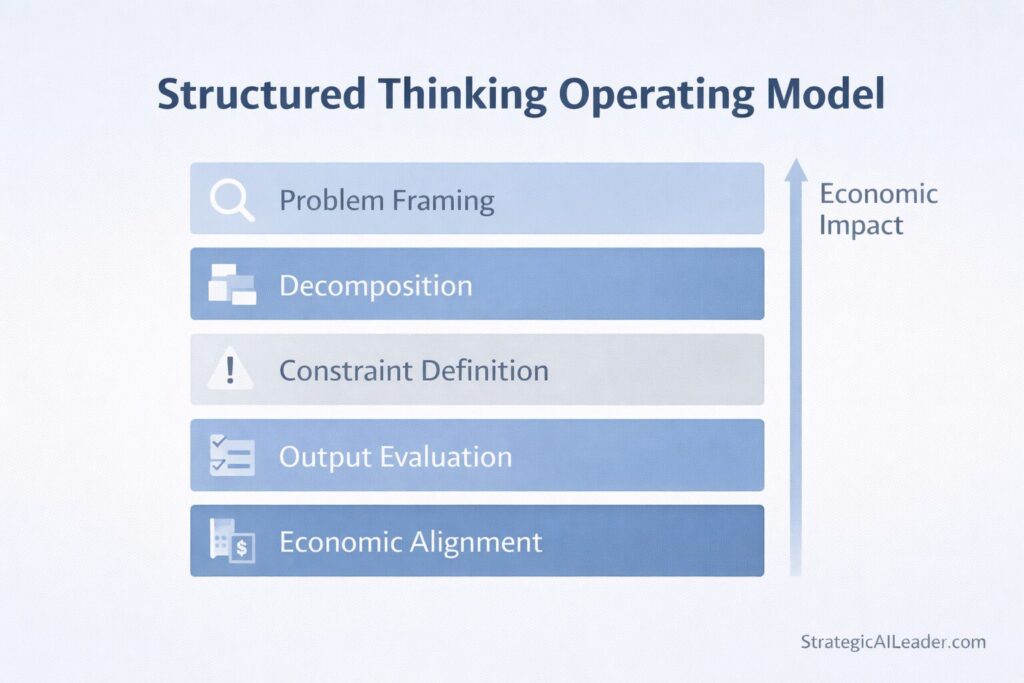
from problem framing through economic alignment
The Structured Thinking Operating Model is a five-component framework for redesigning knowledge work under Cognitive Compression. The AI Operating Model shifts organizational focus from artifact production to decision architecture.
1. Problem Framing
Translate vague intent into measurable outcomes. Define success before execution.
- Example: Instead of “improve customer engagement,” specify “increase 30-day retention from 62% to 68% for Q1 cohort by reducing activation friction in onboarding”.
2. Decomposition
Break complexity into explicit decision layers. Separate strategic choices (what to build, which market to enter) from tactical execution (how to implement, which vendor to use). Large Language Models excel at tactical execution when strategic direction is clear.
McKinsey explicitly notes that generative AI automates and accelerates specific tasks within workflows, while human workers retain responsibility for higher-order judgment, strategy, and decision-making.
3. Constraint Definition
Specify authority boundaries, data access limits, risk thresholds, and approval gates before delegating to Agent AI systems.
- Example: “Generate pricing scenarios for new tier structure. Use historical data from 2023-2024. Do not model below a $49/month floor. Flag any margin compression beyond 5%.”
4. Output Evaluation
Define evaluation criteria before work begins, not after delivery. What makes a good brief? What constitutes a strong analysis? Codify judgment into rubrics that both humans and AI systems can reference.
5. Economic Alignment
Tie every workflow to revenue, margin, retention, or risk reduction. Knowledge work automation creates output abundance. Without economic discipline, organizations produce more analysis, more prototypes, and more content, none of which correlates with value.
Second-Order Effects Leaders Are Underestimating
Velocity Drift
Velocity Drift occurs when production accelerates but strategic clarity lags, causing organizations to ship faster in the wrong direction. Scarce development bandwidth once created natural checkpoints where teams had time to course-correct, but execution compression removes the buffer.
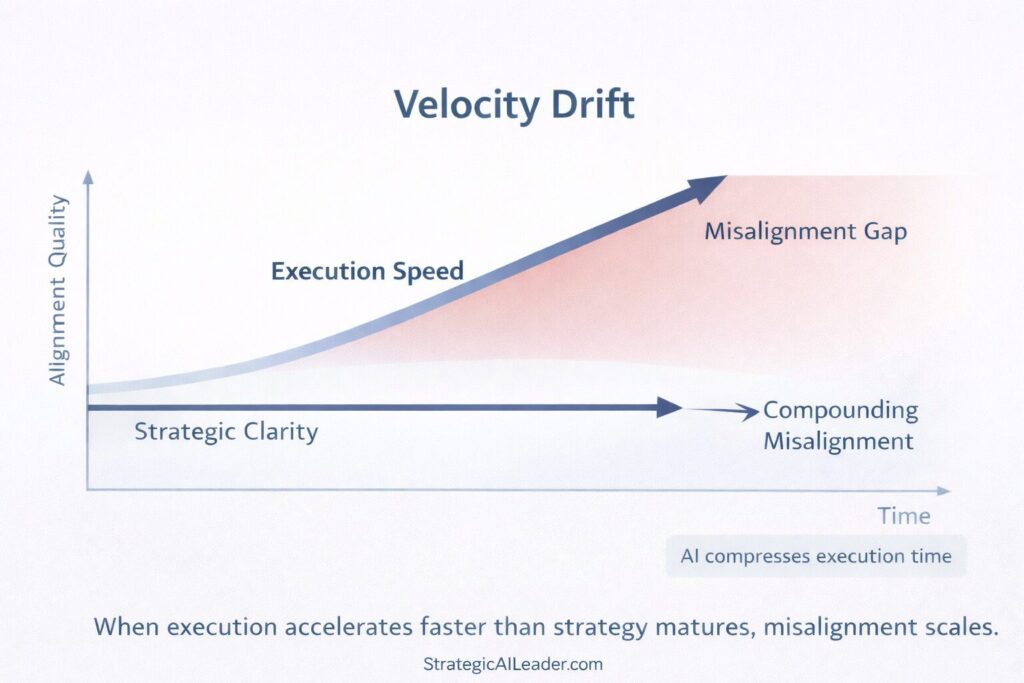
Without tighter strategic loops, organizations will produce more output at a higher quality but less aligned with actual business needs. Companies deploying AI at scale already show visible signs of this drift. Teams generate comprehensive reports that no one reads, and product features fail to impact retention drivers.
Hierarchy Destabilization as Artifact Quality Equalizes
For decades, seniority correlated with artifact quality. Senior leaders produced better memos, cleaner analyses, and sharper decks. Generative AI now raises the quality floor of all written output, making artifact production no longer a signal of expertise.
- A junior analyst with strong prompting skills can now generate executive-grade analysis.
- A mid-level PM can produce decks indistinguishable from those of a VP.
Hierarchy survives, but it must re-anchor around judgment, context, and decision rights. Leaders who derived authority from their ability to write well will find that authority challenged.
Incentive Misalignment and Output Volume
Most organizations still measure knowledge work by output volume: number of features shipped, reports delivered, or campaigns launched. Execution compression makes these volume metrics pathological. AI strips away the friction of production, causing volume metrics to incentivize waste. Shifting performance metrics to economic outcomes is the only correction.
Middle-Layer Compression
Middle-management roles defined primarily by information aggregation are at risk of elimination. Agent AI systems now perform coordination and synthesis functions with higher consistency. The value of middle layers must migrate to judgment, relationship management, and strategic context.
Increased Accountability as AI Logs Decisions
AI systems create audit trails for every prompt and constraint. The logging of these interactions raises accountability standards across the organization. AI governance and oversight will make decision quality more visible than ever before. Vague briefs once allowed blame to diffuse, but an AI system executing an ill-defined instruction produces poor output and reveals the origin of failure: the person who wrote the prompt.
What This Means for Current Knowledge Workers
If you are a professional whose value historically came from producing structured output, the following shift is required:
- From producing artifacts to specifying systems: Now the measurement shifts to how precisely you can define what a system should produce.
- From executing tasks to defining constraints: AI handles execution; your job is to define boundaries and outcomes.
- From writing briefs to defining economic outcomes: The question is no longer “what should we build,” but what economic outcome does this drive?
The Judgment Premium emerges as AI increases option volume. Judgment, defined as the ability to choose between viable alternatives when data is incomplete, becomes a scarce resource. World Economic Forum talked about this back in 2023, “Future of Jobs Report 2023“. The report identifies analytical thinking, creative thinking, and decision-making as rising core skills in the AI era.
Strategic Roadmap: Next 12-18 Months
Leaders who wait for consensus will lose 18 months of organizational learning.
- Audit Where AI Compresses Execution: Identify workflows where execution time has collapsed or will collapse in 6-12 months.
- Redesign Performance Metrics: Stop rewarding output volume. Start measuring economic impact and the precision of requirements.
- Standardize Structured Problem Statements: Create organizational templates for framing problems. Poor problem framing should halt work, not slow it down.
- Define Authority Boundaries for Agent AI: Explicitly decide which decisions AI can make autonomously and what thresholds trigger escalation.
- Install Tighter Economic Review Loops: Implement monthly or bi-weekly reviews to tie activity to outcomes.
Key Takeaways
- Cognitive Compression in the AI Era describes the rapid reduction in execution time, revealing thinking quality as the primary constraint in knowledge work.
- Execution compression forces judgment expansion: As development cycles collapse, the bottleneck migrates to requirements clarity.
- The Structured Thinking Operating Model provides a five-component framework: Problem Framing, Decomposition, Constraint Definition, Output Evaluation, and Economic Alignment.
- Velocity Drift occurs when production accelerates but strategic clarity lags, causing organizations to ship faster in the wrong direction.
- AI workforce transformation does not eliminate knowledge workers. It eliminates unstructured thinking.
- The Judgment Premium emerges as AI increases option volume; leadership determines which ideas deserve capital, not which are technically feasible.
Frequently Asked Questions
Will AI replace knowledge workers?
No. AI replaces unstructured work, not knowledge workers. Roles defined primarily by producing artifacts will compress, while roles defined by judgment and strategic framing will expand.
Why are requirements becoming the new bottleneck?
Because execution is no longer scarce. Generative AI and Agent AI orchestration collapse development cycles from weeks to hours, pushing the constraint upstream. Poor requirements now lead to worse outcomes faster.
What is Cognitive Compression in the AI Era?
Cognitive Compression is the rapid shrinking of execution time that exposes thinking quality as the primary constraint in knowledge work. Speed alone does not define it; the visibility of upstream decisions defines it.
What skills survive knowledge work automation?
Judgment under ambiguity, strategic framing, constraint definition, economic reasoning, relationship management, and context synthesis. AI systems cannot commoditize these skills because they require organizational knowledge and political awareness.
Help Support My Writing
Subscribe for weekly articles on leadership, growth, SEO and AI-driven strategy. You’ll receive practical frameworks and clear takeaways that you can apply immediately. Connect with me on LinkedIn or Substack for conversations, resources, and real-world examples that help.
Related Articles
AI Search SEO Measurement. The Truth About Rankings Now
Building AI Tools With LLMs: A Practical Guide Leaders Need
Regression vs Classification: The Truth About My $8K ML Failure
AI Task Analysis: How Top Performers Cut Workflow Time 40%
AI Traffic in GA4: How to Separate Humans vs Bots
The Truth About AI-Driven SEO Most Pros Miss
Intent-Driven SEO: The Future of Scalable Growth
SEO Strategy for ROI: A Better Way to Win Big
Future of SEO: Unlocking AEO & GEO for Smarter Growth
Skyrocket Growth with Keyword Strategy for Founders
Unlock Massive Growth with This 4-Step SEO Funnel
About the Author
I’m Richard Naimy, an operator and product leader with over 20 years of experience growing platforms like Realtor.com and MyEListing.com. I work with founders and operating teams to solve complex problems at the intersection of product, marketing, AI, systems, and scale. I write to share real-world lessons from inside fast-moving organizations, offering practical strategies that help ambitious leaders build smarter and lead with confidence.
I write about:
- AI + MarTech Automation
- AI Strategy
- COO Ops & Systems
- Growth Strategy (B2B & B2C)
- Infographic
- Leadership & Team Building
- My Case Studies
- Personal Journey
- Revenue Operations (RevOps)
- Sales Strategy
- SEO & Digital Marketing
- Strategic Thinking
Want 1:1 strategic support?
Connect with me on LinkedIn
Read my playbooks on Substack
Leave a Reply